
Also known as Republic of Kenya, KE, KEN, ke
동아프리카의 나라
OverviewAI-generated
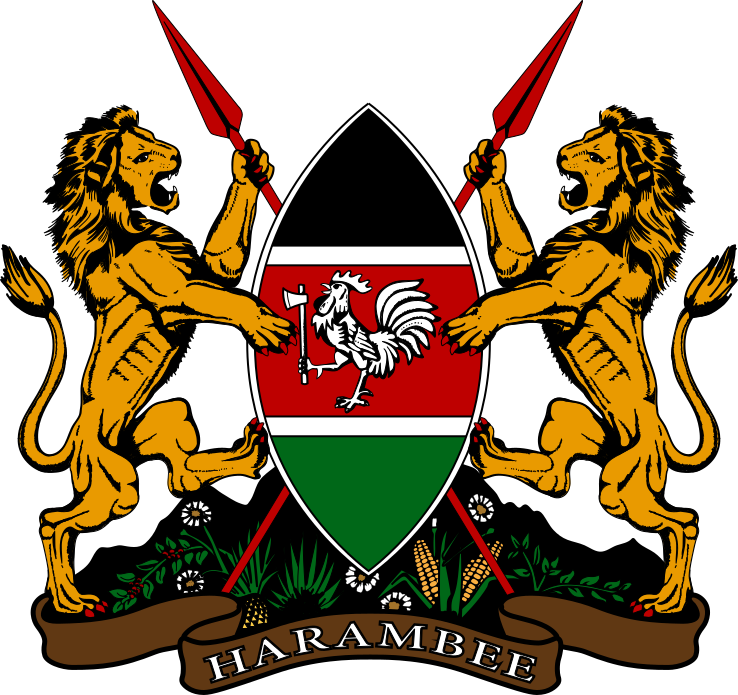
Kenya, officially the Republic of Kenya, is a country in Eastern Africa. Its capital is Nairobi, and it covers an area of 580367. The nation uses the Kenyan shilling as its currency and observes the UTC+03:00 timezone. Its motto is Harambee, and its license plate code is EAK. The country gained independence in 1963.
The population is reported as 48468138, 53330978, or 56432944 in various sources. Major ethnic groups include the Kikuyu, Luhya, Luo peoples, and Kalenjin people. Languages spoken include Logooli, Aweer, Samburu, and Embu. The government structure includes a Parliament of Kenya, with the head of government holding the office of Prime Minister of Kenya or President of Kenya. The emergency phone number is 999.
Kenya shares diplomatic relations with Italy, Germany, Australia, and Austria. It is twinned with Cheltenham. The country’s flag is 🇰🇪, and its top-level domain is .ke. The internet user percentage is 34.97622513, and the urban population percentage is 31.8937831721599. The life expectancy is 63.834 years, and the unemployment rate is 5.449 percent.
Synthesized by Vinony from 68 facts across 9 sources: Wikidata, Openweathermap, Open Meteo, REST Countries, World Bank, OpenStreetMap, PubMed, Vinony graph, Geo. Generated from structured data (not the Wikipedia text) and checked against those facts — may still contain errors.
Weather now
7-day forecast
via Open-Meteo
Country

- Capital
- Nairobi
- Population
- 53,330,978
- Region
- Africa · Eastern Africa
- Demonym
- Kenyan
- Currencies
- KES (Sh)
- Languages
- English, Swahili
- Calling code
- +254
- Drives on
- Left
- Gini
- 40.8 (2015)
- FIFA code
- KEN
- TLD
- .ke
- Timezones
- UTC+03:00
- Borders
- ETH, SOM, SSD, TZA, UGA
via REST Countries
Indicators · World Bank
- GDP
- $120.3B(2024)
- Population
- 56,432,944(2024)
- Life expectancy
- 63.8 yrs(2024)
- Unemployment
- 5.4 %(2025)
- Urban population
- 31.9 %(2024)
- Internet users
- 35 %(2024)
- Forest area
- 6.2 %(2023)
- Renewable energy
- 67.7 %(2021)
via World Bank Open Data · CC BY 4.0
Wikipedia views (30d)
133,601 totalvia Wikimedia Pageviews API
Key facts
- Country.established_event1
- Dominion
- Country.established_date1
- 12 December 1963
- Country.established_event2
- Republic
- Country.established_date2
- 12 December 1964
- Country.established_event3
- Current Constitution
- Country.established_date3
- 27 August 2010
- Country.area_km2
- 580,367
- Country.area_rank
- 48th
- Country.area_sq_mi
- 224,960
- Country.percent_water
- 2.3
- Country.population_estimate
- 53,330,978
- Country.population_estimate_year
- 2025
- Country.population_estimate_rank
- 28th
- Country.population_census
- 47,564,296
- Country.population_census_year
- 2019
- Country.population_density_km2
- 82
- Country.population_density_sq_mi
- auto
- Country.population_density_rank
- 124th
via Wikipedia infobox
Research
58,330 papers- Kenya.ReviewMarine pollution bulletin · 2001Obura DODOI: 10.1016/s0025-326x(01)00241-7
- Kenya.Department of State publication. Background notes series · 1988United States. Department of State. Bureau of Public Affairs
- Kenya.Population policy compendium · 1985United Nations. Department of International Economic and Social Affairs. Population Division, United Nations Fund for Population Activities UNFPA
- A Narrative Review of Kenya's Surgical Capacity Using the Lancet Commission on Global Surgery's Indicator Framework.ReviewGlobal health, science and practice · 2022Shirley H, Wamai RDOI: 10.9745/GHSP-D-21-00500
- Population-Based Estimate of Melioidosis, Kenya.Emerging infectious diseases · 2019Muthumbi EM, Gordon NC, Mochamah G et al.DOI: 10.3201/eid2505.180545
- Kenya's experience implementing event-based surveillance during the COVID-19 pandemic.BMJ global health · 2023Ndegwa L, Ngere P, Makayotto L et al.DOI: 10.1136/bmjgh-2023-013736
- Nursing and midwifery education, regulation and workforce in Kenya: A scoping review.International nursing review · 2023Kimani RW, Gatimu SMDOI: 10.1111/inr.12840
- Health system opportunities and challenges for PrEP implementation in Kenya: A qualitative framework analysis.ReviewPloS one · 2022Atkins K, Musau A, Mugambi M et al.DOI: 10.1371/journal.pone.0259738
via PubMed
Wikidata facts
- Instance of
- country
- Named after
- Mount Kenya
- Official name
- la République du Kenya
- Demonym
- Céiniach
- Country
- Kenya
- Contains
- Nairobi Province
- Continent
- Africa
- Capital
- Nairobi
- Official language
- English language
- Currency
- Kenyan shilling
- Population
- 47564296
- Area
- 581309
- Head of government
- William Ruto
- Head of state
- William Ruto
- Legislature
- Parliament of Kenya
- Anthem
- Ee Mungu Nguvu Yetu
- Shares border with
- Lake Victoria
- Highest point
- Mount Kenya
- Official website
- www.president.go.ke
- Image
- Kenya - Location Map (2013) - KEN - UNOCHA.svg
- Life expectancy
- 67.032
- Nominal GDP
- 113420008179
- Unemployment rate
- 9
- Calling code
- +254
Show 68 more facts
- Licence plate code
- EAK
- Electrical plug type
- BS 1363
- Mains voltage
- 240
- Motto
- Cenia Lledrithiol
- Flag
- flag of Kenya
- Coat of arms
- coat of arms of Kenya
- language used
- Naandi
- topic's main Wikimedia portal
- Portal:Kenya
- motto
- Harambee
- ethnic group
- African people
- Unicode character
- 🇰🇪
- category of associated people
- Category:Kenyan people
- emergency phone number
- 999
- geography of topic
- Geography of Kenya
- office held by head of government
- Prime Minister of Kenya
- number of out-of-school children
- 3718484
- diplomatic relation
- China
- inception
- 1963-00-00
- Commons gallery
- Kenya
- trunk prefix
- 0
- twinned administrative body
- Cheltenham
- mobile country code
- 639
- total fertility rate
- 4.334
- maritime identification digits
- 634
- marriageable age
- 18
- topic's main category
- Category:Kenya
- age of majority
- 18
- railway traffic side
- left
- category for films shot at this location
- Category:Films shot in Kenya
- category for people who died here
- Category:Deaths in Kenya
- office held by head of state
- President of Kenya
- Commons category
- Kenya
- top-level Internet domain
- .ke
- category for people born here
- Category:Births in Kenya
- driving side
- left
- lowest point
- Indian Ocean
- history of topic
- history of Kenya
- central bank
- Central Bank of Kenya
- native label
- Republic of Kenya
- GS1 country code
- 616
- culture
- culture of Kenya
- VAT rate
- 16
- BTI Status Index
- 5.33
- BTI Governance Index
- 4.84
- replaces
- Kenya (1963–1964)
- economy of topic
- economy of Kenya
- demographics of topic
- demographics of Kenya
- different from
- Kenia
- Democracy Index
- 5.05
- Human Development Index
- 0.575
- P11012
- Borken
- hashtag
- kenya
- on focus list of Wikimedia project
- Wikipedia:Vital articles/Level/4
- Happy Planet Index score
- 45.2
- Gini coefficient
- 40.8
- Inequality-adjusted Human Development Index
- 0.426
- suicide rate
- 11
- P12749
- Edgar
- birth rate
- 27.54
- male population
- 26777549
- death rate
- 7.83
- rural population
- 38358435
- female population
- 27249938
- urban population
- 15669052
- P8168
- Kamelevo
- Commonwealth Sport country code
- KEN
- located in/on physical feature
- East Africa
Sources (15)
via Wikidata · CC0
Travel guide
Understand
thumb|Nairobi skyline
Kenya is one of Africa's most visited countries by tourists, and rightfully so - it boasts a diversity of attractions and a well-developed hospitality and tourism sector that most of its neighbors envy. The relative ease of travel, the abundance of tour operators, pleasant year-round climate, natural sights and friendly people all contribute to its relative popularity by African standards.
Although made up of many diverse ethnic groups and tribes, Kenyans have a strong sense of national pride. This may be due in part to their unity in the struggle for Uhuru (Kiswahili: "freedom") – independence from British colonial rule, achieved in 1963. While Kenyans can spot ethnic differences among themselves quite easily, to most foreigners these will not be distinguishable. Outsiders on the whole tend to find Kenyans to be relaxed, hospitable, and joyous. Hostility towards foreigners is uncommon; if anything, some visitors may be uncomfortable with the timidity that comes with a perceived dependence on tourist dollars.
Lake Turkana and the area around is also known as the cradle of mankind as many prehistoric fossils have been discovered. Hominid fossils of significant scientific interest have been found in Rift Valley areas such as Olorgesaille, and it is often believed that this area of Africa is where the human species originated from (although recent discoveries in Ethiopia contest that theory).
Economically, the Kenyan story is one of two steps forward, o…
See
thumb|Zebras are among animals you may see in Kenya
In Kenya, nature is the main attraction. The cities offer little really worth seeing, apart from the lively and chaotic city life.
Kenya has some of the world's best game reserves where you can go for a safari, and see some of the finest African flora and fauna. The parks are famous for lions, giraffes, elephants and huge herds of zebras, wildebeests and buffaloes. It's wise to shop around for tour operators before picking one, to see what's on offer, who you vibe with, and to get a competitive price.
The annual wildebeest migration (from Maasai Mara to the Serengeti) is an awesome sight and best experienced in a balloon safari. Bookings to watch the migration are best done months in advance due to the high demand and limited lodging available in the Mara. Migration is during August and September.
Kenya also is a great destination for beach holidays, with several located along the coastal regions and the city of Mombasa, especially Diani Beach. Other coastal towns worth visiting include Lamu and Malindi.
Kenya is also becoming a golf holiday destination, thanks to the many beautiful lush courses around the major urban areas including some which have hosted international Golf tournaments such as Muthaiga and Karen Golf Courses. Outside of Nairobi there is the well known Limuru Golf Club and the Great Rift Valley Golf Resort close to Lake Naivasha. Green fees range from US$15–60 per round, plus a US$5–7 caddy fee for 18 h…
Do
Beaches: Travel organizations usually offer beach holidays at South Coast or North Coast, which simply means south or north of Mombasa. While the South Coast (Tiwi Beach, Diani Beach, Galu Beach, Gazi Beach, Msambweni Beach, Mwazaro Beach) has the nicer beaches and more primordial nature the North Coast near Mombasa (Njali Beach, Bamburi Beach, Shandzu Beach, Mtwapa Beaches, Kikambala Beach) offers much more activities. The beaches further north (Kilifi, Watamu, Malindi) are like South Coast, primordial and tranquil, not as long and broad as Diani Beach but even more photogenic. thumb|Maasai warriors guiding tourists in the Maasai Mara game park If you want to spend some time in the urban social scene, you might consider attending music and cultural events such as Blankets and Wine, which features international and local artists performing in a picnic-like setting for families and friends looking to enjoy African talent. The event happens on the first Sunday of every month in Nairobi. Rift Valley Festival, which incorporates a camping experience with a sample of cultural and musical tastes from around the country and internationally. Samosa Festival is an event set up to integrate the Asian and African cultures in the country. A significant percentage of the urban population is of Asian (Indian) ancestry and has existed since before independence. Their immigration was brought on by the construction of the railway. This event features cuisine from both cultures, poetry and lit…
Eat
The cuisine of Kenya is influenced by the country's geography, climate, and diverse cultural heritage. Here are some key features of Kenyan cuisine: Staple foods: Ugali, a maize-based porridge, is the most common staple food in Kenya. It is often served with stews or sauces made from meat, vegetables, or beans. Other popular staples include rice, chapati (a type of flatbread), and sukuma wiki (a leafy green vegetable). Meat dishes: Beef, chicken, and goat are the most commonly consumed meats in Kenya. Popular meat dishes include nyama choma (grilled meat), samosas (deep-fried pastry filled with meat or vegetables), and biryani (a spiced rice dish with meat or vegetables). Seafood: Kenya's long coastline means that seafood is also an important part of the cuisine. Popular seafood dishes include grilled fish, prawn curry, and seafood stew. Vegetables: Kenya's fertile soil means that vegetables are plentiful and varied. Common vegetables used in Kenyan cuisine include kale, cabbage, spinach, tomatoes, and onions. Spices: Kenyan cuisine is known for its use of spices, including cinnamon, cardamom, ginger, and turmeric. These spices are often used to flavor meat dishes and stews. Tea and coffee: Kenya is a major producer of tea and coffee, and both beverages are an important part of Kenyan culture. Kenyan tea is typically strong and sweet, while Kenyan coffee is known for its rich, fruity flavor.
Ugali with beef and sauce.JPG|Ugali served with beef and sauce Menu of a typical Ken…
Drink
Kenya has several local beer brands, the most popular being Tusker. Imported beers are generally available in higher-end establishments.
Imported and local wines and spirits are widely available, though it is advisable to avoid local brews such as "changaa" and "busaa", which are often illegal, unhygienically brewed, and whose consumption has led to deaths on many occasions.
Soft drinks, especially from Coca-Cola, are widely available, and the strong, locally produced Stoney "Tangawizi" ginger ale is fantastic.
Most bars and small shops will expect you to leave behind your glass bottles so they can return them to their distributors.
Sleep
thumb|View from a resort at the Indian Ocean
Nairobi has a wide variety of tourist hotels, from backpackers hostels to five-star establishments such as the Norfolk Hotel. As long as you don't mind basic accommodations, there is no need to spend more than US$100 per night on a hotel or hostel. In addition, the international Intercontinental and Hilton chains are also represented as well as a number of very highly regarded local chains (Serena and Sarova Hotels). Small boarding and lodging establishments are ubiquitous in central urban areas for low cost, although these are rarely safe as they are located in high crime areas.
thumb|Simple room in guest house
Guest houses often offer the best value for budget minded travellers. In small towns or villages, lodging can be found for less than Ksh 1,000. The most simple guest houses have shared bathrooms and start at as little as Ksh 500/night--though often of questionable cleanliness and not entirely bug-free. Private, 'self-contained' rooms go for Ksh 500-1000 and often can be rented at bars or clubs (expect a noisy night).
Homestays are increasingly gaining popularity. Part of the reason is that one can experience Kenyan culture in a deeper and more meaningful way. Most homes charge about US$20 per night inclusive of meals. Some may include laundry on that price.
People staying longer-term may rent accommodation; prices range from estate-agent 'international style' rentals US$150 per week, to privately arranged furnished apa…
Stay safe
Although Kenya is generally safe, it has had bouts of jihadist activities and occasional post-election violence.
Homosexuality is against the law but is practised secretly. Overt displays of homosexuality (especially male to male relationships) may, at times, result in open hostility. Although violent reactions are quite uncommon, it is best to be discreet if engaging in any such activities with travel mates or locals. However, it is common to see people of the same gender hold hands while engaged in conversation. A new law, with penalties of 10 years of jail for many acts of homosexuality or discussing homosexuality is proposed in the spring of 2023, similar to ones in Ghana and Uganda.
Stay alert when walking or driving through Nairobi. You should always be careful to be aware of your surroundings and, if possible, ensure that you have a guide with you. Even daylight muggings on crowded streets are not uncommon. Infrequently, violent and sometimes fatal criminal attacks, including armed carjackings and home invasions/burglaries can occur at any time and in any location, particularly in Nairobi. Particularly avoid walking after dark. Take a taxi if you can afford it, or a bus if you cannot, but care should be taken as most buses, even modern ones, tend to be overcrowded and can pose dangers from pickpocketing.
Avoid ostentatious displays of wealth. Objects most tempting to thieves are cameras, phones and electronics. The bus from the airport to downtown Nairobi is a notor…
Stay healthy
Protect yourself from mosquitoes, as they carry numerous diseases such as dengue fever, malaria and yellow fever. Get expert advice on malaria preventatives. Guard against mosquito bites. Wear long sleeves and long trousers and apply an effective insect repellent. If arriving from or travelling to other African countries, having a yellow fever vaccination certificate is typically mandatory. The vaccine can be administered at an affordable price at most reliable Nairobi clinics and hospitals.
Malaria medications are recommended if you are travelling to rural areas (Nairobi is not within the malaria zone). The prophylactics most commonly used in this region are doxycycline (an antibiotic) and malarone (a combination of atovaquone and proguanil, also sold locally as malanil). Chloroquine is not as useful because of the high incidence of resistance and Mefloquine, also known as lariam, mefliam, and mephaquin, is associated with various side effects, including a high incidence of mood disturbances and a lower risk of severe neurological disturbance. Consult your physician and government health advisories for current advice.
If you get flu-like symptoms, including fever, joint aches and vomiting, consult a doctor immediately. If no doctor is available, take a treatment dose of an appropriate anti-malarial and go immediately to a hospital. While the public hospitals are slightly cheaper, long waits and poor conditions and care at these facilities may make it worthwhile to go to a …
Respect
Although Kenya is predominantly Christian and somewhat liberal, there are areas with major Muslim influence, such at the Coastal regions, where it is considered indecent to wear short dresses. This is true in rural Christian areas as well. The locals, however, are extremely friendly.
Beachwear is acceptable on the beach but not while strolling around town. Nudism and topless bathing are prohibited in Kenya. Even though some hotels allow topless or nude sunbathing, these are in restricted areas and not in public.
Kissing or heavy petting is frowned upon in public, even though Kenyan youth engage in both liberally in night clubs.
thumb|Homosexuality is against the law
Permission is required in order to take pictures of people, as a matter of etiquette. Photos of military and public facilities such as police stations, banks, ferries, etc. are typically prohibited.
If you are invited to a Kenyan home, it is proper to bring a small gift according to the occasion. If you are a white man and go out with Kenyans, you are expected to pay the bills. If you invite a Kenyan out to a pub or restaurant, you are also expected to pay their transport costs, especially if you are a man inviting a woman.
It is disrespectful to reject food offered to you. Always accept tea and chapati, or mandazi, which is very commonly offered to visitors.
The legacy of British colonial rule in Kenya is a sensitive subject, with the violent suppression of the 1950-62 Mau Mau uprising by the British gover…
Travel guide from Wikivoyage (CC BY-SA 4.0)
Gallery (59)
On the map
9 mapped locations
Available in 275 languages
- Español
- Français
- Deutsch
- 中文
- 日本語
- Русский
- Português
- Italiano
- العربية
- हिन्दी
- Abkhazian
- Achinese
- Adyghe
- Afrikaans
- Albanian
- Albanian
- Amharic
- ami
Show 256 more
- Angika
- Aragonese
- Armenian
- Arpitan
- Assamese
- Asturian
- Awadhi
- Aymara
- azb
- Azerbaijani
- Bahasa Indonesia
- Balinese
- Bambara
- Bangla
- Banjar
- Bashkir
- Basque
- bat_smg
- Bavarian
- be_x_old
- Belarusian
- Betawi
- Bhojpuri
- Bikol
- Bishnupriya
- Bislama
- blk
- Bosnian
- Breton
- Bulgarian
- Buriat
- Burmese
- Catalan
- cbk_zam
- cdo
- Cebuano
- Central Kurdish
- Chechen
- Chuvash
- Cornish
- Corsican
- Crimean Tatar
- Croatian
- Czech
- dag
- Danish
- Dinka
- Divehi
- dty
- Dzongkha
- Egyptian Arabic
- Erzya
- Esperanto
- Estonian
- Ewe
- Extremaduran
- Faroese
- Fiji Hindi
- Filipino
- Finnish
- fiu_vro
- Fon
- Frafra
- Fula
- Gagauz
- Galician
- Ganda
- gcr
- Georgian
- Gilaki
- Goan Konkani
- gpe
- Greek
- Guarani
- Gujarati
- Haitian Creole
- Hakka Chinese
- Hausa
- Hawaiian
- Hebrew
- Hungarian
- hyw
- Iban
- Icelandic
- Ido
- Igbo
- Iloko
- Inari Sami
- Interlingua
- Interlingue
- Irish
- Jamaican Creole English
- Javanese
- Jju
- Kabyle
- kai
- Kannada
- Kanuri
- Kara-Kalpak
- Karachay-Balkar
- Kashmiri
- Kashubian
- Kazakh
- kbp
- kge
- Khmer
- Kikuyu
- Kinyarwanda
- Kongo
- Kotava
- Kurdish
- Kyrgyz
- Ladino
- Latgalian
- Latin
- Latvian
- Lezghian
- Ligurian
- Limburgish
- Lingala
- Lingua Franca Nova
- Lithuanian
- lld
- Lojban
- Lombard
- Low German
- Lower Sorbian
- Luxembourgish
- Macedonian
- Madurese
- Maithili
- Malagasy
- Malay
- Malayalam
- Maltese
- Manipuri
- Manx
- Māori
- map_bms
- Marathi
- Mari
- Mazanderani
- Minangkabau
- Mingrelian
- Mirandese
- Moksha
- Mongolian
- Moroccan Arabic
- Mossi
- Navajo
- nds_nl
- Neapolitan
- Nederlands
- Nepali
- Newari
- Nigerian Pidgin
- Northern Frisian
- Northern Sami
- Northern Sotho
- Norwegian
- Norwegian Nynorsk
- Novial
- nup
- Obolo
- Occitan
- Odia
- Old English
- olo
- Oromo
- Ossetic
- Pampanga
- Pangasinan
- Papiamento
- Pashto
- Piedmontese
- Polski
- Punjabi
- Quechua
- Romanian
- Rundi
- Rusyn
- Samoan
- Sango
- Sanskrit
- Santali
- Sardinian
- Saterland Frisian
- Scots
- Scottish Gaelic
- Serbian
- Serbian (Latin)
- Shan
- Shona
- Sicilian
- Silesian
- simple
- Sindhi
- Sinhala
- Slovak
- Slovenian
- Somali
- South Ndebele
- Southern Sotho
- Standard Moroccan Tamazight
- Sundanese
- Svenska
- Swahili
- Swati
- szy
- Tajik
- Talysh
- Tamil
- Taroko
- Tatar
- tay
- Telugu
- Tibetan
- Tiếng Việt
- Tigrinya
- Tok Pisin
- Toki Pona
- Tsonga
- Tswana
- Tumbuka
- Türkçe
- Turkmen
- Tyap
- Udmurt
- Ukrainian
- Upper Sorbian
- Urdu
- Uyghur
- Uzbek
- Venetian
- Veps
- Volapük
- Waray
- Welsh
- Western Frisian
- Western Mari
- Western Panjabi
- Wolof
- Wu Chinese
- Yakut
- Yiddish
- Yoruba
- Zaza
- Zeelandic
- zh_classical
- zh_min_nan
- zh_yue
- Zhuang
- Zulu
- فارسی
- ไทย
- 한국어
via Wikidata sitelinks · CC0