File:Kepler186f-ArtistConcept-20140417.jpg · Wikimedia Commons · See Wikimedia Commons
Kepler-186 f
Sign in to saveOverviewAI-generated
Kepler-186 f is a planetary object orbiting the star Kepler-186. It was discovered in 2014 by the Kepler facility. The planet has a mass of 1.76 and a radius of 1.438. NASA data lists its mass as 1.71 Earth masses and its radius as 1.17 Earth radii. Its equilibrium temperature is 177 K.
The orbital period of Kepler-186 f is 129.9533307, with NASA specifying 129.9441 days. The semi-major axis of its orbit is 0.432, and it has an orbital eccentricity of 0.04. The orbital inclination is 89.96. The system is located at a distance of 177.594 parsecs, or 579 light-years.
Synthesized by Vinony from 28 facts across 4 sources: Wikidata, NASA, SIMBAD, Vinony graph. Generated from structured data (not the Wikipedia text) and checked against those facts — may still contain errors.
Astronomical data · SIMBAD
- Object type
- Pl
- Distance
- 579 light-years
- Coordinates
- RA 298.6527° · Dec 43.9550°
via SIMBAD · CDS Strasbourg
Key facts
- Planet.name
- Kepler-186f
- Planet.image
- Kepler186f-ArtistConcept-20140417.jpg
- Planet.caption
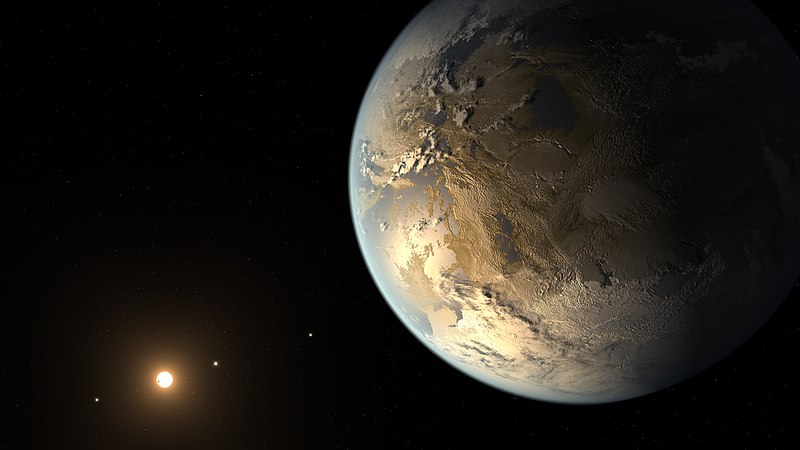
- Artist's depiction of Kepler-186f (foreground) as a rocky Earth-like planet in the habitable zone, with the Kepler-186 system visible in the background (bottom left). The actual appearance and composition of the exoplanet is not currently known.
- Planet.discoverer
- Elisa Quintana
- Planet.discovery_site
- Kepler space telescope
- Planet.discovered
- 17 April 2014
- Planet.discovery_method
- Transit
- Planet.alt_names
- KOI-571.05
- Planet.apsis
- astron
- Planet.period
- 0.355768 y
- Planet.star
- Kepler-186
- Planet.single_temperature
- Teq:
via Wikipedia infobox
Exoplanet data
- Host star
- Kepler-186
- Discovered
- 2014
- Discovered by
- Kepler
- Orbital period
- 129.94 days
- Radius
- 1.17 × Earth
- Mass
- 1.71 × Earth
- Equilibrium temp
- 177 K
- Distance
- 177.59 pc
via NASA Exoplanet Archive
Wikidata facts
- Constellation
- Cygnus
- Parent body
- Kepler-186
- Radius
- 0.104
- Mass
- 1.76
- Orbital period
- 129.94188177
- Image
- Kepler186f-ArtistConcept-20140417.jpg
Show 15 more facts
- time of discovery or invention
- 2014-04-00
- discoverer or inventor
- Kepler Space Telescope
- discovery method
- transit method
- Commons category
- Kepler-186 f
- located in/on physical feature
- circumstellar habitable zone
- catalog code
- Kepler-186f
- right ascension
- 298.65272341883920
- declination
- 43.95500719275723
- semi-major axis of an orbit
- 0.432
- orbital eccentricity
- 0.04
- epoch
- J2000.0
- right ascension component of proper motion
- 2.099
- declination component of proper motion
- -4.361
- parallax
- 5.6020
- orbital inclination
- 89.96
via Wikidata · CC0
~12 min read
Encyclopedic overview
16 sectionsContents
- Discovery and follow-up studies
- Physical characteristics
- Mass, radius and temperature
- Host star
- Orbit
- Habitability
- Follow-up studies
- Target of SETI investigation
- Future technology and observations
- Previous names
- Comparison
- In popular culture
- See also
- Notes
- References
- External links
Kepler-186f (also known by its Kepler object of interest designation KOI-571.05) is a candidate Earth-sized exoplanet orbiting within the habitable zone of the red dwarf star Kepler-186, the outermost of five planets discovered around the star by NASA's Kepler space telescope. It is located about from Earth in the constellation of Cygnus.
Kepler-186f orbits its star at a distance of about from its host star with an orbital period of roughly 130 days, and a radius around 1.17 times that of Earth. As one of the more promising candidates for habitability, it was the first planet with a radius similar to Earth's to be discovered in the habitable zone of another star. However, key components still need to be found to determine its habitability for life, including an atmosphere, and its composition and if liquid water can exist on its surface.
Excerpted from Wikipedia’s “Kepler-186 f” article, available under the CC BY-SA 4.0 licence.