Kazakhstan
Sign in to saveAlso known as Republic of Kazakhstan, kz, Qazaqstan, Republic of Qazaqstan
Kazakhstan, officially the Republic of Kazakhstan, is a landlocked country situated primarily in Central Asia, with a portion of its territory extending into Eastern Europe. It borders Russia to the north and west, China to the east, Kyrgyzstan to the southeast, Uzbekistan to the south, and Turkmenistan to the southwest, and it has a coastline along the Caspian Sea. The capital is Astana and the country's largest city and principal cultural and economic center is Almaty, which served as the capital until 1997.
OverviewAI-generated
Kazakhstan, officially the Republic of Kazakhstan, is a transcontinental country located in Asia and Europe. It is a unitary state with a presidential system of government. The nation shares borders with Turkmenistan, China, Kyrgyzstan, and Uzbekistan. Its highest point is Khan Tengri. The country is landlocked and contains administrative entities such as Astana, Almaty, Akmola Region, and Aktobe Region.
Astana serves as the capital, though Almaty is also listed as a capital. The population is recorded at 20,426,568 or 20,592,571, covering an area of 2,724,900. The official languages are Kazakh and Russian, and the currency is the Kazakhstani tenge. Qasym-Jomart Toqaev and Nursultan Nazarbayev are listed as heads of state. The country is a member of the United Nations, Commonwealth of Independent States, Shanghai Cooperation Organisation, and Central Asian Cooperation Organization.
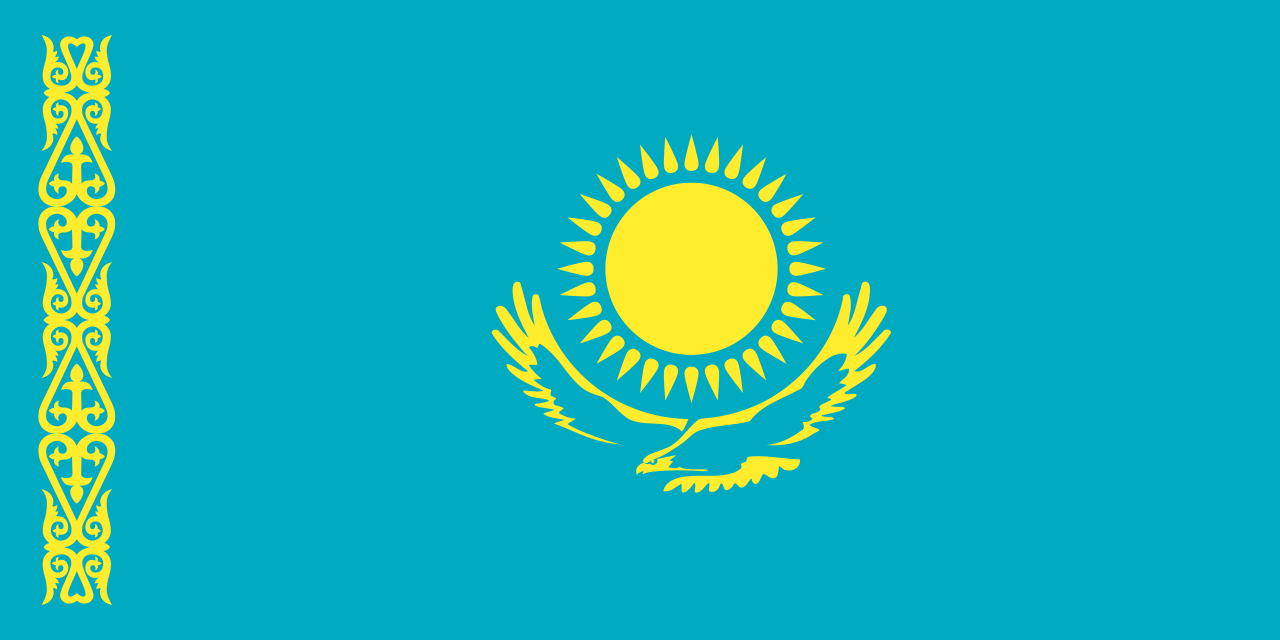
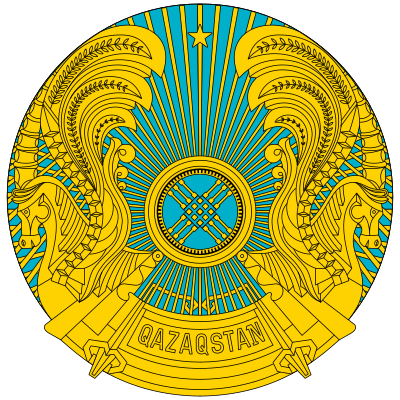
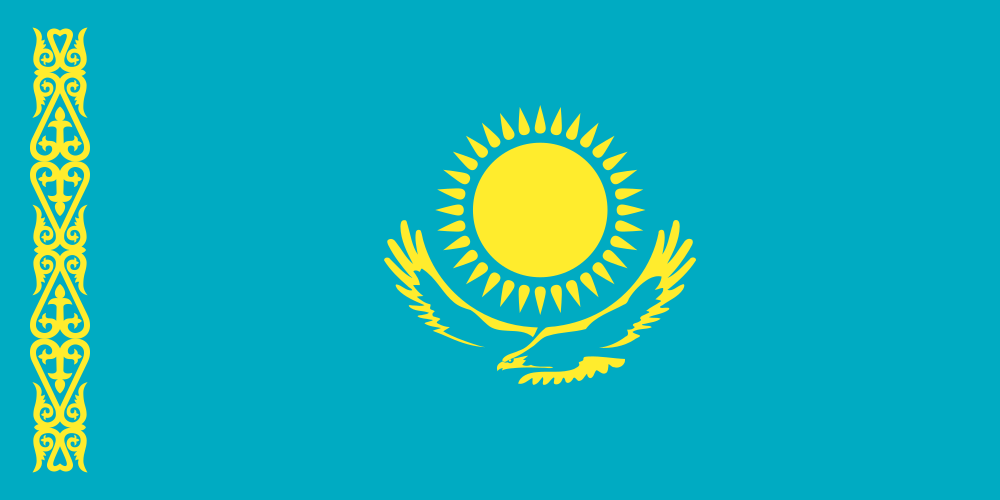
The flag of Kazakhstan and the emblem of Kazakhstan represent the nation. Its anthem is Menıñ Qazaqstanym. The top-level Internet domains are .kz and .қаз. The telephone country codes are 7, 997, "+7", and "+997". Kazakhstan is located in time zones UTC+05:00 and UTC+06:00. It is named after the Kazakhs.
Synthesized by Vinony from 68 facts across 9 sources: Wikidata, REST Countries, Open Meteo, Openweathermap, World Bank, OpenStreetMap, PubMed, Vinony graph, Geo. Generated from structured data (not the Wikipedia text) and checked against those facts — may still contain errors.
Weather now
cached 16h ago7-day forecast
via Open-Meteo
Country
- Capital
- Astana
- Population
- 20,426,568
- Region
- Asia · Central Asia
- Demonym
- Kazakhstani
- Currencies
- KZT (₸)
- Languages
- Kazakh, Russian
- Calling code
- +7
- Drives on
- Right
- Gini
- 27.8 (2018)
- FIFA code
- KAZ
- TLD
- .kz, .қаз
- Timezones
- UTC+05:00 · +1 more
- Borders
- CHN, KGZ, RUS, TKM, UZB
via REST Countries
Indicators · World Bank
- GDP
- $291.5B(2024)
- Population
- 20,592,571(2024)
- Life expectancy
- 74.5 yrs(2024)
- Unemployment
- 4.8 %(2025)
- Urban population
- 62.1 %(2024)
- Internet users
- 93.4 %(2024)
- Forest area
- 1.3 %(2023)
- Renewable energy
- 2 %(2021)
via World Bank Open Data · CC BY 4.0
Wikipedia views (30d)
245,919 totalvia Wikimedia Pageviews API
Key facts
- Country.HDI_year
- 2023
- Country.conventional_long_name
- Republic of Kazakhstan
- Country.common_name
- Kazakhstan
- Country.image_flag
- Flag of Kazakhstan.svg
- Country.flag_width
- 135
- Country.image_coat
- Emblem of Kazakhstan (3D).svg
- Country.symbol_width
- 85
- Country.symbol_type
- Emblem
- Country.national_anthem
- "State Anthem of the Republic of Kazakhstan"
- Country.capital
- Astana
- Country.largest_city
- Almaty
- Country.ethnic_groups_year
- 2025
- Country.religion_year
- 2021
- Country.government_type
- Unitary presidential republic under an authoritarian government
- Country.leader_title1
- President
- Country.leader_name1
- Kassym-Jomart Tokayev
- Country.leader_title2
- Prime Minister
- Country.leader_name2
- Oljas Bektenov
via Wikipedia infobox
Research
14,755 papers- Implantation of Implantable Cardioverter Defibrillators in Kazakhstan.ReviewGlobal heart · 2022Begisbayev T, Kosherbayeva L, Akhmetov V et al.DOI: 10.5334/gh.1119
- Medicinal Plants of the Flora of Kazakhstan Used in the Treatment of Skin Diseases.ReviewMolecules (Basel, Switzerland) · 2023Berganayeva G, Kudaibergenova B, Litvinenko Y et al.DOI: 10.3390/molecules28104192
- Historical Assessment and Mapping of Human Plague, Kazakhstan, 1926-2003.ReviewEmerging infectious diseases · 2024Rametov N, Abdel Z, Zhumadilova Z et al.DOI: 10.3201/eid3012.231659
- Tick-borne pathogens and their vectors in Kazakhstan - A review.Ticks and tick-borne diseases · 2020Perfilyeva YV, Shapiyeva ZZ, Ostapchuk YO et al.DOI: 10.1016/j.ttbdis.2020.101498
- Pulmonary tuberculosis epidemiology and genetics in Kazakhstan.Frontiers in public health · 2024Yerezhepov D, Gabdulkayum A, Akhmetova A et al.DOI: 10.3389/fpubh.2024.1340673
- Glaucoma screening in Kazakhstan.Scientific reports · 2025Urazhanova M, Kadraliyeva E, Dautbayeva Z et al.DOI: 10.1038/s41598-025-12540-3
- Rabies in Kazakhstan.PLoS neglected tropical diseases · 2016Sultanov AA, Abdrakhmanov SK, Abdybekova AM et al.DOI: 10.1371/journal.pntd.0004889
- Prevalence of Vitamin D Deficiency Among Adults in Kazakhstan: A Systematic Review and Meta-Analysis.Medicina (Kaunas, Lithuania) · 2024Karibayeva I, Bilibayeva G, Yerzhanova A et al.DOI: 10.3390/medicina60122043
via PubMed
Wikidata facts
- Instance of
- country
- Named after
- Kazakhs
- Official name
- la République du Kazakhstan
- Demonym
- Kasakse
- Country
- Kazakhstan
- Contains
- Almaty
- Continent
- Asia
- Capital
- Almaty
- Official language
- Russian
- Currency
- Kazakhstani tenge
- Population
- 20139914
- Area
- 2724900
- Time zone
- UTC+06:00
- Head of government
- Älihan Smaiylov
- Head of state
- Nursultan Nazarbayev
- Form of government
- presidential system
- Legislature
- Parliament of Kazakhstan
- Anthem
- Menıñ Qazaqstanym
- Shares border with
- Russia
- Highest point
- Khan Tengri
- Official website
- www.gov.kz
- Life expectancy
- 74
- Nominal GDP
- 220623001967
- Unemployment rate
- 4
Show 71 more facts
- Calling code
- +997
- Licence plate code
- KZ
- Electrical plug type
- Schuko
- Mains voltage
- 220
- Coat of arms
- emblem of Kazakhstan
- top-level Internet domain
- .қаз
- Commons category
- Kazakhstan
- topic's main category
- Category:Kazakhstan
- topic's main Wikimedia portal
- Portal:Kazakhstan
- category for people who died here
- Category:Deaths in Kazakhstan
- category for people born here
- Category:Births in Kazakhstan
- category for films shot at this location
- Category:Films shot in Kazakhstan
- category of associated people
- Category:Kazakhstani people
- history of topic
- history of Kazakhstan
- Commons gallery
- Kazakhstan
- lowest point
- Karagiye
- mobile country code
- 401
- diplomatic relation
- Hungary
- inception
- 1991-00-00
- driving side
- right
- geography of topic
- Geography of Kazakhstan
- language used
- Dungan
- trunk prefix
- 8
- marriageable age
- 17
- short name
- 哈萨克斯坦
- office held by head of government
- Prime Minister of Kazakhstan
- office held by head of state
- President of Kazakhstan
- executive body
- Government of Kazakhstan
- number of out-of-school children
- 36790
- total fertility rate
- 2.74
- maritime identification digits
- 436
- replaces
- Soviet Union
- category for people buried here
- Category:Burials in Kazakhstan
- described by source
- Draft History of Qing
- railway traffic side
- right
- Unicode character
- 🇰🇿
- central bank
- National Bank of Kazakhstan
- native label
- قزاقستان
- located in/on physical feature
- Eastern Europe
- minimum temperature record
- -57
- GS1 country code
- 487
- culture
- culture of Kazakhstan
- VAT rate
- 12
- BTI Status Index
- 4.91
- BTI Governance Index
- 4.56
- economy of topic
- economy of Kazakhstan
- demographics of topic
- demographics of Kazakhstan
- Democracy Index
- 3.08
- hashtag
- Kazakhstan
- P8168
- Harper Point
- Human Development Index
- 0.811
- P11012
- metrology
- category for honorary citizens of entity
- Q7981833
- Gini coefficient
- 27.8
- on focus list of Wikimedia project
- Wikipedia:Vital articles/Level/4
- Happy Planet Index score
- 38.6
- Inequality-adjusted Human Development Index
- 0.755
- social media followers
- 23756
- P12749
- José Manuel Balmaceda
- topic has template
- Template:Kazakhstan topics
- birth rate
- 20.57
- male population
- 9449147
- death rate
- 6.8
- rural population
- 8248656
- female population
- 10185836
- urban population
- 11386327
- most populous urban area
- Almaty
- name in native language
- Қазақстан РеспубликасыQazaqstan Respublikasy
- maintained by WikiProject
- WikiProject Kazakhstan
Sources (15)
via Wikidata · CC0
Travel guide
Get in
Entering Kazakhstan is no longer the hassle it used to be. The Kazakh government is keen on opening up Kazakhstan to the rest of the world, and most people can enter the country without a visa.
Get around
thumbnail|Road sign pointing to Uzbek Khan's grave near [[Aktau]] You can travel within the country using taxis, buses, trains and planes, it depends on your budget and demands.
See
As the Kazakhs were traditionally nomads who lived on horseback, Kazakhstan for the most part lacks the monumental Islamic architecture of neighboring Uzbekistan. However, Kazakhstan makes up for this with its wealth of natural beauty, which can be seen in the wide open spaces between its cities.
Visitors wanting to experience the traditional Kazakh nomadic lifestyle will likely be disappointed. Under Stalin's collectivization policy during the period of Soviet rule, the Kazakhs were forced to sedentarize and become farmers, all but wiping out the nomadic tradition within the borders of modern Kazakhstan. There are opportunities for tourists to stay in Kazakh yurts, but these were re-created in the post-Soviet era as tourist attractions, and are not an authentic part of the daily lives of regular Kazakh people. Nevertheless, traditional Kazakh clothing still reflects that nomadic heritage and traditional life on horseback, the horse remains an important part of Kazakh culture, which visitors can see on display in its full glory during major traditional festivals. Perhaps ironically, the traditional Kazakh nomadic lifestyle is better preserved among the ethnic Kazakh minorities in Western Mongolia and China's Xinjiang province than in Kazakhstan, making those better destinations if that is what you are looking to experience.
Various tour companies operate in Almaty and Astana year-round, shuttling tourists to nature and scenic destinations outside of urban centres. These co…
Do
Many attractions in Kazakhstan are closed on Monday as a "sanitary day", so that uninterrupted cleaning and maintenance can occur. Saunas: Because of its cold and windy weather, visiting saunas with friends is very popular in Kazakhstan. Saunas (Russian banyas or Finnish steam rooms) are an excellent place to discuss business issues or just socialize with friends. Having parties (birthdays, New Year, etc.) in saunas is a normal practice. In fact many modern sauna complexes in Almaty and Astana are usually fully equipped with karaoke, billiards, swimming pools, relax rooms, massage rooms, etc. Some saunas are a cover for sex services, and many will include a "happy end" option when taking a massage. Football: Kazakhstan is about as central in Asia as you can get, but does have some territory west of the Ural River (considered to be the continental border between Europe and Asia) and chooses to affiliate to UEFA. That means its national and leading club soccer teams are often involved in tournaments with better-known western teams, involving a very long journey. The domestic playing season is March-Nov to escape the rigours of the steppes winter. The men's national team usually play in Astana. The domestic top tier is the Premier League with 14 clubs, two in Astana and one in Almaty.
Eat
Meat, potatoes, rice and pasta. And lots of it. If you're vegetarian be wary, because if it doesn't have meat in it, it will be almost certainly cooked in meat stock. thumbnail|Beshbarmak thumbnail|Manty thumbnail|Korean carrot salad, created by Koryo people (the Korean diaspora in Central Asia) Some recommended dishes: Beshbarmak - "five fingers", a horse meat and pasta dish with potato and onion. The national traditional dish of Kazakhstan and Kyrgyzstan most often served for special occasions. Can also be made with beef or lamb. Most restaurants that serve it will present a portion enough for two or three people. Kazy - handmade horse meat sausage, could be cooked and served with Beshbarmak, but not at the restaurants, unless you ask to do so when preorder menu. If you did not, it would be served as cold meat appetizer with other types of cold meat appetizers (Zhaya, Basturma, Shyzhyk). And separate price would be charged. Kazakh dish. Laghman - a thick noodle dish with meat, carrot and onion, usually served as a soup.Some other veggies could be added too. Manty - large steamed dumplings full of meat and onions. Sometimes made with onions or pumpkin. Traditional Uighur dish. Plov - wonderful dish of fried rice, meat, carrots, and sometimes other bits such as raisins or tomatoes. Traditional Uzbek dish. Shashlyk or Shish Kebab - skewered, roasted chunks of marinated meat, served with some sort of flatbread (usually lavash) and onions. Various marinates can be used, and diff…
Drink
thumbnail|Kumys looks just like regular milk (this individual brand is from Russia)
Traditional beverages include:
Kumiss - fermented mare's milk, up to 6% alcohol content. Imagine tart lemonade, mixed with semi-sour milk. Kumyran (Shubat)- fermented camel's milk Kvas - described as similar to root beer it can be bought in a bottle in a store, or by the cup from people with giant yellowish tanks of it on the street. Tan. Fizzy beverage made of mare's milk. Cheap alcoholic drinks can be found at every little corner shop (called the astanovka). These places are open 24/7, just knock on their door if the shopkeeper is asleep. Kazakhstan's speciality is cognac, though stores still sell vodka cheaper than bottled water at times. However, some of these astanovka sometimes sell alcohol of dubious origin; for the sake of your stomach you may want to buy your beverage in a supermarket, although the price will definitely be higher. Several brands of beer, of good quality and flavor, are made in Karaganda. Becker, Staut, Tian-Shan, Derbes, Irbis, Alma-Ata. Local brands brewed in Almaty are pretty good. Juices, in cartons, are common and delicious, especially peach juice. Tea is widely available, mostly very good and often quite strong. If you are on a budget this is the thing to order with your food. Tea is culturally important in Kazakhstan - "shai" time is one of the most important things a visitor can engage in to learn about the culture. Coffee. Modern coffee houses and western-st…
Sleep
There are numerous hotels, from very cheap ones (€10 per night) to the luxurious ones. You wouldn't find the cheapest ones on the web; the only way to book them is to call directly, but in that case you'll have to speak Russian at the least.
There are almost no camping sites except in Burabay/Borovoe in Kazakhstan. You can, however, camp almost anywhere due to the huge uninhabited spots. The scenery is beautiful but because of the very hot weather: don't forget to take plenty of water with you as you can very easily spend many of days without seeing anybody. If you camp near a nomadic tribe, ask for the permission to stay near; it will not be refused.
Stay safe
Generally, Kazakh cities are safe during the day, but certain parts of major cities should be avoided at night to reduce risk, namely, all parts of Almaty below Tashkentskaya street and all microdistrict areas within these zones, certain other remote microdistricts, and areas with high concentrations of shabby private houses (such as Shanyrak) and all smaller towns such as Shar, Stepnogorsk, and Temirtau may present a higher risk of mugging and violent crime.
In smaller towns, e.g. Taraz, Balkhash, Shymkent, Taldykorgan, Uralsk, Semey and Ust-Kamenogorsk, going out at night should not present a significant risk, though infrequent muggings do occur.
Keep your passport (or a certified copy of your passport and visa) with you at all times. While the situation has improved lately, police might still try to extort money from foreigners, especially on trains and long-distance buses. Unless the officers involved are drunk, it is possible to avoid paying them by pretending not to understand, or by claiming poverty.
The risk of violent crime is comparable with Eastern European countries and rougher parts of major US cities. An ordinary tourist should not experience any violent crime and is unlikely to be a target of minor crimes, if their behaviour stays within generally accepted norms in public places. thumb|Dusk in Almaty Excessive consumption of alcohol and visiting a nightclub will always present a higher risk, especially if a person goes out alone. It is advisable to go out as…
Stay healthy
In general, the level of health care and hygiene is not up to Western standards. When travelling to smaller places, it is a good idea to bring your own medical supplies. There may also be a shortage of medicines.
In an emergency, call an ambulance at the general hospital on duty on 103. However, you should consider using local hospitals.
When travelling to forested and mountainous areas, especially in the early summer months, tick-borne encephalitis should be taken into account. Tuberculosis and HIV are also present in the country. There have been a few cases of Crimean-Congo haemorrhagic fever in South Kazakhstan and cases of Lyme disease in rural areas.
In order to avoid stomach infections and food poisoning, particular attention should be paid to hygiene when preparing food and drinks, especially during the summer months. The municipal water is more or less drinkable, with no real nasties, but try to boil it if possible. Bottled water is cheap and easily available. When at restaurants, ask specifically for Asu, Borjomi, Sary-Agash or Tassay mineral waters. Many other widely-known water brands can be found in restaurants and supermarkets. If you have to use tap water, it is advisable to boil the water before using it.
Travellers should have comprehensive travel insurance, including cover for aircraft evacuation in the event of serious illness or accident. Many hospitals either do not accept international travel insurance at all or only accept it from certain insurance c…
Respect
Kazakh people have more pride than most Westerners would expect. Therefore, insulting or negative comments about Kazakhstan or local Kazakh people will often result in arguments and possible threats of physical violence. It is not recommended to get into an argument with locals, as Kazakhstan is a nation where physical power is part of the local culture, and can occasionally lead to a fatal last argument.
Do not associate the country with Borat. Kazakhs believe the films misrepresents and defames the country, and are quite tired of hearing Borat jokes and comments. That aside, the catchphrase "Very nice" was used in its tourism promotion campaign.
Travel guide from Wikivoyage (CC BY-SA 4.0)
~40 min read
Encyclopedic overview
52 sectionsContents
- Etymology
- History
- Turkic Khaganate and Cuman-Kipchak
- Mongol Empire and Golden Horde
- Kazakh Khanate
- Russian Kazakhstan
- Kazakh SSR
- Independence
- Geography
- Natural resources
- Climate
- Wildlife
- Government and politics
- Political system
- Political reforms
- Administrative divisions
- Municipal divisions
- Urban centres
- Foreign relations
- Military
- Human rights
- Economy
- Foreign trade
- Agriculture
- Energy
- Infrastructure
- Tourism
- Foreign direct investment
- Banking
- Economic competitiveness
- Corruption
- Science and technology
- Demographics
- Ethnic groups
- Languages
- Religion
- Education
- Culture
- Literature
- Music
- Fine arts
- Cuisine
- Sport
- Film
- Media
- UNESCO World Heritage sites
- Public holidays
- See also
- Explanatory notes
- References
- Further reading
- External links
Kazakhstan, officially the Republic of Kazakhstan, is a landlocked country situated primarily in Central Asia, with a portion of its territory extending into Eastern Europe. It borders Russia to the north and west, China to the east, Kyrgyzstan to the southeast, Uzbekistan to the south, and Turkmenistan to the southwest, and it has a coastline along the Caspian Sea. The capital is Astana and the country's largest city and principal cultural and economic center is Almaty, which served as the capital until 1997.
Kazakhstan is the world's ninth-largest country by land area and the largest landlocked country. Hilly plateaus and plains account for nearly half its vast territory, with lowlands composing another third; its southern and eastern frontiers are composed of mountainous regions. Kazakhstan has a population of 20.5 million and one of the lowest population densities in the world, with fewer than 8 people per square kilometre (21 people/mi). Ethnic Kazakhs constitute a majority, while ethnic Russians form a significant minority. Officially secular, Kazakhstan is a Muslim-majority country with a sizeable Christian community.
Excerpted from Wikipedia’s “Kazakhstan” article, available under the CC BY-SA 4.0 licence.
Gallery (59)
On the map
12 mapped locations
Available in 280 languages
- Español
- Français
- Deutsch
- 中文
- 日本語
- Русский
- Português
- Italiano
- العربية
- हिन्दी
- Abkhazian
- Achinese
- Adyghe
- Afrikaans
- Albanian
- Albanian
- Amharic
- ami
Show 261 more
- Angika
- Aragonese
- Aramaic
- Armenian
- Arpitan
- Assamese
- Asturian
- Avaric
- Awadhi
- Aymara
- azb
- Azerbaijani
- Bahasa Indonesia
- Balinese
- Bangla
- Banjar
- Bashkir
- Basque
- bat_smg
- Batak Toba
- Bavarian
- be_x_old
- Belarusian
- Betawi
- Bhojpuri
- Bikol
- Bishnupriya
- Bislama
- Bosnian
- Breton
- Buginese
- Bulgarian
- Buriat
- Burmese
- Catalan
- cbk_zam
- cdo
- Cebuano
- Central Dusun
- Central Kurdish
- Chechen
- Cherokee
- Church Slavic
- Chuvash
- Cornish
- Corsican
- Crimean Tatar
- Croatian
- Czech
- dag
- Danish
- Divehi
- dty
- Egyptian Arabic
- Erzya
- Esperanto
- Estonian
- Ewe
- Extremaduran
- Faroese
- Fiji Hindi
- Filipino
- Finnish
- fiu_vro
- Friulian
- Fula
- Gagauz
- Galician
- gcr
- Georgian
- Gilaki
- Goan Konkani
- Gorontalo
- Greek
- Guarani
- Gujarati
- Haitian Creole
- Hakka Chinese
- Hausa
- Hawaiian
- Hebrew
- Hungarian
- hyw
- Iban
- Icelandic
- Ido
- Igbo
- Iloko
- Inari Sami
- Ingush
- Interlingua
- Interlingue
- Inuktitut
- Irish
- Jamaican Creole English
- Javanese
- Kabardian
- Kabyle
- Kannada
- Kanuri
- Kara-Kalpak
- Karachay-Balkar
- Kashmiri
- Kashubian
- Kazakh
- kbp
- kge
- Khmer
- Kinyarwanda
- Komi
- Komi-Permyak
- Kongo
- Kurdish
- Kyrgyz
- Ladino
- Lao
- Latgalian
- Latin
- Latvian
- lbe
- Lezghian
- Ligurian
- Limburgish
- Lingala
- Lingua Franca Nova
- Lithuanian
- lld
- Lojban
- Lombard
- Low German
- Lower Sorbian
- Luxembourgish
- Macedonian
- Madurese
- Maithili
- Malagasy
- Malay
- Malayalam
- Maltese
- Manipuri
- Manx
- Māori
- map_bms
- Marathi
- Mari
- Mazanderani
- Minangkabau
- Mingrelian
- Mirandese
- Moksha
- Mongolian
- Moroccan Arabic
- Navajo
- nds_nl
- Nederlands
- Nepali
- Newari
- Northern Frisian
- Northern Sami
- Northern Sotho
- Norwegian
- Norwegian Nynorsk
- Novial
- Occitan
- Odia
- Old English
- olo
- Oromo
- Ossetic
- Pampanga
- Pangasinan
- Papiamento
- Pashto
- Pennsylvania German
- Picard
- Piedmontese
- Polski
- Pontic
- Punjabi
- Quechua
- roa_rup
- roa_tara
- Romanian
- Romansh
- Rusyn
- Samoan
- Sanskrit
- Santali
- Sardinian
- Saterland Frisian
- Scots
- Scottish Gaelic
- Serbian
- Serbian (Latin)
- Shan
- Shona
- Sicilian
- Silesian
- simple
- Sindhi
- Sinhala
- skr
- Slovak
- Slovenian
- Somali
- Southern Altai
- Southern Sotho
- Sranan Tongo
- Sundanese
- Svenska
- Swahili
- Swati
- szy
- Tajik
- Talysh
- Tamil
- Taroko
- Tatar
- tay
- Telugu
- Tetum
- Tibetan
- Tiếng Việt
- Toki Pona
- Tongan
- Tsonga
- Tulu
- Tumbuka
- Türkçe
- Turkmen
- Tuvinian
- Udmurt
- Ukrainian
- Upper Sorbian
- Urdu
- Uyghur
- Uzbek
- Venetian
- Veps
- Volapük
- Walloon
- Waray
- Welsh
- West Flemish
- Western Frisian
- Western Panjabi
- Wolof
- Wu Chinese
- Xhosa
- Yakut
- Yiddish
- Yoruba
- Zaza
- Zeelandic
- zh_classical
- zh_min_nan
- zh_yue
- Zhuang
- فارسی
- ไทย
- 한국어
via Wikidata sitelinks · CC0