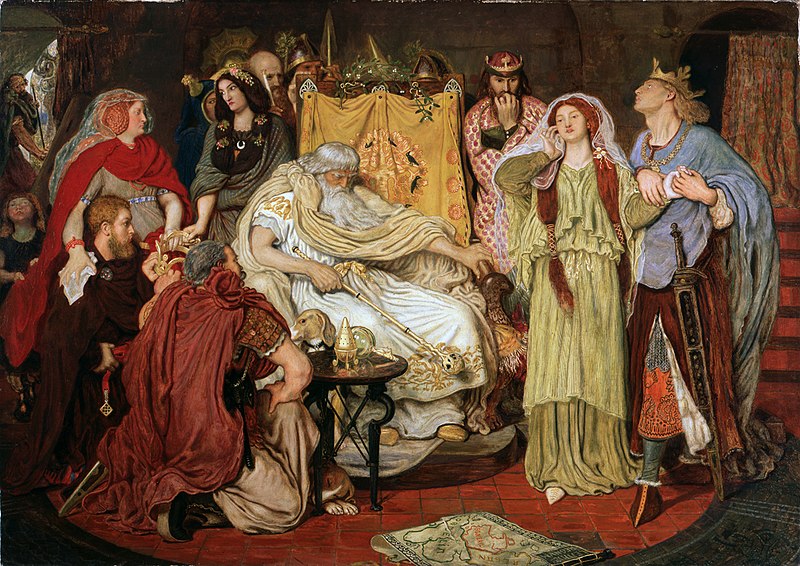
File:Cordelia's_Portion.jpg · Wikimedia Commons · See Wikimedia Commons
Król Lear
Sign in to saveAlso known as The Tragedie of King Lear, The Tragedy of King Lear, Tragedy of King Lear, The Life and Death of King Lear, Life and death of king lear
sztuka teatralna (autor: William Shakespeare)
"King Lear" is a tragedy by William Shakespeare about an aging king who divides his kingdom among his daughters based on their flattery, leading to betrayal, madness, and destruction. The play explores themes of power, family loyalty, and human suffering, and is considered one of Shakespeare's greatest works.
AI-generated from the Wikipedia summary — may contain errors.
In the Vinony graph
Within Vinony's link graph, Król Lear is referenced by 2,474 other articles, and connects out to International Standard Serial Number, Oxford University Press and Cambridge University Press.
Vinony files it under 1605 plays, British plays adapted for radio and British plays adapted for television.
Its subject is documented across 72 Wikipedia language editions.
Wikidata facts
- Author
- William Shakespeare
- Genre
- tragedy
- Image
- King Lear.jpg
Show 14 more facts
- Commons category
- King Lear
- topic's main category
- Category:King Lear
- Commons gallery
- King Lear
- inception
- 1606-00-00
- language of work or name
- English language
- title
- The Tragedy of King Lear
- location of first performance
- Palace of Whitehall
- date of first performance
- 1606-00-00
- copyright status
- public domain
- number of parts of this work
- 5
- form of creative work
- play
- publication date
- 1608-00-00
- on focus list of Wikimedia project
- Wikipedia:Vital articles/Level/4
- time period
- Renaissance
Sources (11)
via Wikidata · CC0
Article · Polski
Król Lear (ang. King Lear) – tragedia Williama Shakespeare’a, prawdopodobnie napisana w roku 1605. Fabuła dramatu oparta jest na legendzie o Llyrze, mitycznym królu Brytanii. Bezpośrednim źródłem inspiracji była anonimowa sztuka o królu Learze, wystawiana w czasach Szekspira. Król Lear uznawany jest za jedno z największych osiągnięć Szekspira.
Abstract from DBpedia / Wikipedia · CC BY-SA
Gallery (12)
Available in 72 languages
- Español
- Français
- Deutsch
- 中文
- 日本語
- Русский
- Português
- Italiano
- العربية
- हिन्दी
- Afrikaans
- Albanian
- Armenian
- Asturian
- Bahasa Indonesia
- Bangla
- Basque
- Belarusian
Show 53 more
- Bosnian
- Bulgarian
- Catalan
- Croatian
- Czech
- Danish
- Egyptian Arabic
- Esperanto
- Estonian
- Finnish
- Galician
- Georgian
- Greek
- Hebrew
- Hungarian
- Irish
- Kurdish
- Latin
- Latvian
- Lingua Franca Nova
- Lithuanian
- Macedonian
- Malay
- Malayalam
- Marathi
- Nederlands
- Nepali
- Norwegian
- Occitan
- Polski
- Punjabi
- Romanian
- Scots
- Serbian
- Serbian (Latin)
- simple
- Sindhi
- Slovak
- Svenska
- szy
- Tibetan
- Tiếng Việt
- Türkçe
- Ukrainian
- Urdu
- Waray
- Welsh
- Western Frisian
- Wu Chinese
- zh_classical
- zh_yue
- فارسی
- 한국어
via Wikidata sitelinks · CC0