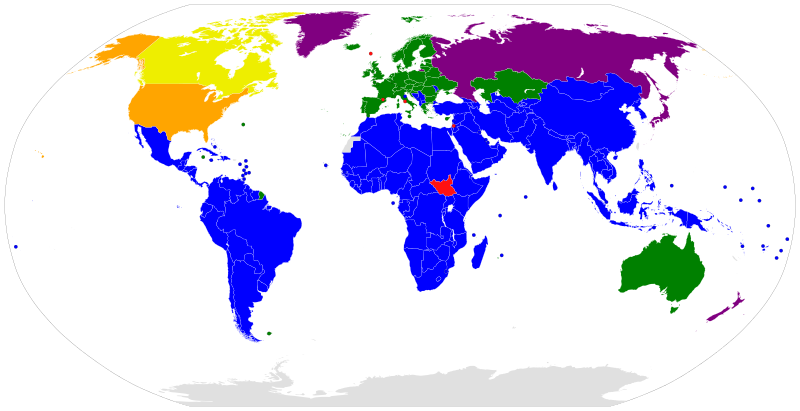
File:Kyoto_Protocol_parties.svg · Wikimedia Commons · See Wikimedia Commons
Kyoto Protocol
Sign in to saveAlso known as Kyoto Protocol to the United Nations Framework Convention on Climate Change
international treaty to reduce greenhouse gas emissions
The Kyoto Protocol is an international agreement where countries committed to reducing their greenhouse gas emissions, which contribute to climate change. It matters because it was one of the first major global efforts to get nations to work together on limiting pollution that warms the planet.
AI-generated from the Wikipedia summary — may contain errors.
Wikidata facts
- Named after
- Kyoto
- Author
- United Nations
- Image
- Doha Amendment of Kyoto.svg
Show 15 more facts
- Commons category
- Kyoto Protocol
- depositary
- United Nations Secretary-General
- point in time
- 1997-12-11
- publication date
- 1997-12-10
- ratified by
- Zimbabwe
- on focus list of Wikimedia project
- WikiProject Climate change
- law identifier
- 平成17年条約第1号
- language of work or name
- Czech
- start time
- 2005-02-16
- maintained by WikiProject
- WikiProject International relations
- signatory
- Zambia
- effective date
- 2005-02-16
- title
- Kyoto Protocol to the United Nations Framework Convention on Climate Change
- subtitle
- K Rámcové úmluvě Organizace spojených Národů o změně klimatu
via Wikidata · CC0
~40 min read
Encyclopedic overview
Kyoto International Conference Center The Kyoto Protocol (Japanese: 京都議定書, Hepburn: Kyōto Giteisho) was an international treaty which extended the 1992 United Nations Framework Convention on Climate Change (UNFCCC) that commits state parties to reduce greenhouse gas emissions, based on the scientific consensus that global warming is occurring and that human-made CO2 emissions are driving it. The Kyoto Protocol was adopted in Kyoto, Japan, on 11 December 1997 and entered into force on 16 February 2005. There were 192 parties (Canada withdrew from the protocol, effective December 2012) to the Protocol in 2020.
The Kyoto Protocol implemented the objective of the UNFCCC to reduce the onset of global warming by reducing greenhouse gas concentrations in the atmosphere to "a level that would prevent dangerous anthropogenic interference with the climate system" (Article 2). The Kyoto Protocol applied to the seven greenhouse gases listed in Annex A: carbon dioxide (CO2), methane (CH4), nitrous oxide (N2O), hydrofluorocarbons (HFCs), perfluorocarbons (PFCs), sulfur hexafluoride (SF6), nitrogen trifluoride (NF3). Nitrogen trifluoride was added for the second compliance period during the Doha Round.
Excerpted from Wikipedia’s “Kyoto Protocol” article, available under the CC BY-SA 4.0 licence.
Gallery (11)
Available in 84 languages
- Español
- Français
- Deutsch
- 中文
- 日本語
- Русский
- Português
- Italiano
- العربية
- हिन्दी
- Albanian
- Armenian
- Azerbaijani
- Bahasa Indonesia
- Bangla
- Basque
- Belarusian
- Bosnian
Show 65 more
- Bulgarian
- Burmese
- Catalan
- Croatian
- Czech
- Danish
- Egyptian Arabic
- Esperanto
- Estonian
- Finnish
- Galician
- Georgian
- Greek
- Hausa
- Hebrew
- Hungarian
- Icelandic
- Igbo
- Irish
- Javanese
- Kannada
- Kazakh
- Kurdish
- Latin
- Latvian
- Lithuanian
- Luxembourgish
- Macedonian
- Malay
- Malayalam
- Marathi
- Nederlands
- Norwegian
- Norwegian Nynorsk
- Occitan
- Pashto
- Polski
- Romanian
- Santali
- Scots
- Serbian
- Sicilian
- simple
- Sinhala
- Slovak
- Slovenian
- Svenska
- Swahili
- Tamil
- Telugu
- Tiếng Việt
- Türkçe
- Ukrainian
- Urdu
- Uyghur
- Walloon
- Welsh
- Wu Chinese
- Yakut
- zh_classical
- zh_min_nan
- zh_yue
- فارسی
- ไทย
- 한국어
via Wikidata sitelinks · CC0