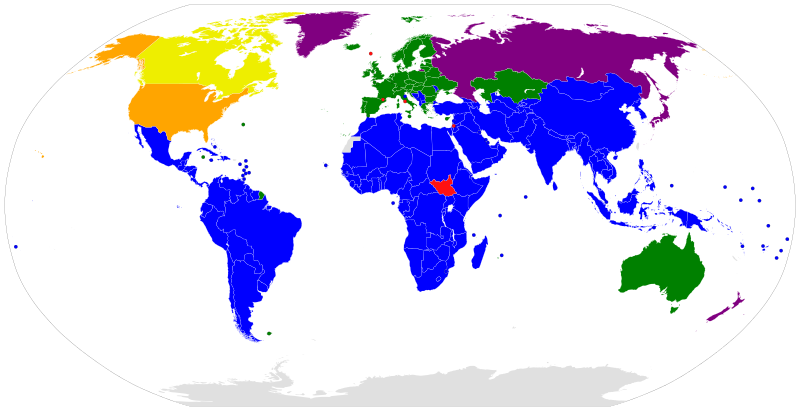
File:Kyoto_Protocol_parties.svg · Wikimedia Commons · See Wikimedia Commons
protocole de Kyoto
Sign in to saveAlso known as Kyoto Protocol to the United Nations Framework Convention on Climate Change
accord international sur le climat
The Kyoto Protocol is an international agreement where countries committed to reducing their greenhouse gas emissions, which contribute to climate change. It matters because it was one of the first major global efforts to get nations to work together on limiting pollution that warms the planet.
AI-generated from the Wikipedia summary — may contain errors.
Wikidata facts
- Named after
- Kyoto
- Author
- United Nations
- Image
- Doha Amendment of Kyoto.svg
Show 15 more facts
- Commons category
- Kyoto Protocol
- depositary
- United Nations Secretary-General
- point in time
- 1997-12-11
- publication date
- 1997-12-10
- ratified by
- Zimbabwe
- on focus list of Wikimedia project
- WikiProject Climate change
- law identifier
- 平成17年条約第1号
- language of work or name
- Czech
- start time
- 2005-02-16
- maintained by WikiProject
- WikiProject International relations
- signatory
- Zambia
- effective date
- 2005-02-16
- title
- Kyoto Protocol to the United Nations Framework Convention on Climate Change
- subtitle
- K Rámcové úmluvě Organizace spojených Národů o změně klimatu
via Wikidata · CC0
Article · Français
Le protocole de Kyoto est un accord international visant à la réduction des émissions de gaz à effet de serre et qui vient s'ajouter à la Convention-cadre des Nations unies sur les changements climatiques dont les pays participants se rencontrent une fois par an depuis 1995. Signé le 11 décembre 1997 lors de la troisième conférence des parties à la convention (COP 3) à Kyoto, au Japon, il est entré en vigueur le 16 février 2005 « au quatre-vingt dixième jour après la date à laquelle au moins 55 parties à la Convention, incluant les parties « Annexe I » qui comptaient en 1990 un total d'au moins 55 % des émissions de CO2 de ce groupe, avaient déposé leurs instruments de ratification, d’acceptation, d’approbation ou d’accession ». « Au 14 janvier 2009, 184 États avaient déposé leurs instruments de ratification, d’accession, d’approbation ou d’acceptation ». Ce protocole visait à réduire, entre 2008 et 2012, d'au moins 5 % par rapport au niveau de 1990 les émissions de six gaz à effet de serre : dioxyde de carbone, méthane, protoxyde d'azote et trois substituts des chlorofluorocarbones.
Abstract from DBpedia / Wikipedia · CC BY-SA
Gallery (11)
Available in 84 languages
- Español
- Français
- Deutsch
- 中文
- 日本語
- Русский
- Português
- Italiano
- العربية
- हिन्दी
- Albanian
- Armenian
- Azerbaijani
- Bahasa Indonesia
- Bangla
- Basque
- Belarusian
- Bosnian
Show 65 more
- Bulgarian
- Burmese
- Catalan
- Croatian
- Czech
- Danish
- Egyptian Arabic
- Esperanto
- Estonian
- Finnish
- Galician
- Georgian
- Greek
- Hausa
- Hebrew
- Hungarian
- Icelandic
- Igbo
- Irish
- Javanese
- Kannada
- Kazakh
- Kurdish
- Latin
- Latvian
- Lithuanian
- Luxembourgish
- Macedonian
- Malay
- Malayalam
- Marathi
- Nederlands
- Norwegian
- Norwegian Nynorsk
- Occitan
- Pashto
- Polski
- Romanian
- Santali
- Scots
- Serbian
- Sicilian
- simple
- Sinhala
- Slovak
- Slovenian
- Svenska
- Swahili
- Tamil
- Telugu
- Tiếng Việt
- Türkçe
- Ukrainian
- Urdu
- Uyghur
- Walloon
- Welsh
- Wu Chinese
- Yakut
- zh_classical
- zh_min_nan
- zh_yue
- فارسی
- ไทย
- 한국어
via Wikidata sitelinks · CC0