Lenz's law
electromagnetic phenomena where changing magnetic fields induce currents with opposing fields
AI overview
Lenz's law states that when a magnetic field changes, it creates an electric current that produces its own magnetic field opposing that change. This principle is important because it explains how electromagnetic systems naturally resist changes and is fundamental to how many devices like generators and transformers work.
AI-generated from the Wikipedia summary — may contain errors.
Article
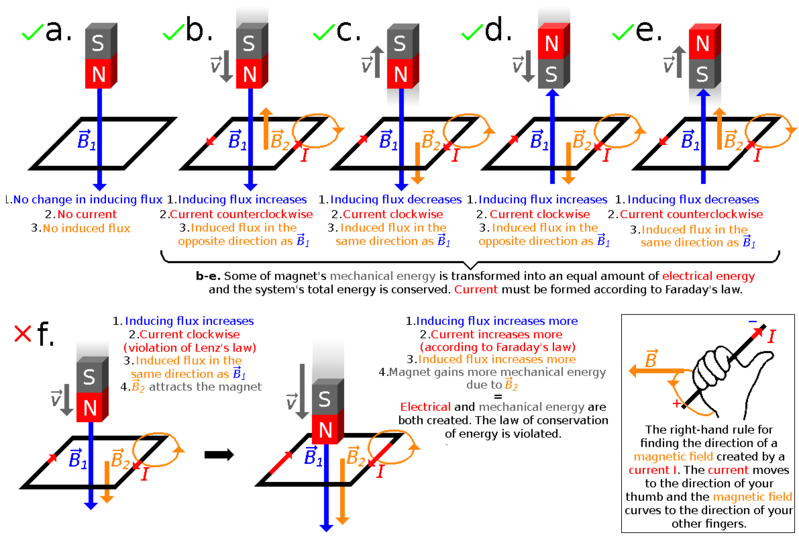
Lenz's law states that the direction of the electric current induced in a conductor by a changing magnetic field is such that the magnetic field created by the induced current opposes changes in the initial magnetic field. It is named after physicist Heinrich Lenz, who formulated it in 1834.
The Induced current is the current generated in a wire due to change in magnetic flux. An example of the induced current is the current produced in the generator which involves rapidly rotating a coil of wire in a magnetic field.