
File:Leon_Trotsky_1918_(3x4_rotated_cropped_b).jpg · Wikimedia Commons · See Wikimedia Commons
Léon Trotski
Sign in to saveAlso known as Lev Bronstein, Lev Davidovich Bronshtein, Lev Davidovich Bronstein, Leon Trotski, Trotsky, Lev Davidovich Bronshteyn, Lev Bronshteyn, Lev Trotsky
révolutionnaire et homme politique russo-soviétique
OverviewAI-generated
Leon Trotsky was a male person associated with the Soviet Union. He is described by tags including political, industrial, socialist, and socialism. His works are referenced by 2,985 other encyclopedia articles. He has five works listed in Crossref and three in Europeana Sparql.
He used pseudonyms such as "Троцкий", "Перо", "Антид Ото", and "Л. Седов". He was born in 1879 and died in 1940. His height was 176. A quote attributed to him states that learning carries dangers because one must learn from enemies.
On Last.fm, he has 790 listeners and a playcount of 2125. Similar artists include Noam Chomsky, Anatoli Lunacharsky, Vladimir Lenin, and Троцкий Лев Давидович. He is also associated with the tag impossible for liberals to deal with.
Synthesized by Vinony from 25 facts across 8 sources: Wikidata, Last.fm, Firecrawl, Crossref, Wikiquote, Europeana Sparql, MusicBrainz, Vinony graph. Generated from structured data (not the Wikipedia text) and checked against those facts — may still contain errors.
Music · MusicBrainz
- Type
- Person
- Gender
- Male
- Origin
- Soviet Union
- Active from
- 1879-11-07
- Active to
- 1940-08-21
via MusicBrainz · CC0
Listeners · Last.fm
- Listeners
- 790
- Total plays
- 2,125
Tags
Similar artists
<a href="https://www.last.fm/music/Leon+Trotsky">Read more on Last.fm</a>
Recent publications · Crossref
5 total works indexed
- A Theory of Cognitive Dissonance
· 1957 · cited 17,062x
- A Theory of Social Comparison Processes
· 1954 · cited 14,475x
- Global burden of bacterial antimicrobial resistance in 2019: a systematic analysis
· 2022 · cited 13,873x
- PhysioBank, PhysioToolkit, and PhysioNet
· 2000 · cited 12,071x
- GW170817: Observation of Gravitational Waves from a Binary Neutron Star Inspiral
· 2017 · cited 8,252x
via Crossref · CC0
Quotes
- “As long as I breathe I hope. As long as I breathe I shall fight for the future, that radiant future, in which man, strong and beautiful, will become master of the drifting stream of his history and will direct it towards the boundless horizons of beauty, joy and happiness!”
- “Lenin's methods [of "hard" centralism and mistrust of the working class] lead to this: the party organization substitutes itself for the party, the central committee substitutes itself for the organization, and, finally, a "dictator" substitutes himself for the central committee. … The party must seek the guarantee of its stability in its own base, in an active and self-reliant proletariat, and not in its top caucus … which the revolution may suddenly sweep away with its wing.”
- “In our eyes, individual terror is inadmissible precisely because it belittles the role of the masses in their own consciousness, reconciles them to their own powerlessness, and turns their eyes and hopes toward a great avenger and liberator who someday will come and accomplish his mission.”
- “Root out the counterrevolutionaries without mercy, lock up suspicious characters in concentration camps... Shirkers will be shot, regardless of past service.”
- “Capital was really safer in Russia than anywhere else. ... No true Marxist would allow sentiment to interfere with business.”
- “Learning carries within itself certain dangers because out of necessity one has to learn from one's enemies.”
via Wikiquote · CC BY-SA
Described at
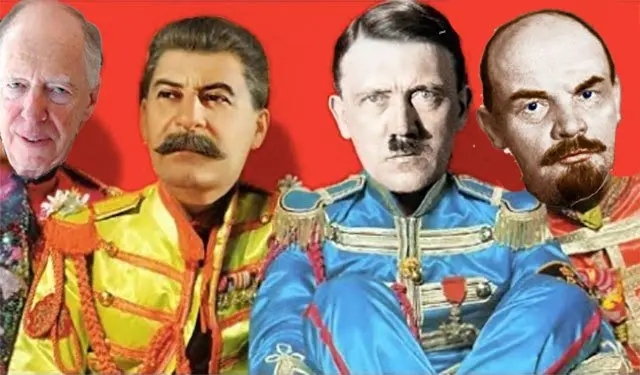
中文译稿首发 德媒揭秘撒旦罗斯柴尔德计划 * 阿波罗新闻网
在现代历史上,这可能是最具爆炸性的文件了。它揭示了”文化战争”的真相。这是撒旦-卡巴拉的中央银行对欧洲-西方文明的进攻。 The Red Symphony(《红色交响曲》)是来自光明派内部知情人克里斯蒂安•拉科夫斯基(Christian Rakowski)1938年阴谋的节选。他确认了,中央银行在全世界,也就是在新的世界秩序中,秉持共产主义的目标。
aboluowang.com →Link to a page describing this subject · 14,737 chars · not written by Vinony
Wikidata facts
- Instance of
- human
- Gender
- male
- Citizenship
- Mexico
- Place of birth
- Bereslavka
- Place of death
- Coyoacán
- Spouse
- Aleksandra Sokolovskaya
- Sibling
- Olga Kameneva
- Occupation
- communist
- Political party
- Social Democratic Party of Switzerland
- Languages spoken
- French
- Notable work
- The Revolution Betrayed
- Participant in
- 12th Congress of the Russian Communist Party
- Movement
- Trotskyism
- Conflict
- Polish–Soviet War
- Military branch
- Red Army
- Military rank
- general
- Image
- Лев Давидович Троцкий.jpg
- Height
- 176
- Work location
- Moscow
- Significant event
- Nazi book burnings
- Political ideology
- Trotskyism
Show 25 more facts
- pseudonym
- Старик
- Commons Creator page
- Leon Trotsky
- Commons category
- Leon Trotsky
- Commons gallery
- Лев Троцкий
- date of death
- 1940-08-20
- topic's main category
- Category:Leon Trotsky
- killed by
- Joseph Stalin
- manner of death
- homicide
- described by source
- Trotsky
- place of burial
- Coyoacán
- birth name
- Лейба Давидович Бронштейн
- name in native language
- Лев Давидович Троцкий
- archives at
- International Institute of Social History
- date of birth
- 1879-11-07
- allegiance
- Soviet Union
- significant person
- Robert Service
- writing language
- English language
- described at URL
- www.marxists.org/chinese/louguohua/luxun-study/13.htm
- facial hair
- Van Dyke beard
- ethnic group
- Russian Jews
- on focus list of Wikimedia project
- Wikipedia:Vital articles/Level/4
- relative
- Semen Semkovski
- P12749
- Cucubalus
- cause of death
- cerebral hemorrhage
Sources (15)
via Wikidata · CC0
Works in European collections
3 objects attributed to Léon Trotski, held across European museums, libraries & archives · via Europeana

Article · Français
Léon Trotski (ou Trotsky, voire Trotzky ou Trotzki ; en russe : Лев Троцкий), de son vrai nom Lev Davidovitch Bronstein (en russe : Лев Давидович Бронштейн), né le 26 octobre 1879 (7 novembre 1879 dans le calendrier grégorien) à Ianovka (alors dans l'Empire russe, aujourd'hui en Ukraine) et mort assassiné le 21 août 1940 à Mexico (Mexique), est un révolutionnaire communiste et homme politique russe, puis soviétique. Militant marxiste du Parti ouvrier social-démocrate de Russie (POSDR), puis à partir de l'été 1917, bolchevik, il est plusieurs fois déporté en Sibérie ou exilé de Russie, et est notamment président du soviet de Pétrograd lors de la révolution russe de 1905. En 1917, il est le principal acteur, avec Lénine, de la révolution d'Octobre qui permet aux bolcheviks d'arriver au pouvoir. Membre du gouvernement communiste, il n'est pas favorable à une paix immédiate avec les puissances de la quadruplice, mais en mars 1918 il accepte le point de vue de Lénine et la paix de Brest-Litovsk qui est une capitulation de fait. Durant la guerre civile russe qui s'ensuit, il fonde l'Armée rouge et se montre partisan de mesures de Terreur : son action contribue à la victoire des bolcheviks et à la survie du régime soviétique. Il est dès lors, et durant plusieurs années, l'un des plus importants dirigeants de l'Internationale communiste (Troisième Internationale) et de l'URSS naissante. Il s'oppose à ce qu'il désigne comme la bureaucratisation du parti et du régime et à Staline en prenant la tête de l'Opposition de gauche ; Staline le fait finalement chasser du gouvernement (1924) et du Parti communiste (1927), puis l'exile en Asie centrale avant de le bannir d'URSS (1929). Trotski entreprend alors d'organiser ses partisans, qui se réunissent en 1938 au sein de la Quatrième Internationale. En 1940, installé au Mexique, il est assassiné sur ordre de Staline par un agent du NKVD. À la fois orateur, théoricien, historien, mémorialiste et homme d'action, Trotski demeure l'inspirateur dont se réclament toujours les divers groupes trotskistes à travers le monde.
Abstract from DBpedia / Wikipedia · CC BY-SA
Gallery (12)
Available in 139 languages
- Español
- Français
- Deutsch
- 中文
- 日本語
- Русский
- Português
- Italiano
- العربية
- हिन्दी
- Afrikaans
- Albanian
- Albanian
- Angika
- Aragonese
- Armenian
- Assamese
- Asturian
Show 120 more
- Awadhi
- Aymara
- Azerbaijani
- Bahasa Indonesia
- Balinese
- Bangla
- Bashkir
- Basque
- bat_smg
- Bavarian
- be_x_old
- Belarusian
- Bosnian
- Breton
- Bulgarian
- Burmese
- Catalan
- cdo
- Cebuano
- Central Kurdish
- Chuvash
- Cornish
- Crimean Tatar
- Croatian
- Czech
- Danish
- Egyptian Arabic
- Esperanto
- Estonian
- Extremaduran
- Filipino
- Finnish
- fiu_vro
- Galician
- Georgian
- Gilaki
- Goan Konkani
- Greek
- Hausa
- Hebrew
- Hungarian
- Icelandic
- Ido
- Interlingua
- Irish
- Javanese
- Kazakh
- Kurdish
- Ladino
- Lao
- Latin
- Latvian
- Limburgish
- Lingua Franca Nova
- Lithuanian
- Lojban
- Luxembourgish
- Macedonian
- Maithili
- Malagasy
- Malay
- Malayalam
- Marathi
- Mazanderani
- Mingrelian
- Mongolian
- Nederlands
- Nepali
- Newari
- Northern Frisian
- Norwegian
- Norwegian Nynorsk
- Occitan
- Old English
- Pashto
- Piedmontese
- Polski
- Punjabi
- Quechua
- Romanian
- Rusyn
- Sanskrit
- Scots
- Scottish Gaelic
- Serbian
- Serbian (Latin)
- Sicilian
- simple
- Slovak
- Slovenian
- Svenska
- Swahili
- Tajik
- Talysh
- Tamil
- Tatar
- Telugu
- Tibetan
- Tiếng Việt
- Türkçe
- Turkmen
- Ukrainian
- Upper Sorbian
- Urdu
- Uzbek
- Volapük
- Waray
- Welsh
- Western Frisian
- Western Panjabi
- Wu Chinese
- Yakut
- Yiddish
- Zaza
- zh_classical
- zh_min_nan
- zh_yue
- فارسی
- ไทย
- 한국어
via Wikidata sitelinks · CC0