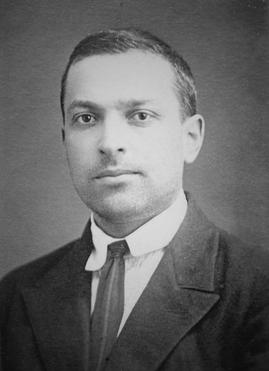
File:Lev_Vygotsky.jpg · Wikimedia Commons · See Wikimedia Commons
Lev Vygotsky was a Soviet psychologist who studied how children learn and develop, emphasizing the importance of social interaction and cultural context in shaping human thinking. His ideas—developed in the early 20th century and influential today—challenged the view that learning is purely individual, instead suggesting that relationships with others and cultural tools like language fundamentally shape how our minds work.
AI-generated from the Wikipedia summary — may contain errors.
Wikidata facts
- Instance of
- human
- Given name
- Lev
- Gender
- male
- Citizenship
- Soviet Union
- Place of birth
- Orsha
- Place of death
- Moscow
- Occupation
- anthropologist
- Educated at
- Moscow City People’s University
- Languages spoken
- Russian
- Doctoral student
- Leonid Zankov
- Field of work
- literary studies
- Image
- Lev-Semyonovich-Vygotsky-1896-1934.jpg
Show 13 more facts
- relative
- David Vygodsky
- place of burial
- Novodevichy Cemetery
- cause of death
- tuberculosis
- date of birth
- 1896-11-17
- date of death
- 1934-07-11
- Commons category
- Lev Vygotsky
- medical condition
- tuberculosis
- manner of death
- natural causes
- student
- Natalia Menchinskaya
- birth name
- Лев Симхович Выгодский
- influenced by
- Benedictus de Spinoza
- on focus list of Wikimedia project
- Wikipedia:Vital articles/Level/4
- Commons Creator page
- Lev Vygotsky
via Wikidata · CC0
~22 min read
Encyclopedic overview
Lev Semyonovich Vygotsky (Russian: Лев Семёнович Выготский, IPA: [vɨˈɡotskʲɪj]; Belarusian: Леў Сямёнавіч Выгоцкі; November 17 [O.S. November 5] 1896 – June 11, 1934) was a Russian and Soviet psychologist, best known for his work on psychological development in children and creating the framework known as cultural-historical activity theory. After his early death, his books and research were banned in the Soviet Union until Joseph Stalin's death in 1953, with a first collection of major texts published in 1956. A Review of General Psychology survey, published in 2002, ranked Vygotsky as the 83rd most cited psychologist of the 20th century.
His major ideas include:
Excerpted from Wikipedia’s “Lev Vygotsky” article, available under the CC BY-SA 4.0 licence.
Available in 73 languages
- Español
- Français
- Deutsch
- 中文
- 日本語
- Русский
- Português
- Italiano
- العربية
- हिन्दी
- Afrikaans
- Albanian
- Armenian
- Asturian
- azb
- Azerbaijani
- Bahasa Indonesia
- Basque
Show 54 more
- be_x_old
- Belarusian
- Bulgarian
- Catalan
- Croatian
- Czech
- Danish
- Egyptian Arabic
- eml
- Esperanto
- Estonian
- Finnish
- Galician
- Georgian
- Greek
- Haitian Creole
- Hebrew
- Hungarian
- Icelandic
- Kannada
- Kazakh
- Kyrgyz
- Latin
- Latvian
- Macedonian
- Malagasy
- Malayalam
- Nederlands
- Norwegian
- Norwegian Nynorsk
- Occitan
- Piedmontese
- Polski
- Punjabi
- Romanian
- Serbian
- Serbian (Latin)
- simple
- Slovak
- Slovenian
- Svenska
- Tajik
- Tamil
- Telugu
- Tiếng Việt
- Tok Pisin
- Türkçe
- Ukrainian
- Uzbek
- Waray
- Wu Chinese
- zh_yue
- فارسی
- 한국어
via Wikidata sitelinks · CC0