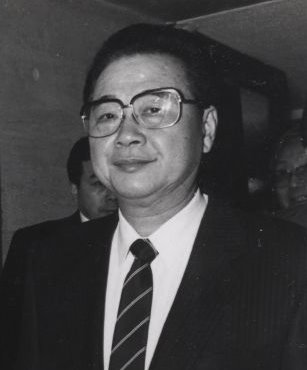
File:Lipeng.jpg · Wikimedia Commons · See Wikimedia Commons
Li Peng
Sign in to save4th Premier of the People's Republic of China (1928–2019)
Li Peng was a Chinese politician who served as the fourth Premier of the People's Republic of China, the country's top government administrative official. He is a significant figure in modern Chinese history whose tenure shaped major policies during a crucial period of the nation's development.
AI-generated from the Wikipedia summary — may contain errors.
Wikidata facts
- Instance of
- human
- Family name
- Li
- Gender
- male
- Citizenship
- China
- Place of birth
- Shanghai
- Place of death
- Beijing
- Father
- Li Shuoxun
- Occupation
- politician
- Educated at
- Moscow Power Engineering Institute
- Political party
- Chinese Communist Party
- Languages spoken
- Chinese
- Religion
- atheism
- Image
- Lipeng.jpg
- Significant event
- Panama Papers
- Political ideology
- communism
Show 12 more facts
- political alignment
- far-left politics
- Commons category
- Li Peng
- date of birth
- 1928-10-20
- topic's main category
- Category:Li Peng
- name in native language
- 李鹏
- date of death
- 2019-07-22
- manner of death
- natural causes
- cause of death
- disease
- place of burial
- Babaoshan Revolutionary Cemetery
- nickname
- pekingi hentes
- relative
- Zhou Enlai
- P10632
- Li Peng
Sources (7)
via Wikidata · CC0
~24 min read
Encyclopedic overview
Li Peng (Chinese: 李鹏; pinyin: Lǐ Péng; 20 October 1928 – 22 July 2019) was a Chinese politician who served as the premier of China from 1987 to 1998, and as the chairman of the Standing Committee of the National People's Congress, China's top legislative body, from 1998 to 2003. For much of the 1990s Li was ranked second in the Chinese Communist Party (CCP) hierarchy behind then CCP General Secretary Jiang Zemin. He retained his seat on the CCP Politburo Standing Committee until his retirement in 2002.
Li was the son of an early Communist revolutionary, Li Shuoxun, who was executed by the Kuomintang. After meeting Zhou Enlai in Sichuan, Li was raised by Zhou and his wife, Deng Yingchao. Li trained to be an engineer in the Soviet Union and worked at an important national power company after returning to China. He escaped the political turmoil of the 1950s, 1960s, and 1970s due to his political connections and his employment in the company. After Deng Xiaoping became China's leader in the late 1970s, Li took a number of increasingly important and powerful political positions, first becoming Vice Minister and later Minister of Power. In 1983, he became a vice premier. In 1985, he became the minister of the State Education Commission as well as a member of the Politburo and the Party Secretariat. He was elected to the Politburo Standing Committee in 1987.
Excerpted from Wikipedia’s “Li Peng” article, available under the CC BY-SA 4.0 licence.