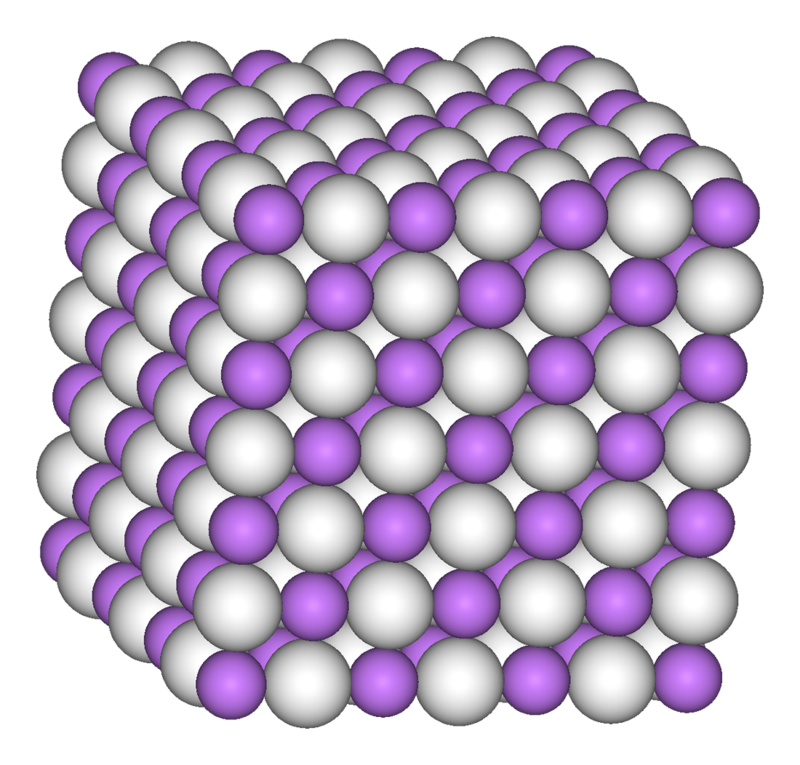
File:Lithium-hydride-3D-vdW.png · Wikimedia Commons · See Wikimedia Commons
Chemical data
- Formula
- HLi
- Molecular weight
- 8 g/mol
- IUPAC name
- lithium hydride
- SMILES
- [H-].[Li+]
- InChIKey
- SRTHRWZAMDZJOS-UHFFFAOYSA-N
- Polar surface area
- 0 Ų
- H-bond donors
- 0
- H-bond acceptors
- 1
- Formal charge
- 0
via PubChem
Wikidata facts
- Subclass of
- chemical compound
- Has part
- hydrogen
- Mass
- 8.024
- Image
- LiHcrack.jpg
Show 11 more facts
- canonical SMILES
- [H-].[Li+]
- NIOSH Pocket Guide ID
- 0371
- density
- 0.78
- immediately dangerous to life or health
- 0.5
- melting point
- 1256
- vapor pressure
- 0
- time-weighted average exposure limit
- 0.025
- chemical formula
- LiH
- standard enthalpy of formation
- -90.7
- molar fusion enthalpy
- -21.8
- Commons category
- Lithium hydride
Sources (3)
via Wikidata · CC0
~12 min read
Encyclopedic overview
Lithium hydride (LiH) is an inorganic compound composed of lithium and hydrogen. This alkali metal hydride is a colorless solid, although commercial samples are grey. Characteristic of a salt-like (ionic) hydride, it has a high melting point, and it is not soluble but reactive with all protic organic solvents. It is soluble and nonreactive with certain molten salts such as lithium fluoride, lithium borohydride, and sodium hydride. With a molar mass of 7.95 g/mol, it is the lightest ionic compound.
Physical properties
Excerpted from Wikipedia’s “lithium hydride” article, available under the CC BY-SA 4.0 licence.