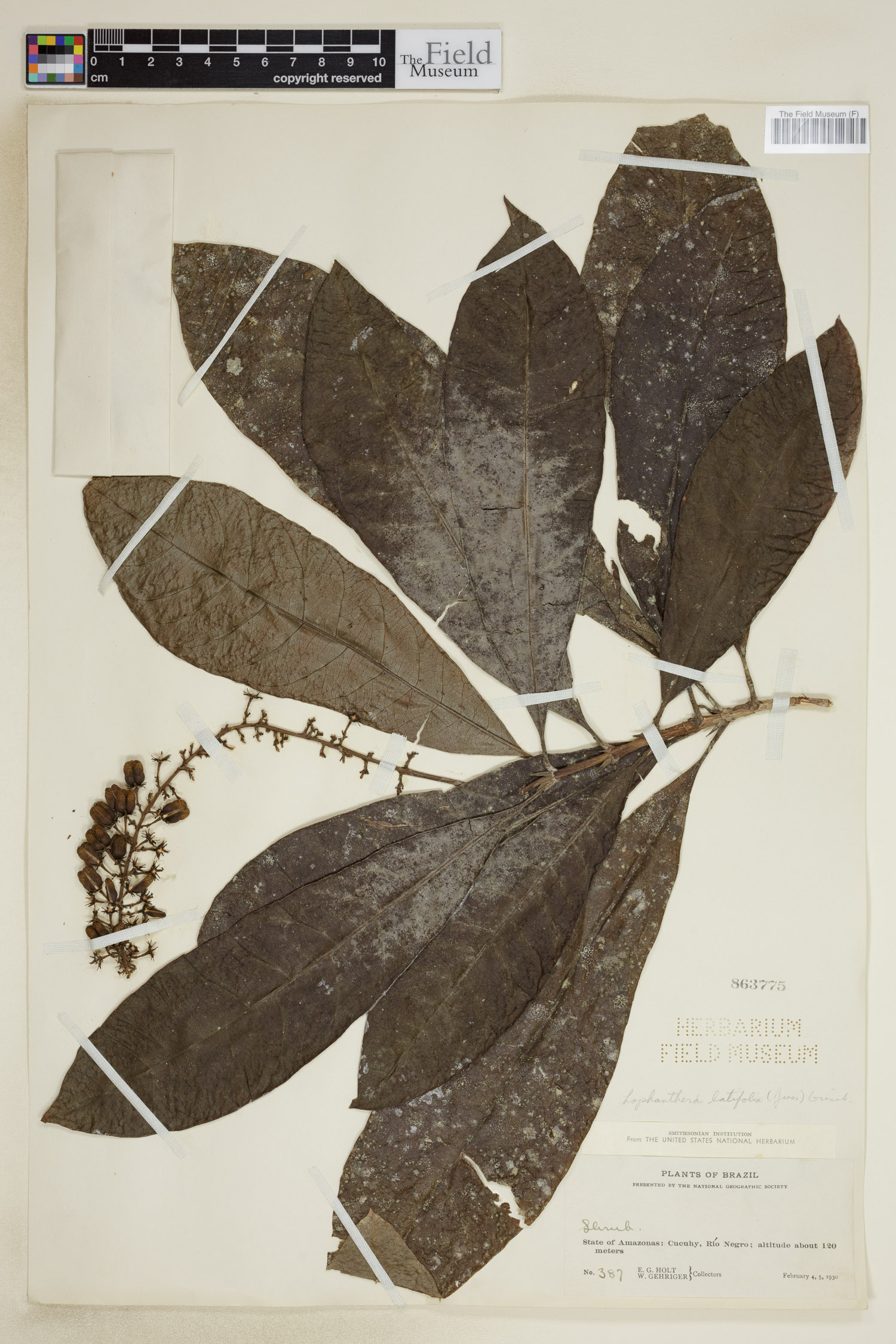
Specimen image via iDigBio
Lophanthera
Sign in to saveLophanthera is a genus in the Malpighiaceae, a family of about 75 genera of flowering plants in the order Malpighiales. Lophanthera comprises 5 species of shrubs and trees, all but one native to the Amazonian South America; the exception (L. hammelii) is from Costa Rica. Lophanthera lactescens has become popular in recent decades as a cultivated ornamental in many warm regions of the Old and New World. It is propagated by cuttings and seeds.
In the Vinony graph
Vinony's link graph records 1 inbound reference to Lophanthera, and connects out to South America, Costa Rica and plant.
It sits within the topics Malpighiaceae and Malpighiaceae genera.
Vinony links it to 9 Wikipedia language editions.
Species
GENUS
- KingdomPlantae
- PhylumTracheophyta
- ClassMagnoliopsida
- OrderMalpighiales
- FamilyMalpighiaceae
via GBIF · Kew POWO
Museum specimens
- Specimen records
- 83
- With media
- 36
- Family
- Malpighiaceae
- Collections
- ESALQ, UFMT, NY, INSTITUTO NACIONAL DE PESQUISAS DA AMAZÔNIA (INPA), UEFS, IAC
- Recorded in
- Brasil, Brazil
Wikidata facts
- Instance of
- taxon
- Parent taxon
- Malpighiaceae
- Image
- Lophanthera lactescens 1.jpg
Show 5 more facts
- taxon name
- Lophanthera
- taxon rank
- genus
- Commons category
- Lophanthera
- topic's main category
- Category:Lophanthera
Sources (1)
via Wikidata · CC0
~1 min read
Encyclopedic overview
1 sectionsContents
- External links
Lophanthera is a genus in the Malpighiaceae, a family of about 75 genera of flowering plants in the order Malpighiales. Lophanthera comprises 5 species of shrubs and trees, all but one native to the Amazonian South America; the exception (L. hammelii) is from Costa Rica. Lophanthera lactescens has become popular in recent decades as a cultivated ornamental in many warm regions of the Old and New World. It is propagated by cuttings and seeds.
==External links== Malpighiaceae Malpighiaceae - description, taxonomy, phylogeny, and nomenclature Lophanthera
Excerpted from Wikipedia’s “Lophanthera” article, available under the CC BY-SA 4.0 licence.