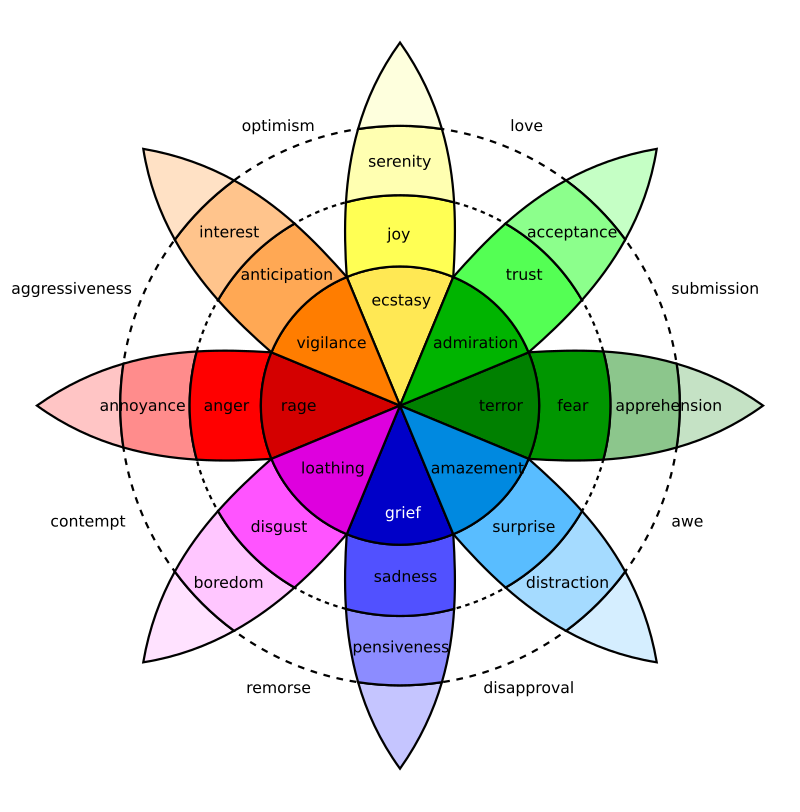
File:Plutchik-wheel.svg · Wikimedia Commons · See Wikimedia Commons
love
Sign in to saveAlso known as affection
Love is an emotion involving strong attraction, affection, emotional attachment or concern for a person, animal, or thing. It is expressed in many forms, encompassing a range of strong and positive emotional and mental states, from the most sublime virtue, good habit, deepest interpersonal affection, to the simplest pleasure. An example of this range of meanings is that the love of a mother differs from the love of a spouse, which, in turn, differs from the love of food.
OverviewAI-generated
Love is a theme and an emotion that is a subclass of affection. It is characterized by intimacy and is the opposite of hatred. The subject is distinct from infatuation, limerence, and the terms Love and Amour. It is referenced by 2,465 other encyclopedia articles.
The topic has a template and appears in the Commons category and gallery under "Love." It is on the focus list of the Wikipedia project for vital articles. Described by sources including the Dictionnaire Infernal and the Jewish Encyclopedia of Brockhaus and Efron, it is associated with hashtags such as love, Liebe, любовь, and amore. The Unicode character ❤ represents the concept. A PubMed query for love yields a count of 25243.
Synthesized by Vinony from 16 facts across 3 sources: Wikidata, PubMed, Vinony graph. Generated from structured data (not the Wikipedia text) and checked against those facts — may still contain errors.
Research
25,243 papers- The neurobiology of love.ReviewFEBS letters · 2007Zeki SDOI: 10.1016/j.febslet.2007.03.094
- Romantic love conceptualized as an attachment process.Journal of personality and social psychology · 1987Hazan C, Shaver PDOI: 10.1037//0022-3514.52.3.511
- The Molecular Basis of Love.ReviewInternational journal of molecular sciences · 2025Babková J, Repiská GDOI: 10.3390/ijms26041533
- Romantic love: an fMRI study of a neural mechanism for mate choice.ReviewThe Journal of comparative neurology · 2005Fisher H, Aron A, Brown LLDOI: 10.1002/cne.20772
- The Science of Love: State of the Art.Advances in experimental medicine and biology · 2021Marazziti D, Palermo S, Mucci FDOI: 10.1007/978-3-030-74046-7_16
- Love and Medicine.JAMA · 2024Kanne TDOI: 10.1001/jama.2023.26366
- What makes people grow? Love and hope.ReviewJournal of physiological anthropology · 2023Bogin BDOI: 10.1186/s40101-023-00330-7
- Psychodynamic Aspects of Love: A Narrative Review.ReviewPsychiatria Danubina · 2022Bilić V, Eterović M, Marčinko DDOI: 10.24869/psyd.2022.3
via PubMed
Wikidata facts
Show 11 more facts
- Commons category
- Love
- topic's main category
- Category:Love
- Commons gallery
- Love
- opposite of
- hatred
- different from
- falling in love
- on focus list of Wikimedia project
- Wikipedia:Vital articles/Level/4
- hashtag
- amor
- has characteristic
- intimacy
- Unicode character
- ❤
- topic has template
- Template:Love sidebar
- P8168
- Antiochis
Sources (7)
via Wikidata · CC0
~52 min read
Encyclopedic overview
36 sectionsContents
- Definitions
- Impersonal
- Interpersonal
- Biological basis
- Psychological basis
- Love as a necessity
- Evolutionary basis
- Adaptive benefit
- Comparison of scientific models
- Health
- Cultural views
- Ancient Greek
- Ancient Roman
- Chinese<span class="anchor" id="China"></span>
- Japanese
- Indian
- Persian
- Religious views
- Abrahamic
- Judaism
- Christianity
- Islam
- Bahá'í Faith
- Dharmic
- Buddhism
- Hinduism
- Political views
- Philosophical views
- Literature depictions
- See also
- References
- Notes
- Citations
- Sources
- Further reading
- External links
Love is an emotion involving strong attraction, affection, emotional attachment or concern for a person, animal, or thing. It is expressed in many forms, encompassing a range of strong and positive emotional and mental states, from the most sublime virtue, good habit, deepest interpersonal affection, to the simplest pleasure. An example of this range of meanings is that the love of a mother differs from the love of a spouse, which, in turn, differs from the love of food.
Love is considered to be both positive and negative, with its virtue representing kindness, compassion, and affection—"the unselfish, loyal, and benevolent concern for the good of another"—and its vice representing a moral flaw akin to vanity, selfishness, amour-propre, and egotism. It may also describe compassionate and affectionate actions towards other humans, oneself, or animals. In its various forms, love acts as a major facilitator of interpersonal relationships, and owing to its central psychological importance, is one of the most common themes in the creative arts. Love has been postulated to be a function that keeps human beings together against menaces and to facilitate the continuation of the species.
Excerpted from Wikipedia’s “love” article, available under the CC BY-SA 4.0 licence.
Gallery (46)
Available in 186 languages
- Español
- Français
- Deutsch
- 中文
- 日本語
- Русский
- Português
- Italiano
- العربية
- हिन्दी
- Afrikaans
- Akan
- Albanian
- Albanian
- Amharic
- Aragonese
- Armenian
- Assamese
Show 167 more
- Asturian
- Avaric
- azb
- Azerbaijani
- Bahasa Indonesia
- Bangla
- Bashkir
- Basque
- bat_smg
- Bavarian
- be_x_old
- Belarusian
- Bhojpuri
- Bikol
- Bosnian
- Breton
- btm
- Bulgarian
- Buriat
- Burmese
- Catalan
- cdo
- Central Kurdish
- Chechen
- Chuvash
- Colognian
- Cornish
- Corsican
- Crimean Tatar
- Croatian
- Czech
- Danish
- Egyptian Arabic
- Esperanto
- Estonian
- Extremaduran
- Fiji Hindi
- Filipino
- Finnish
- Galician
- Gan Chinese
- gcr
- Georgian
- Goan Konkani
- Greek
- Guarani
- Gujarati
- guw
- Haitian Creole
- Hakka Chinese
- Hausa
- Hebrew
- Hungarian
- hyw
- Icelandic
- Ido
- Igbo
- Iloko
- Inari Sami
- Interlingua
- Inuktitut
- Irish
- Jamaican Creole English
- Javanese
- Kannada
- Kanuri
- Kara-Kalpak
- Kashmiri
- Kazakh
- Khmer
- Kikuyu
- Kinyarwanda
- Kurdish
- Kyrgyz
- Lao
- Latin
- Latvian
- Ligurian
- Limburgish
- Lingala
- Lithuanian
- Lombard
- Low German
- Luxembourgish
- Macedonian
- Madurese
- Malagasy
- Malay
- Malayalam
- Maltese
- Marathi
- Mazanderani
- Mingrelian
- Mirandese
- mnw
- Mongolian
- Moroccan Arabic
- nah
- nds_nl
- Nederlands
- Nepali
- Newari
- Nias
- Norwegian
- Norwegian Nynorsk
- Occitan
- Odia
- Old English
- Pashto
- Picard
- Piedmontese
- Polski
- Punjabi
- Quechua
- Romanian
- Rusyn
- Santali
- Sardinian
- Scottish Gaelic
- Serbian
- Serbian (Latin)
- Shona
- Sicilian
- simple
- Sindhi
- Sinhala
- Slovak
- Slovenian
- Somali
- South Ndebele
- Svenska
- Swahili
- Swati
- Tajik
- Tamil
- Tatar
- Telugu
- Tibetan
- Tiếng Việt
- Toki Pona
- Tsonga
- Türkçe
- Turkmen
- Tuvinian
- Tyap
- Ukrainian
- Urdu
- Uyghur
- Uzbek
- Veps
- Walloon
- Waray
- Welsh
- Western Frisian
- Western Panjabi
- Wu Chinese
- Xhosa
- Yakut
- Yiddish
- zh_classical
- zh_min_nan
- zh_yue
- Zhuang
- Zulu
- فارسی
- ไทย
- 한국어
via Wikidata sitelinks · CC0