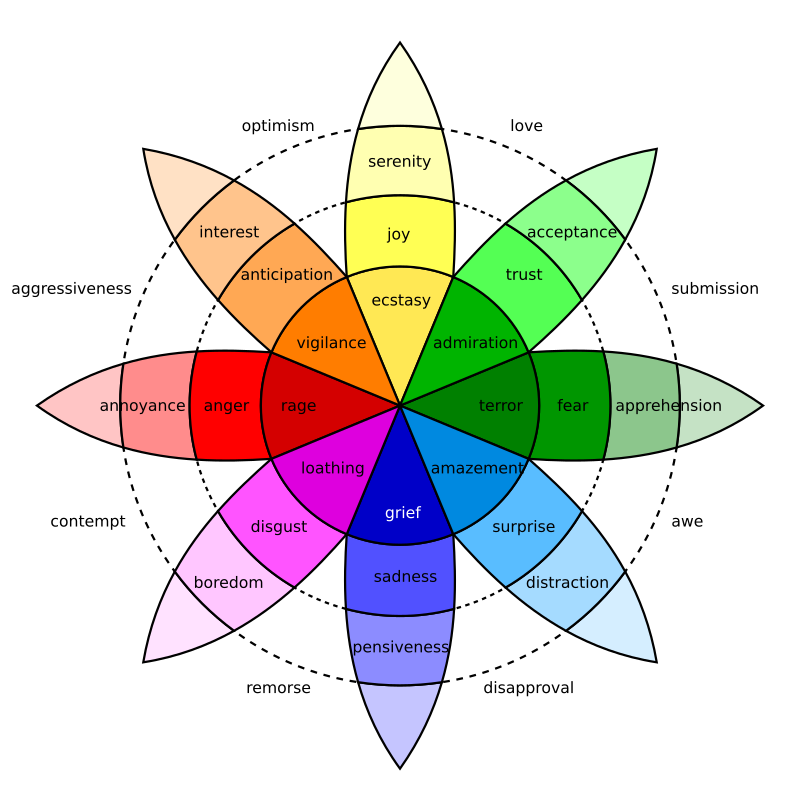
File:Plutchik-wheel.svg · Wikimedia Commons · See Wikimedia Commons
Liebe
Sign in to saveAlso known as affection
stärkstes menschliches Gefühl der Zuwendung und Zuneigung zu mindestens einem anderen Subjekt
OverviewAI-generated
Love is a theme and an emotion that is a subclass of affection. It is characterized by intimacy and is the opposite of hatred. The subject is distinct from infatuation, limerence, and the terms Love and Amour. It is referenced by 2,465 other encyclopedia articles.
The topic has a template and appears in the Commons category and gallery under "Love." It is on the focus list of the Wikipedia project for vital articles. Described by sources including the Dictionnaire Infernal and the Jewish Encyclopedia of Brockhaus and Efron, it is associated with hashtags such as love, Liebe, любовь, and amore. The Unicode character ❤ represents the concept. A PubMed query for love yields a count of 25243.
Synthesized by Vinony from 16 facts across 3 sources: Wikidata, PubMed, Vinony graph. Generated from structured data (not the Wikipedia text) and checked against those facts — may still contain errors.
Research
25,243 papers- The neurobiology of love.ReviewFEBS letters · 2007Zeki SDOI: 10.1016/j.febslet.2007.03.094
- Romantic love conceptualized as an attachment process.Journal of personality and social psychology · 1987Hazan C, Shaver PDOI: 10.1037//0022-3514.52.3.511
- The Molecular Basis of Love.ReviewInternational journal of molecular sciences · 2025Babková J, Repiská GDOI: 10.3390/ijms26041533
- Romantic love: an fMRI study of a neural mechanism for mate choice.ReviewThe Journal of comparative neurology · 2005Fisher H, Aron A, Brown LLDOI: 10.1002/cne.20772
- The Science of Love: State of the Art.Advances in experimental medicine and biology · 2021Marazziti D, Palermo S, Mucci FDOI: 10.1007/978-3-030-74046-7_16
- Love and Medicine.JAMA · 2024Kanne TDOI: 10.1001/jama.2023.26366
- What makes people grow? Love and hope.ReviewJournal of physiological anthropology · 2023Bogin BDOI: 10.1186/s40101-023-00330-7
- Psychodynamic Aspects of Love: A Narrative Review.ReviewPsychiatria Danubina · 2022Bilić V, Eterović M, Marčinko DDOI: 10.24869/psyd.2022.3
via PubMed
Wikidata facts
Show 11 more facts
- Commons category
- Love
- topic's main category
- Category:Love
- Commons gallery
- Love
- opposite of
- hatred
- different from
- falling in love
- on focus list of Wikimedia project
- Wikipedia:Vital articles/Level/4
- hashtag
- amor
- has characteristic
- intimacy
- Unicode character
- ❤
- topic has template
- Template:Love sidebar
- P8168
- Antiochis
Sources (7)
via Wikidata · CC0
Article · Deutsch
Liebe (über mittelhochdeutsch liep, „Gutes, Angenehmes, Wertes“ von indogermanisch *leubh- gern, lieb haben, begehren) ist eine Bezeichnung für stärkste Zuneigung und Wertschätzung. Nach engerem und verbreitetem Verständnis ist Liebe ein starkes Gefühl, mit der Haltung inniger und tiefer Verbundenheit zu einer Person (oder Personengruppe), die den Zweck oder den Nutzen einer zwischenmenschlichen Beziehung übersteigt und sich in der Regel durch eine entgegenkommende tätige Zuwendung zum anderen ausdrückt. Liebe kann unabhängig davon empfunden werden, ob sie erwidert wird oder nicht. Insbesondere in der Entwicklung eines heranwachsenden Menschen ist die Erfahrung liebender Zuwendung unabdingbar. Absoluter Mangel an Liebe führt beim Kind zu Hospitalismus. Fehlentwicklungen der Liebesfähigkeit sind im Sinne des „reinen“ Liebesbegriffes das Besitzdenken (Eifersucht) oder verschiedene Formen der freiwilligen Abhängigkeit bzw. Aufgabe der Autonomie bis hin zur Hörigkeit.
Abstract from DBpedia / Wikipedia · CC BY-SA
Gallery (46)
Available in 186 languages
- Español
- Français
- Deutsch
- 中文
- 日本語
- Русский
- Português
- Italiano
- العربية
- हिन्दी
- Afrikaans
- Akan
- Albanian
- Albanian
- Amharic
- Aragonese
- Armenian
- Assamese
Show 167 more
- Asturian
- Avaric
- azb
- Azerbaijani
- Bahasa Indonesia
- Bangla
- Bashkir
- Basque
- bat_smg
- Bavarian
- be_x_old
- Belarusian
- Bhojpuri
- Bikol
- Bosnian
- Breton
- btm
- Bulgarian
- Buriat
- Burmese
- Catalan
- cdo
- Central Kurdish
- Chechen
- Chuvash
- Colognian
- Cornish
- Corsican
- Crimean Tatar
- Croatian
- Czech
- Danish
- Egyptian Arabic
- Esperanto
- Estonian
- Extremaduran
- Fiji Hindi
- Filipino
- Finnish
- Galician
- Gan Chinese
- gcr
- Georgian
- Goan Konkani
- Greek
- Guarani
- Gujarati
- guw
- Haitian Creole
- Hakka Chinese
- Hausa
- Hebrew
- Hungarian
- hyw
- Icelandic
- Ido
- Igbo
- Iloko
- Inari Sami
- Interlingua
- Inuktitut
- Irish
- Jamaican Creole English
- Javanese
- Kannada
- Kanuri
- Kara-Kalpak
- Kashmiri
- Kazakh
- Khmer
- Kikuyu
- Kinyarwanda
- Kurdish
- Kyrgyz
- Lao
- Latin
- Latvian
- Ligurian
- Limburgish
- Lingala
- Lithuanian
- Lombard
- Low German
- Luxembourgish
- Macedonian
- Madurese
- Malagasy
- Malay
- Malayalam
- Maltese
- Marathi
- Mazanderani
- Mingrelian
- Mirandese
- mnw
- Mongolian
- Moroccan Arabic
- nah
- nds_nl
- Nederlands
- Nepali
- Newari
- Nias
- Norwegian
- Norwegian Nynorsk
- Occitan
- Odia
- Old English
- Pashto
- Picard
- Piedmontese
- Polski
- Punjabi
- Quechua
- Romanian
- Rusyn
- Santali
- Sardinian
- Scottish Gaelic
- Serbian
- Serbian (Latin)
- Shona
- Sicilian
- simple
- Sindhi
- Sinhala
- Slovak
- Slovenian
- Somali
- South Ndebele
- Svenska
- Swahili
- Swati
- Tajik
- Tamil
- Tatar
- Telugu
- Tibetan
- Tiếng Việt
- Toki Pona
- Tsonga
- Türkçe
- Turkmen
- Tuvinian
- Tyap
- Ukrainian
- Urdu
- Uyghur
- Uzbek
- Veps
- Walloon
- Waray
- Welsh
- Western Frisian
- Western Panjabi
- Wu Chinese
- Xhosa
- Yakut
- Yiddish
- zh_classical
- zh_min_nan
- zh_yue
- Zhuang
- Zulu
- فارسی
- ไทย
- 한국어
via Wikidata sitelinks · CC0