magnetic pole of Earth
Also known as magnetic dip pole, magnetic pole
wandering point on the Earth where the geomagnetic field lines are directed vertically, either upwards or downwards
Described at
Pole Shift: North Races, South Crawls
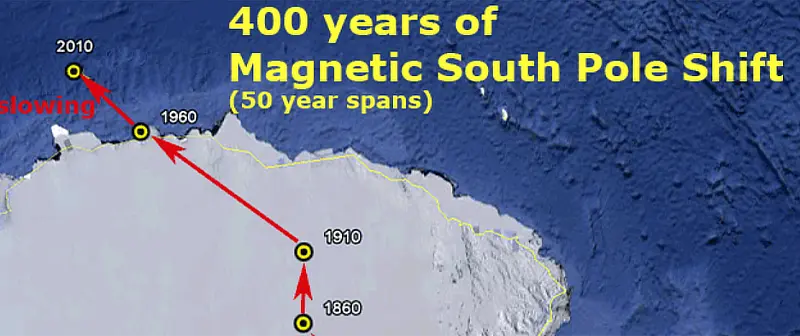
North Pole Shift races and speeds up while South Pole Shift slows down to a crawl. See the images and graphs that illustrate the remarkable difference.
modernsurvivalblog.com →While the speed of the earth’s magnetic north pole shift has drastically sped up lately (originally posted during 2011) to about 34 miles per year (55 km), let’s look at what is happening with the south magnetic pole . Every magnetic field has two polarities, North and South for example, and one might think that whatever is happening with one pole would be happening (in the inverse?) to it’s opposite pole. Not only that, but it’s interesting to note that both the north and south magnetic poles are favoring one side of the earth – the south pole is heavily favoring one side, and continues to move further away from true south. The south magnetic pole is actually 1,800 miles (2,900 km) away from the earth’s true south pole! That is a substantial offset. The north magnetic pole is fairly near true north and is ‘only’ about 360 miles (580 km) away. Since we know that the earth’s magnetic field is generated from the spinning liquid molten iron Outer Core (encapsulating a solid iron Inner Core), is one part of the Outer core churning differently than the other? Could the Outer Core, or part of it, be offset somehow, causing the magnetic pole axis to pass through one side of the planet more than the other? Wouldn’t that cause the planet to wobble? Is the iron consistency changing in one part of the Outer Core more than the other? These are all interesting things to think about (for some of us), and while being just a logical minded casual observer, there is no doubt that these earth changes are powerful ones – even if only occurring relative to the time frame of the planets life. Take a look at the following graph and see the extreme difference in North versus South Pole Shift speed since about 1930. As they say, a picture’s worth a thousand words… Could crustal movements, earthquakes and volcanoes be affected differently on this side of the planet than the other? The location is certainly right on top of the pacific ring of fire, and very near the general vicinity of Indonesia (most active volcanoes in the world), and located in the part of the world that gets the majority of earthquakes. It could purely coincidental, but who’s to say… The liquid part of the earth’s core is the outer core, the inner core is believed to consist of solid iron, nickel and traces of heavy elements. An assumption that many people make, is that the transition between the inner and outer core is smooth like the transition between the layers of an onion. This is completely incorrect, the transition between these two structures is very complex, being a mixture of solid, liquid and in-between states which may be 10s or hundreds of miles thick. This, and the Coriolis effect gives rise to very complex eddy currents within the liquid outer core which in turn create a very complex magnetic field which is constantly changing. Many texts approximate the earth’s magnetic field as a bar magnet located between the two geographic poles, but this is an over simplification with the true magnetic field being very hard to describe. It is true that at this time the predominant field direction in the northern hemisphere is north, but the strength of this field varies significantly from location to location. If you investigate the magnetic field you will find that there are areas of north polarity (and always have been) in the southern hemisphere and likewise areas of south polarity in the northern hemisphere.