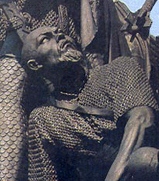
File:Mamai.jpg · Wikimedia Commons · See Wikimedia Commons
Mamai
Sign in to saveAlso known as Mamay
Mamai (; ; 1325?–1380/1381) was a powerful Turco-Mongol military commander who held the rank of beylerbey in the Golden Horde. He was from the Kiyat clan. Contrary to popular misconception, he was not a khan (king), but was a kingmaker for several khans, and dominated parts or all of the Golden Horde for almost two decades in the 1360s and 1370s. Although he was unable to stabilize central authority during the 14th-century Golden Horde war of succession known as the Great Troubles, Mamai remained a remarkable and persistent leader for decades, while others came and went in rapid succession. Hi
Key facts
- Royalty.name
- Mamai
- Royalty.title
- Beylerbey
- Royalty.image
- File:Mamai.jpg
- Royalty.caption
- Mamai on the Millennium of Russia monument in Veliky Novgorod
- Royalty.predecessor
- ?
- Royalty.successor
- Edigu
- Royalty.spouse
- Berdi Beg's daughter, probably Tulun Beg Khanum
- Royalty.issue
- Mansur Kiyat
- Royalty.dynasty
- Kiyat
- Royalty.father
- Alash Beg?
- Royalty.religion
- Sunni Islam
- Royalty.birth_date
- 1325?
- Royalty.death_place
- Crimea
- Royalty.burial_place
- Şeyh Mamay (today Aivazovske, Kirovske Raion, Crimea)
via Wikipedia infobox
Wikidata facts
- Instance of
- human
- Gender
- male
- Place of birth
- Staryi Krym
- Place of death
- Feodosiia
- Spouse
- Tulunbeg
- Occupation
- military leader
- Family
- Genghisid
- Image
- Mamai.jpg
Show 5 more facts
- Commons category
- Mamai
- date of death
- 1380-00-00
- different from
- Mamay
- place of burial
- Aivazovs'ke
- date of birth
- 1335-00-00
Sources (1)
via Wikidata · CC0
~27 min read
Encyclopedic overview
12 sectionsContents
- Origins
- Rise to power
- Kingmaker after the death of Berdi Beg
- Mamai and the Great Troubles in the Golden Horde
- Mamai and overseas: Mamluks and Italians
- Mamai and Lithuania
- Attempts to control the Russian principalities
- Three final defeats: Vozha, Kulikovo, Kalka
- Death
- Purported descendants: Princes Glinski
- References
- Bibliography
Mamai (; ; 1325?–1380/1381) was a powerful Turco-Mongol military commander who held the rank of beylerbey in the Golden Horde. He was from the Kiyat clan. Contrary to popular misconception, he was not a khan (king), but was a kingmaker for several khans, and dominated parts or all of the Golden Horde for almost two decades in the 1360s and 1370s. Although he was unable to stabilize central authority during the 14th-century Golden Horde war of succession known as the Great Troubles, Mamai remained a remarkable and persistent leader for decades, while others came and went in rapid succession. His defeat in the Battle of Kulikovo by an alliance of the Russian principalities marked the beginning of the decline of the Horde, as well as his own rapid downfall.
==Origins== Unlike the khans of the so-called Golden Horde, Mamai was not a descendant of Genghis Khan and his son Jochi, but belonged to the powerful Turco-Mongol Kiyat clan that branched from the Mongol Kiyat clan, which claimed descent from Mugetu Kiyan (Mūngdū Qayān), an older brother of Genghis Khan's father Yesugei Baghatur. While they served the rulers of the Golden Horde from at least Batu Khan, the Kiyats may have risen in importance after the fall of the rival khan Nogai in 1299. Abandoning Nogai in favor of the legitimate khan, Toqta, Aq-Buqa Kiyat enjoyed the favor of the khan and his successor, and served as one of the chief emirs. Another Kiyat, Isatai, was entrusted with governing the former ulus of Orda in the eastern part of the Golden Horde, by Öz Beg Khan. Isatai's son Jir-Qutluq and the latter's son Tingiz-Buqa enjoyed the same position under the next khans, Jani Beg and Berdi Beg. Specific information about Mamai's immediate origins is very limited, but his father is named as Alash Beg (possibly Ali Beg), probably the son Isatai. At least part of the clan may have been ensconced in the Crimea, perhaps since the early 14th century, before several Kiyats appeared as governor on the eastern periphery of the Golden Horde. The date of Mamai's birth can be estimated only generally, to somewhere in the mid-to-late 1320s. At birth, he appears to have received the Muslim name Muḥammad, sometimes paired with the nickname Kičik ("little"), perhaps due to his short stature. Whether "Mamai" is a variation of that name or an additional, "folk" name, remains unclear. According to contemporary Timurid source Nizam al-Din Shami’s Ẓafar-nāma Kiyats were called Uzbek: "chun hissa-yi ab-i khud bi-Uzbak dadi ki az nasl-i Qiyat ast, dar ulus-i Chaghatay zikr-i in makrumat baqi manad". Later sources, such as Majmu al-tawarikh [ru], included Kiyat clan as one of ninety-two Uzbek [ru] clans of the Golden Horde.
Excerpted from Wikipedia’s “Mamai” article, available under the CC BY-SA 4.0 licence.