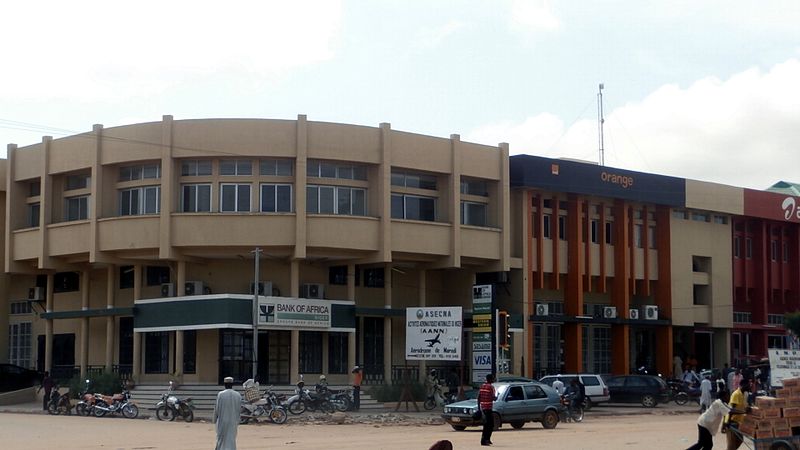
File:Maradi_2.JPG · Wikimedia Commons · See Wikimedia Commons
OverviewAI-generated
Maradi is a city and municipality in Niger, serving as the capital of the Maradi Region. It is situated in the Madarounfa Department on the African continent, near the River Goulbi de Maradi. The city’s head of government is Mamane Oumarou, and it is twinned with Akhisar.
The population of Maradi is recorded as 267,249, while another source lists it as 361,702. The city operates in the West Africa Time zone (UTC+01:00). Its elevation above sea level is cited as 385 meters, with other measurements indicating 356 or 360 meters.
Synthesized by Vinony from 47 facts across 7 sources: Wikidata, Openweathermap, Open Meteo, OpenStreetMap, GeoNames, Vinony graph, Geo. Generated from structured data (not the Wikipedia text) and checked against those facts — may still contain errors.
Weather now
7-day forecast
via Open-Meteo
Place details
- Locality
- Maradi
- Region
- Maradi
- Country
- Niger
- Population
- 361,702
- Timezone
- Africa/Niamey
via OpenStreetMap · GeoNames
Air quality
- PM2.5
- 32.6 µg/m³
- PM10
- 53.3 µg/m³
Key facts
- Country
- Niger
- Region
- Maradi Region
- Department
- Maradi Department
- Urban commune
- Maradi
- Type
- Seat of Departmental and Regional councils, Urban Commune
- Land
- 74 km (29 sq mi)
- Elevation
- 385 m (1,263 ft)
- Total
- 267,249
- Density
- 3,600/km (9,400/sq mi)
- Summer dst
- UTC+1
via Wikipedia infobox
Wikidata facts
- Instance of
- big city
- Official name
- Maradi
- Country
- Niger
- Located in
- Madarounfa Department
- Continent
- Africa
- Population
- 8808
- Elevation
- 385
- Time zone
- West Africa Time
- Body of water
- River Goulbi de Maradi
- Head of government
- Mamane Oumarou
- Capital of
- Maradi Region
- Image
- Maradi.JPG
Show 5 more facts
- twinned administrative body
- Akhisar
- Commons category
- Maradi
- topic's main category
- Category:Maradi, Niger
- native label
- Maradi
- P12749
- Theopompus
via Wikidata · CC0
Travel guide
Understand
The region of Maradi enjoys very fertile land, and the region is known for its peanuts, groundnuts, and livestock, and for the Nigerien staples of millet and sorghum. The city also benefits from factories producing cooking oil, plastic bags, and mattresses, and a strategic location along both the country's major east-west highway and along a primary road south to Nigeria. As a result, Maradi has an unusually robust economy for one of the world's poorest countries, and visitors can pick up on kind of a 'boom town' feel as they navigate the city's sprawling market district, stepping around trucks from a half-dozen West African countries and leaping to avoid the swarms of speeding motorcycles. If Maradi isn't Niger's New York, it certainly is Niger's Houston.
Maradi's commercial and industrial identity makes it somewhat less of a draw for most tourists, and while there are many local attractions in the city and in the region that a traveler would find edifying, there are probably few who would view those attractions as being 'worth the trip' (8-10 hours by bus on rough roads from Niamey). Additionally, while international development agencies are prominent in Maradi as they are throughout Niger, the number of foreign aid workers based in the city is much smaller than in Niamey or Zinder, and the presence is far less detectable. As a result, foreigners may find the city far more difficult to visit than places like Niamey, Agadez, or Zinder. This is not because the residents are …
Get in
Maradi is on the National Route 1, the main highway between Niamey and the entire southeast of the country (including the cities of Birnin Konni, Zinder, and Diffa, and passing through every administrative region of the country except Agadez). It is also the transportation hub for the region. This makes Maradi as easy and straightforward to travel to as any city in Niger.
Get around
Maradi is an easy city to get around in. The city center is very walkable, assuming you wish to brave the heat and the winding morass of unnamed streets. Few streets are named, and even when they are nobody knows them (and certainly not the house numbers on them). When you're taking a taxi or asking for directions, the convention is that you name a landmark near the place you're going to. Each driver's inventory of landmarks is a little different, and he may call the place you're headed something different (or in a different language) than what you or your guidebook think it's called. Most of them know the names of the cultural sites, the major government offices, the hotels, the markets and major stores, the bus stations, the popular bars and restaurants, and so on. If you are making advance arrangements to meet somebody, you might think to ask your party what they tell the taxi to get there. If you know where you're going and are communicating well, you can also give turn-by-turn directions (as you can once you've gotten to your closest landmark); be aware that this is a great loophole for a surprise fare increase (possibly an honest one) as the driver didn't know where he was headed in advance.
Do
Haggle in the market. Bargaining your way through a West African market can be a fantastically entertaining way to spend an afternoon, and if you're looking for a chance to get into the swing of things before you encounter the markets and tourist shops in Niamey or Zinder (where they have more things that you might actually want to buy, but conversely they are also absolutely trying to screw you) then go out for a dry run to buy a mango, a bolt of fabric, or a piece of minor jewelry in the Maradi market or in one of the specialty shops along the market's periphery. Prices here will be less, and the markup you get for bring a foreigner will also be less. Be friendly; bargaining is a social activity, and you'll want to start by asking after the merchant's health and family, just like any other polite conversation. Ask for a price on what you want; often, you'll be asked to pick out everything you want before you get a final quote (the more you buy, the less you'll be charged per item). For food, you can generally give a counter-offer of about 2/3 the quote; for things like textiles you might even try 1/2. Sometimes this will draw a flat-out refusal; in this case, in Niger it's OK to amend your offer; alternately, you might get a counter-offer from the merchant, and the process will continue. If you're trying to get that last discount, consider flattery ("Because you're a good friend!") or the phrase saboda gobe, a Hausa expression implying that you should get a good price becau…
Buy
Traditional Tuareg Handicrafts at the artisanal center. The Tuaregs (and also the Fulani) are internationally known for the quality of their silver and their leatherwork; the Center's store has a decent selection of highly distinctive silver or nickel rings, bracelets, necklaces, and earrings for both men and women. Ask about the Tuareg crosses; they are a common motif, and the story behind them is engaging. The leather briefcases and sandals are surprisingly sturdy, though rarely as comfortable or as practical as you would hope. If you want something truly specific (and have space in your luggage), consider a Tuareg camel saddle, sword, or wallet; these are all things you can spot the Tuaregs around you actually wearing and using in their everyday life, and they typically exemplify the skill and the aesthetic of both the leatherwork and the metalwork. Kola nut. If you want to sample Niger's most distinctive vice, buy a kola nut. This famously caffeinated tree fruit was one of the early ingredients in Coca-Cola, and it's astoundingly bitter but has a kick that will cause you to never respect your morning coffee again. Kola nuts typically break apart quite naturally into cloves, and many Nigeriens that socially chew goro, as it's known, typically buy only one and share. Dare to eat a whole one only in the early morning, or before your trans-Atlantic flight. Unlike street food, kola nuts are not washed; take it with you and wash it carefully (ideally with a little bleach in th…
Drink
Maradi is at the heart of a highly conservative, Muslim region of West Africa - so much so that their fellow Hausas across the border in Nigeria have instituted Sharia law in their communities. While the Hausa areas of Niger (as well as their countrymen) have resisted the urge to follow along, it wouldn't be a stretch to claim that you will meet almost nobody who will admit to you that they ever consume alcoholic beverages, and most of them are telling the truth. As a result, beer and wine are difficult to come by. However, the number of foreign nationals (as well as the more moderate bureaucrats and technical workers from the western part of the country) coupled with the Hausa entrepreneurial spirit (as strong as anywhere you'll find) means you can rest assured that when you're ready to relax with that beer, your desire can be fulfilled.
There is one liquor store in the city as of this writing that is run by a couple of agreeable gentlemen who claim to never touch their own product. It is in an unmarked, gray building with a colonnaded front walk opposite the northwest corner of the Grand Marché; facing the building, it's the door farthest to the left. Their hours are variable and unpredictable. A can or bottle of beer might be 600-700 FCFA; a bottle of name-brand spirits costs about what it might in the United States ($12-30). On most days, you will be able to find a couple of types of import beer, some cheap wine, and a few bottles of low-cost, hangover-inducing French sp…
Sleep
There are only a few hotels in Maradi, and none of what might be truly considered 'budget' hotels. Nigeriens are not avid travelers, as a general rule, and when they do travel, most make arrangements for accommodation with the family member, friend, agency, or co-worker that they are traveling to visit (tourism for the sake of tourism is a concept foreign to most Nigeriens; you are likely to be regarded with a touch of confusion or even interested surprise if you explain that this is what you're doing). For this reason, many of the aid and missionary organizations that work in Maradi have their own accommodations for their people when they are in town; if you happen to have a connection to such an organization, you might do well to inquire, although many of these agencies have fairly strict standards of use.
Connect
Internet infrastructure has developed in Maradi to the point where cyber cafes have become a reasonable business option, though the connection is often slow (typically, they have multiple computers using single connections, so even places advertising a high-speed connection have this problem) and very few have generators, so they are at the mercy of Maradi's frequent power failures. Most of the cyber-cafes are around the market: A Boy Scout-style youth group, GARKUWA, runs one a block west of the main gate of the market; there is another one on the market's west edge, and one on the south. The most prominent one is located in the Ecobank building on the market's southeast corner.
Public phones are available throughout the city; typically, they are in shops with white-and-blue "Cabine Telephonique" signs (don't take "cabine" too literally; you're just as likely to find market stalls telephoniques or even coffee tables telephoniques) where an attendant charges you by the minute on a largely reliable land-line telephone. You also can occasionally find people who charge you to make calls on their cellular phones, though this is more common in villages.
Stay safe
If you need emergency services, they can be called to come to you, but you're far better off going to them if at all possible (summoning help is a slow process; fire trucks and ambulances may need gas before they can be sent out, and nobody knows the phone number for these agencies anyway as there is no 911 or 999 service). Taxi and moto-taxi drivers typically know the police station (which is just west down the street from the main gate of the market), the hospital (a landmark itself, probably 0.5 km southwest from the market) and the fire station (probably 2 km south of the market). If you have serious injuries, most taxi drivers and private drivers are pretty charitable about getting you to help and securing payment after the fact, if at all.
Maradi is a highly safe city inhabited by friendly, helpful people and you can reasonably expect to get through your stay without experiencing anything worse than a scam or a petty theft. In particular, you will find Maradi to be a pleasant break from the tourist-targeting con artists that haunt the hotels and markets in places like Niamey and Agadez. Still, be smart: It is a city, and all kinds of people live there. Being an obvious foreigner (assuming you are) makes you less of a target than you are in several other Nigerien cities, but don't worsen your odds by wandering around alone, drunk, and conspicuously wealthy. Hide the 10,000 FCFA notes (or better, change them for denominations actually used on the street, if you can), kee…
Go next
You can stop over in Maradi for a short visit (or just a good night's rest) en route to or from Zinder or Diffa, or use Maradi as a jumping-off point to cross the border into Nigeria on your way to Katsina or Kano. There is supposed to be a Nigerien consulate in Kano; there is no consulate for Nigeria in Maradi, so you'll need to have any necessary documents before you arrive. It may or may not be possible to transit north towards Agadez from Maradi; if it is possible, the method will be neither straightforward nor pleasant (i.e. a series of bush taxis on desert tracks), so you're better off trying it in Zinder or, better yet, from Konni, where you can take the bus.
Travel guide from Wikivoyage (CC BY-SA 4.0)
~5 min read
Encyclopedic overview
Maradi is a city in Niger and the administrative centre of Maradi Region. It is also the seat of the Maradi Department and an Urban Commune. Maradi has an estimated population of 270,000 and is the second largest city in Niger after the capital Niamey.
History
Excerpted from Wikipedia’s “Maradi” article, available under the CC BY-SA 4.0 licence.
Gallery (8)
On the map
2 mapped locations