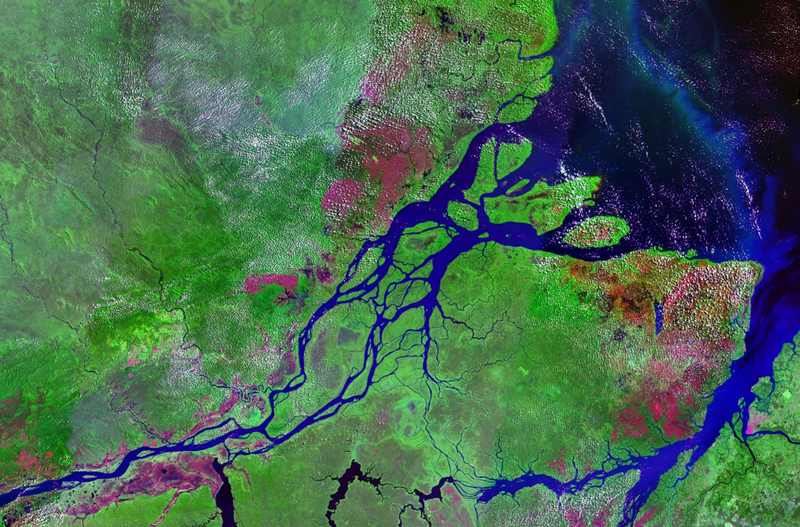
File:Mouths_of_amazon_geocover_1990.png · Wikimedia Commons · See Wikimedia Commons
Marajó
Sign in to saveAlso known as Marajo, Ilha do Marajó
Marajó ( ; ) is a large coastal island in Pará, Brazil. It is the main and largest of the islands in the Marajó Archipelago. Marajó Island is separated from the mainland by Marajó Bay, Pará River, smaller rivers (especially Macacos and Tajapuru), Companhia River, Jacaré Grande River, Vieira Grande Bay and the Atlantic Ocean.
Marajó is a large coastal island in Pará, Brazil, and the biggest island in the Marajó Archipelago. It is geographically significant as a major landmass separated from the Brazilian mainland by Marajó Bay, several rivers, and the Atlantic Ocean.
AI-generated from the Wikipedia summary — may contain errors.
Key facts
- Islands.name
- Marajó
- Islands.image_name
- Mouths of amazon geocover 1990.png
- Islands.image_caption
- Satellite view of Marajó Island
- Islands.map
- Brazil
- Islands.image_map
- File:Marajo_br.jpg
- Islands.image_map_caption
- Location of Marajó in the Amazon Delta
- Islands.map_relief
- yes
- Islands.location
- Pará, Brazil
- Islands.archipelago
- Marajó Archipelago
- Islands.area_km2
- 40100 <!--
- Islands.area
- -->
- Islands.rank
- 35th
- Islands.length_km
- 297 <!--
- Islands.length
- -->
- Islands.width_km
- 204 <!--
- Islands.width
- -->
- Islands.highest_mount
- Breves (city)
- Islands.elevation_m
- 40 <!--
via Wikipedia infobox
Wikidata facts
- Instance of
- island
- Country
- Brazil
- Located in
- Pará
- Continent
- South America
- Population
- 419744
- Area
- 40100
- Elevation
- 19
- Time zone
- UTC−03:00
- Body of water
- Amazon
- Image
- Marajó Island, Brazil (48569220542).jpg
- Width
- 204
- Length
- 297
Show 4 more facts
- native label
- Marajó
- Commons category
- Ilha de Marajó
- on focus list of Wikimedia project
- Wikipedia:Vital articles/Level/4
- P12749
- Joe Lieberman
Sources (2)
via Wikidata · CC0
~7 min read
Encyclopedic overview
7 sectionsContents
- Geography
- Ecology
- Municipalities
- History
- See also
- References
- External links
Marajó ( ; ) is a large coastal island in Pará, Brazil. It is the main and largest of the islands in the Marajó Archipelago. Marajó Island is separated from the mainland by Marajó Bay, Pará River, smaller rivers (especially Macacos and Tajapuru), Companhia River, Jacaré Grande River, Vieira Grande Bay and the Atlantic Ocean.
From approximately 400 BC to 1600 AD, Marajó was the site of an advanced pre-Cabraline society called the Marajoara culture, which may have numbered more than 100,000 people at its peak. Today, the island is known for its large water buffalo population, as well as the pororoca tidal bore periodically exhibited by high tides overcoming the usual complex hydrodynamic interactions in the surrounding rivers. It is the second-largest island in South America, and the 35th largest island in the world.
Excerpted from Wikipedia’s “Marajó” article, available under the CC BY-SA 4.0 licence.
Gallery (10)
On the map
3 mapped locations
Available in 65 languages
- Español
- Français
- Deutsch
- 中文
- 日本語
- Русский
- Português
- Italiano
- العربية
- Afrikaans
- Asturian
- Azerbaijani
- Bahasa Indonesia
- Bashkir
- Basque
- Belarusian
- Bulgarian
- Catalan
Show 46 more
- Cebuano
- Central Kurdish
- Croatian
- Czech
- Danish
- Egyptian Arabic
- Esperanto
- Estonian
- Fiji Hindi
- Finnish
- Galician
- Georgian
- Greek
- Hebrew
- Hungarian
- Ido
- Kazakh
- Latin
- Latvian
- Lithuanian
- Malagasy
- Malayalam
- Nederlands
- Norwegian
- Norwegian Nynorsk
- Ossetic
- Polski
- Romanian
- Scottish Gaelic
- Serbian
- Serbian (Latin)
- simple
- Slovak
- Slovenian
- Svenska
- Swahili
- Tiếng Việt
- Türkçe
- Ukrainian
- Waray
- Welsh
- Wu Chinese
- zh_yue
- فارسی
- ไทย
- 한국어
via Wikidata sitelinks · CC0