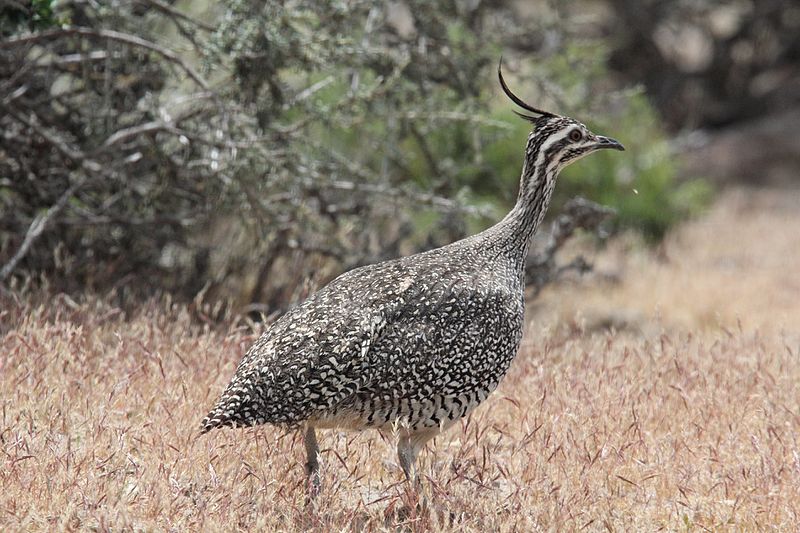
File:Elegant_Crested_Tinamou_(Eudromia_elegans)_(15953728501).jpg · Wikimedia Commons · See Wikimedia Commons
Tinamidae
Sign in to saveAlso known as the tinamou family, tinamou, tinamus, tinamiformes
Tinamous () are members of the order Tinamiformes (), and family Tinamidae (), divided into two distinct subfamilies, containing 46 species found in Mexico, Central America, and South America. The word "tinamou" comes from the Galibi term for these birds, tinamu. Tinamous are the only living group of palaeognaths able to fly, and were traditionally regarded as the sister group of the flightless ratites, but recent work places them well within the ratite radiation as most closely related to the extinct moa of New Zealand, implying flightlessness emerged among ratites multiple times. Tinamous fi
OverviewAI-generated
Tinamidae is a family of birds within the class Aves and phylum Chordata. It belongs to the order Tinamiformes and was described by Gray in 1840. The taxon is recognized as accepted under the International Code of Zoological Nomenclature.
The family has been recorded in Argentina, Brazil, Peru, Panama, and Mexico. Specimens are held by institutions including MSU, CLO, USNM, UNICAMP, and MVZ. Records indicate an occurrence count of 841,600 and a record count of 36.
The group originated approximately 10 million years ago. It is featured in the Brockhaus and Efron Encyclopedic Dictionary and the Encyclopædia Britannica 11th edition. The topic is listed as a Vital article on Wikipedia.
Synthesized by Vinony from 36 facts across 6 sources: Wikidata, GBIF, Gbif Occ, iDigBio, WoRMS, Vinony graph. Generated from structured data (not the Wikipedia text) and checked against those facts — may still contain errors.
Species
Tinamidae
FAMILY
- KingdomAnimalia
- PhylumChordata
- ClassAves
- OrderTinamiformes
- FamilyTinamidae
取自“https://zh.wikipedia.org/w/index.php?title=䳍形目&oldid=50824370” 分类:鸟类䳍形目古颚总目隐藏分类:使用Unicode扩展汉字的条目本地相关图片与维基数据不同全部小作品鳥類小作品
via GBIF
Museum specimens
- Specimen records
- 36
- With media
- 16
- Family
- Tinamidae
- Collections
- MSU, CLO, USNM, UNICAMP, MVZ, CMN
- Recorded in
- Argentina, Brazil, Peru, Panama, Mexico, United States, Locality Unknown, Mexique
Wikidata facts
- Instance of
- taxon
- Parent taxon
- Tinamiformes
- Image
- Stavenn Eudromia elegans 00.jpg
Show 11 more facts
- Commons gallery
- Tinamidae
- taxon rank
- family
- taxon name
- Tinamidae
- Commons category
- Tinamidae
- Code of nomenclature
- International Code of Zoological Nomenclature
- topic's main category
- Category:Tinamidae
- start time
- 10000000-0
- taxon range
- Brazil
- taxon common name
- tinamufamilien
- described by source
- Encyclopædia Britannica 11th edition
- on focus list of Wikimedia project
- Wikipedia:Vital articles/Level/4
Sources (1)
via Wikidata · CC0
~46 min read
Encyclopedic overview
44 sectionsContents
- Taxonomy and systematics
- Fossil record
- Generic relationships
- Species in taxonomic order
- Description
- Plumage
- Voice
- Distribution and habitat
- Range
- Ecology
- Movements
- Behavior
- Flight
- Roosting
- Sociality
- Breeding
- Courtship
- Nesting
- Egg-laying
- Incubation
- Chicks
- Feeding
- Foods
- Feeding methods
- Drinking
- Health and mortality
- Hygiene
- Parasites
- Predators
- Relationship with humans
- Mythology
- Introduction and translocation
- Domestication and aviculture
- Pests
- Research
- Status and conservation
- Land clearance
- Hunting
- See also
- References
- Footnotes
- Sources cited
- Further reading
- External links
Tinamous () are members of the order Tinamiformes (), and family Tinamidae (), divided into two distinct subfamilies, containing 46 species found in Mexico, Central America, and South America. The word "tinamou" comes from the Galibi term for these birds, tinamu. Tinamous are the only living group of palaeognaths able to fly, and were traditionally regarded as the sister group of the flightless ratites, but recent work places them well within the ratite radiation as most closely related to the extinct moa of New Zealand, implying flightlessness emerged among ratites multiple times. Tinamous first appear in the fossil record in the Miocene epoch. They are generally sedentary, ground-dwelling and, though not flightless, when possible avoid flight in favour of hiding or running away from danger. They are found in a variety of habitats, ranging from semi-arid alpine grasslands to tropical rainforests. The two subfamilies are broadly divided by habitat, with the Nothurinae referred to as steppe or open country tinamous, and the Tinaminae known as forest tinamous.
Although some species are quite common, tinamous are shy and secretive birds. They are active during the day, retiring to roosts at night. They generally have cryptic plumage, with males and females similar in appearance, though the females are usually larger. They are opportunistic and omnivorous feeders, consuming a wide variety of plant and animal food from fruits and seeds to worms, insects and small vertebrates. They will dust-bathe as well as wash themselves by standing in heavy rain. They are heard more often than seen, communicating with each other by a variety of frequently given, characteristic calls, especially during the breeding season.
Excerpted from Wikipedia’s “Tinamidae” article, available under the CC BY-SA 4.0 licence.
Gallery (54)
Available in 64 languages
- Español
- Français
- Deutsch
- 中文
- 日本語
- Русский
- Português
- Italiano
- العربية
- Asturian
- Azerbaijani
- Bahasa Indonesia
- Basque
- Breton
- Bulgarian
- Burmese
- Catalan
- Cebuano
Show 45 more
- Croatian
- Czech
- Danish
- Egyptian Arabic
- Esperanto
- Estonian
- Finnish
- Galician
- Georgian
- Hebrew
- Hungarian
- Icelandic
- Kannada
- Kotava
- Latin
- Lingua Franca Nova
- Lithuanian
- Malayalam
- Navajo
- Nederlands
- Northern Frisian
- Norwegian
- Norwegian Nynorsk
- Polski
- Quechua
- Romanian
- Scots
- Serbian
- Serbian (Latin)
- simple
- Slovak
- Slovenian
- Svenska
- Tamil
- Tiếng Việt
- Türkçe
- Ukrainian
- Waray
- Welsh
- Western Mari
- Wu Chinese
- Zeelandic
- zh_yue
- فارسی
- 한국어
via Wikidata sitelinks · CC0