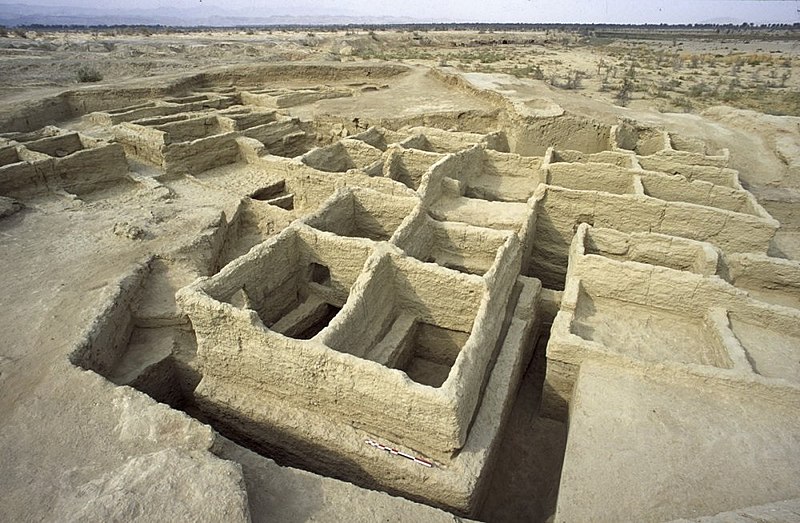
File:Mehrgarh_ruins.jpg · Wikimedia Commons · See Wikimedia Commons
Mehrgarh
Sign in to saveAlso known as Mehrgahr, Merhgarh, Merhgahr
Mehrgarh is a Neolithic archaeological site situated on the Kacchi Plain of Balochistan in Pakistan. It is located near the Bolan Pass, to the west of the Indus River and between the modern-day Pakistani cities of Quetta, Kalat and Sibi. The site was discovered in 1974 by the French Archaeological Mission in the Indus Basin led by the French archaeologists Jean-François Jarrige and Catherine Jarrige. Mehrgarh was excavated continuously between 1974 and 1986, and again from 1997 to 2000. Archaeological material has been found in six mounds, and about 32,000 artifacts have been collected from th
Mehrgarh is an ancient archaeological site in Pakistan that dates to the Neolithic period and was discovered in 1974 by French archaeologists. The site, which has yielded around 32,000 artifacts across six mounds, provides important evidence of early human settlement and development in the region of the Indus Valley.
AI-generated from the Wikipedia summary — may contain errors.
Key facts
- Ancient site.name
- Mehrgarh
- Ancient site.archaeologists
- Jean-François Jarrige Catherine Jarrige
- Ancient site.excavations
- 1974–1986, 1997–2000
- Ancient site.epochs
- Neolithic
- Ancient site.native_name_lang
- ur
- Ancient site.alternate_name
- Mehrgahr, Merhgarh, Merhgahr
- Ancient site.location
- Balochistan, Pakistan
- Ancient site.region
- South Asia
- Ancient site.image
- Mehrgarh ruins.jpg
- Ancient site.map_type
- Pakistan Balochistan#Pakistan#South Asia
- Ancient site.relief
- yes
- Ancient site.caption
- Ruins of houses at Mehrgarh, Balochistan
- Ancient site.map_caption
- Location within the Pakistani province of Balochistan##Location within Pakistan
- Ancient site.map dot label
- Mehrgahr
- Ancient site.discovered
- 1974
- Ancient site.type
- Settlement
via Wikipedia infobox
Wikidata facts
- Instance of
- archaeological site
- Country
- Pakistan
- Located in
- Dhadar
- Image
- Mehrgarh ruins.jpg
Show 7 more facts
- inception
- 7000-01-01
- dissolved, abolished or demolished date
- 2600-01-01
- Commons category
- Mehrgarh
- heritage designation
- Tentative World Heritage Site
- time period
- Bronze Age
- director of archaeological fieldwork
- Jean-François Jarrige
- culture
- Neolithic
Sources (3)
via Wikidata · CC0
~15 min read
Encyclopedic overview
28 sectionsContents
- History
- Periods of occupation
- Mehrgarh Period I (5250-4650 BCE)
- Mehrgarh Period II (4650–4000 BCE) and Period III (4000–3500 BCE)
- Togau phase
- Mehrgarh Periods IV, V and VI (3500–3000 BCE)
- Mehrgarh Period VII (2600–2000 BCE)
- Mehrgarh Period VIII
- Lifestyle and technology
- Artifacts
- Human figurines
- Pottery
- Burials
- Metallurgy
- See also
- Notes
- References
- Sources
- Further reading
- Mehrgarh
- Indus Valley Civilization
- South Asia
- South Asia paleoanthropology
- Central Asia
- Global history
- India
- Indo-Aryans
- External links
Mehrgarh is a Neolithic archaeological site situated on the Kacchi Plain of Balochistan in Pakistan. It is located near the Bolan Pass, to the west of the Indus River and between the modern-day Pakistani cities of Quetta, Kalat and Sibi. The site was discovered in 1974 by the French Archaeological Mission in the Indus Basin led by the French archaeologists Jean-François Jarrige and Catherine Jarrige. Mehrgarh was excavated continuously between 1974 and 1986, and again from 1997 to 2000. Archaeological material has been found in six mounds, and about 32,000 artifacts have been collected from the site. The earliest settlement at Mehrgarh, located in the northeast corner of the site, was a small farming village dated from 7000 BCE or 5250 BCE (see below).
==History==
Excerpted from Wikipedia’s “Mehrgarh” article, available under the CC BY-SA 4.0 licence.
Gallery (12)
On the map
3 mapped locations