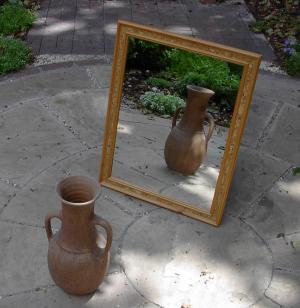
File:Mirror.jpg · Wikimedia Commons · See Wikimedia Commons
mirror
Sign in to saveAlso known as looking glass
thumb|A mirror reflecting the image of a vase thumb|A first-surface mirror coated with aluminium and enhanced with [[dielectric coatings. The angle of the incident light (represented by both the light in the mirror and the shadow behind it) exactly matches the angle of reflection (the reflected light shining on the table).]] thumb|-tall acoustic mirror near Kilnsea Grange, East Yorkshire, UK, from [[World War I. The mirror magnified the sound of approaching enemy Zeppelins for a microphone placed at the focal point. Sound waves are much longer than light waves, thus the object produces di
A mirror is a reflective surface that bounces light back to create an image, with the angle at which light hits the mirror matching the angle at which it reflects away. Mirrors matter because they're useful tools in everyday life—from personal grooming to scientific applications—and the principle of reflection they demonstrate is fundamental to how light behaves.
AI-generated from the Wikipedia summary — may contain errors.
Wikidata facts
- Part of
- optical instrument
- Has part
- glass
- Image
- Mirror-vase.jpg
- Has use
- mirror image
Show 9 more facts
- described by source
- Encyclopædia Britannica 11th edition
- Commons category
- Mirrors
- topic's main category
- Category:Mirrors
- Commons gallery
- Mirror
- exact match
- wordnet-rdf.princeton.edu/wn31/103732475-n
- Unicode character
- 🪞
- different from
- Mirror
- on focus list of Wikimedia project
- Wikipedia:Vital articles/Level/4
- P8168
- crest factor
Sources (2)
via Wikidata · CC0
~71 min read
Encyclopedic overview
58 sectionsContents
- History
- Prehistory
- Bronze Age to Early Middle Ages
- Middle Ages and Renaissance
- Industrial Revolution
- Contemporary technologies
- Burning mirrors
- Types of mirrors
- By shape
- By structural material
- Back-silvered mirrors
- Front-silvered mirrors
- Flexible mirrors
- By reflective material
- Nonlinear optical mirrors
- Physical principles
- Mirror images
- Optical properties
- Reflectivity
- Surface quality
- Surface roughness
- Transmissivity
- Wedge
- Surface defects
- Manufacturing
- Coating
- Silvering
- Dielectric coating
- Shaping and polishing
- Tolerances
- Applications
- Personal grooming
- Safety and easier viewing
- One-way mirrors and windows
- Signalling
- Technology
- Televisions and projectors
- Optical discs
- Solar power
- Instruments
- Face-to-face mirrors
- Military applications
- Seasonal lighting
- Architecture
- Fine art
- Paintings
- Sculpture
- Other artistic mediums
- Religious function of the real and depicted mirror
- Decoration
- Entertainment
- Film and television
- Literature
- <span id="Mirrors and animals"></span> Mirror test
- See also
- References
- Further reading
- External links
thumb|A mirror reflecting the image of a vase thumb|A first-surface mirror coated with aluminium and enhanced with [[dielectric coatings. The angle of the incident light (represented by both the light in the mirror and the shadow behind it) exactly matches the angle of reflection (the reflected light shining on the table).]] thumb|-tall acoustic mirror near Kilnsea Grange, East Yorkshire, UK, from [[World War I. The mirror magnified the sound of approaching enemy Zeppelins for a microphone placed at the focal point. Sound waves are much longer than light waves, thus the object produces diffuse reflections in the visual spectrum.]]
A mirror, also known as a looking glass, is an object that reflects an image. Light that bounces off a mirror forms an image of whatever is in front of it, which is then focused through the lens of the eye or a camera. Mirrors reverse the direction of light at an angle equal to its incidence. This allows the viewer to see themselves or objects behind them, or even objects that are at an angle from them but out of their field of view, such as around a corner. Natural mirrors have existed since prehistoric times, such as the surface of water, but people have been manufacturing mirrors out of a variety of materials for thousands of years, like stone, metals, and glass. In modern mirrors, metals like silver or aluminium are often used due to their high reflectivity, applied as a thin coating on glass because of its naturally smooth and very hard surface.
Excerpted from Wikipedia’s “mirror” article, available under the CC BY-SA 4.0 licence.
Gallery (52)
Available in 136 languages
- Español
- Français
- Deutsch
- 中文
- 日本語
- Русский
- Português
- Italiano
- العربية
- हिन्दी
- Afrikaans
- Akan
- Albanian
- Aragonese
- Aramaic
- Armenian
- Asturian
- azb
Show 117 more
- Azerbaijani
- Bahasa Indonesia
- Balinese
- Bangla
- Banjar
- Basque
- bat_smg
- be_x_old
- Belarusian
- Betawi
- Bikol
- Bosnian
- Breton
- Bulgarian
- Burmese
- Catalan
- cdo
- Central Kurdish
- Chechen
- Chuvash
- Croatian
- Czech
- dag
- Danish
- Egyptian Arabic
- Erzya
- Esperanto
- Estonian
- Fijian
- Filipino
- Finnish
- fiu_vro
- Galician
- Georgian
- Greek
- Guarani
- Haitian Creole
- Hebrew
- Hungarian
- hyw
- Ido
- Iloko
- Irish
- Javanese
- Kabyle
- Kannada
- Kashmiri
- Kazakh
- Kikuyu
- Kurdish
- Latin
- Latvian
- Limburgish
- Lithuanian
- Lombard
- Macedonian
- Malay
- Malayalam
- Marathi
- Mirandese
- nah
- nds_nl
- Nederlands
- Nepali
- Newari
- Northern Frisian
- Norwegian
- Norwegian Nynorsk
- nrm
- Occitan
- Oromo
- Pashto
- Pennsylvania German
- Polski
- Punjabi
- Quechua
- Romanian
- rsk
- Rusyn
- Santali
- Serbian
- Serbian (Latin)
- Shona
- Sicilian
- simple
- Sindhi
- Sinhala
- Slovak
- Slovenian
- Sundanese
- Svenska
- Tajik
- Tamil
- Telugu
- Tiếng Việt
- Toki Pona
- Tongan
- Tulu
- Türkçe
- Ukrainian
- Urdu
- Uzbek
- Veps
- Waray
- Wayuu
- Welsh
- Western Panjabi
- Wu Chinese
- Yakut
- Yiddish
- Yoruba
- zh_min_nan
- zh_yue
- Zulu
- فارسی
- ไทย
- 한국어
via Wikidata sitelinks · CC0