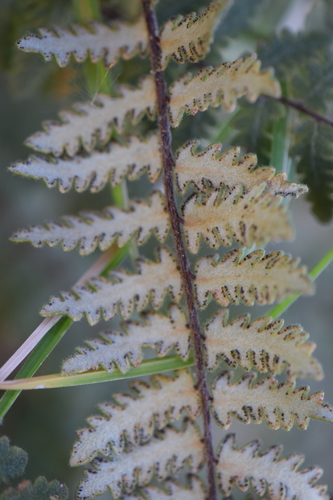
(c) R.E.Llanos, some rights reserved (CC BY-NC-SA), uploaded by R.E.Llanos · cc-by-nc-sa
Myriopteris
Sign in to saveMyriopteris, commonly known as the lip ferns, is a genus of cheilanthoid ferns. Like other cheilanthoids, they are ferns of dry habitats, reproducing both sexually and apogamously. Many species have leaves divided into a large number of small, bead-like segments, the probable inspiration for the generic name. Hairs and/or scales are often present on both the upper and lower surfaces of the leaf, and their presence and appearance are useful in distinguishing between species. The genus is most diverse in Mexico, but species are found from southwestern Canada south to southern Chile, and one spec
Species
golden lipfern
GENUS
- KingdomPlantae
- PhylumTracheophyta
- ClassPolypodiopsida
- OrderPolypodiales
- FamilyPteridaceae
via GBIF
Museum specimens
- Specimen records
- 259
- With media
- 219
- Family
- Pteridaceae
- Collections
- NY, US, SD
- Recorded in
- United States, Mexico
Wikidata facts
- Instance of
- taxon
- Parent taxon
- Cheilanthoideae
- Image
- Cheilanthes wootonii (beaded lip fern) (6744464787).jpg
Show 5 more facts
- taxon name
- Myriopteris
- taxon rank
- genus
- topic's main category
- Category:Myriopteris
- Commons category
- Myriopteris
Sources (1)
via Wikidata · CC0
~8 min read
Encyclopedic overview
7 sectionsContents
- Description
- Taxonomy
- Species
- Distribution and habitat
- Notes and references
- References
- Works cited
Myriopteris, commonly known as the lip ferns, is a genus of cheilanthoid ferns. Like other cheilanthoids, they are ferns of dry habitats, reproducing both sexually and apogamously. Many species have leaves divided into a large number of small, bead-like segments, the probable inspiration for the generic name. Hairs and/or scales are often present on both the upper and lower surfaces of the leaf, and their presence and appearance are useful in distinguishing between species. The genus is most diverse in Mexico, but species are found from southwestern Canada south to southern Chile, and one species is endemic to southern Africa.
==Description== No single morphological character divides Myriopteris, as presently circumscribed, from the other cheilanthoids. Convergent evolution in arid environments is thought to be responsible for widespread homoplasy in the morphological characters traditionally used to classify this group. While small, bead-like ultimate segments are associated with the genus, they only appear in about 40% of its species, and appear in some cheilanthoids outside the genus as well. Cheilanthes sensu stricto bears 32 spores per sporangium in sexual species and 16 in apogamous species; with the exception of a few species of Notholaena, Myriopteris and the other cheilanthoids bear 64 spores per sporangium when sexual and 32 per sporangium when apomictic. Myriopteris can also be separated from Cheilanthes s.s., although less reliably, by spores bearing crests or wrinkles (rather than spines or bumps) and a lack of enlarged vein endings (rather than prominent hydathodes).
Excerpted from Wikipedia’s “Myriopteris” article, available under the CC BY-SA 4.0 licence.