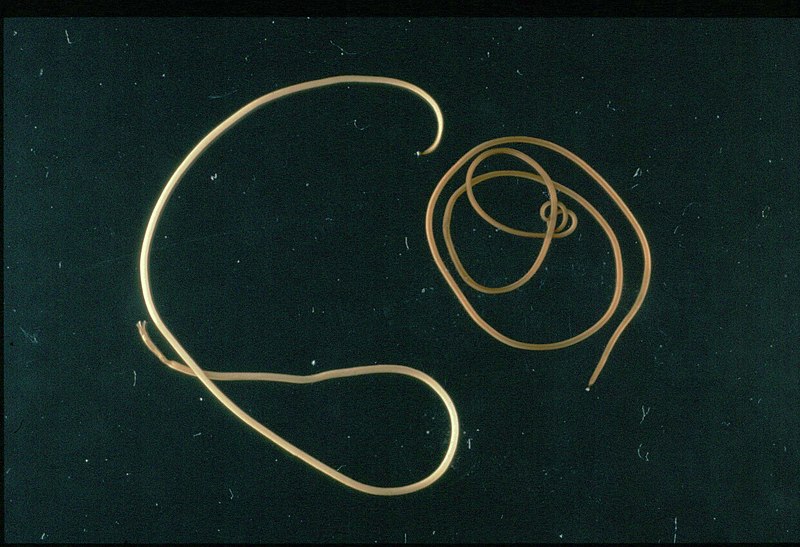
File:Paragordius_tricuspidatus.jpeg · Wikimedia Commons · See Wikimedia Commons
Nematomorpha
Sign in to saveAlso known as horsehair worms, gordian worms, Gordian worm
Nematomorpha (sometimes called Gordiacea, and commonly known as horsehair worms, hairsnakes, or Gordian worms) are a phylum of parasitoid animals similar to yet distinct from nematode worms in morphology, hence the name. Most species range in size from , reaching in extreme cases, and in diameter. Horsehair worms can be discovered in damp areas, such as watering troughs, swimming pools, streams, puddles, and cisterns. The adult worms are free-living, but the larvae are parasitic on arthropods, such as beetles, cockroaches, mantises, orthopterans, and crustaceans. About 351 freshwater species a
OverviewAI-generated
Nematomorpha is a phylum within the kingdom Animalia, commonly referred to as Gordian worms. The taxon was described by Vejdovský in 1886 and holds an accepted status in biological classification. These organisms inhabit both marine and freshwater environments.
Records of Nematomorpha are held by several institutions, including USNM, AUM, CAS, UAM, and YPM. Specimens have been documented in countries such as French Polynesia, the United States, and India. A total of 11,910 occurrences have been recorded, alongside 363 specific records and two media items.
Synthesized by Vinony from 20 facts across 6 sources: Wikidata, GBIF, Gbif Occ, WoRMS, iDigBio, Vinony graph. Generated from structured data (not the Wikipedia text) and checked against those facts — may still contain errors.
Species
Gordian worms
Nematomorpha
PHYLUM
- KingdomAnimalia
- PhylumNematomorpha
线形虫动物门(學名:Nematomorpha),俗稱鐵線蟲、馬毛蟲、馬鬃蟲或髮形蟲,是原口动物中一个拟寄生物的门,具有假体腔,但成虫没有排泄器官,消化道退化。线形虫动物门大约有250种。這些物種在形態上跟线虫动物门非常相似,因而得名。常作为动物学的实验材料。
via GBIF
Museum specimens
- Specimen records
- 363
- With media
- 2
- Collections
- USNM, AUM, CAS, UAM, YPM
- Recorded in
- French Polynesia, United States, India
Wikidata facts
- Instance of
- taxon
- Subclass of
- invertebrate
- Parent taxon
- Ecdysozoa
- Image
- Paragordius tricuspidatus.jpeg
Show 6 more facts
- described by source
- Encyclopædia Britannica 11th edition
- taxon name
- Nematomorpha
- taxon rank
- phylum
- Commons category
- Nematomorpha
- topic's main category
- Category:Nematomorpha
- taxon common name
- žive niti
Sources (2)
via Wikidata · CC0
~8 min read
Encyclopedic overview
9 sectionsContents
- Description and biology
- Life cycle and development
- Community ecology
- Taxonomy
- References
- Citations
- General and cited references
- Further reading
- External links
Nematomorpha (sometimes called Gordiacea, and commonly known as horsehair worms, hairsnakes, or Gordian worms) are a phylum of parasitoid animals similar to yet distinct from nematode worms in morphology, hence the name. Most species range in size from , reaching in extreme cases, and in diameter. Horsehair worms can be discovered in damp areas, such as watering troughs, swimming pools, streams, puddles, and cisterns. The adult worms are free-living, but the larvae are parasitic on arthropods, such as beetles, cockroaches, mantises, orthopterans, and crustaceans. About 351 freshwater species are known and a conservative estimate suggests that there may be about 2000 freshwater species worldwide. The name "Gordian" stems from the legendary Gordian knot. This relates to the fact that nematomorphs often coil themselves in tight balls that resemble knots.
==Description and biology== Nematomorphs possess an external cuticle without cilia. Internally, they have only longitudinal muscle and a non-functional gut, with no excretory, respiratory or circulatory systems. The nervous system consists of a nerve ring near the anterior end of the animal and a ventral nerve cord running along the body.
Excerpted from Wikipedia’s “Nematomorpha” article, available under the CC BY-SA 4.0 licence.
Gallery (8)
Available in 59 languages
- Español
- Français
- Deutsch
- 中文
- 日本語
- Русский
- Português
- Italiano
- العربية
- हिन्दी
- Azerbaijani
- Bahasa Indonesia
- Basque
- Belarusian
- Bosnian
- Bulgarian
- Catalan
- Cebuano
Show 40 more
- Czech
- Danish
- Egyptian Arabic
- Esperanto
- Estonian
- Finnish
- Galician
- Georgian
- Hebrew
- Hungarian
- Kannada
- Kashmiri
- Kazakh
- Kyrgyz
- Latvian
- Malay
- Navajo
- Nederlands
- Northern Frisian
- Norwegian
- Norwegian Nynorsk
- Occitan
- Polski
- Scots
- Serbian
- simple
- Slovak
- Svenska
- Swahili
- tay
- Tiếng Việt
- Türkçe
- Ukrainian
- Waray
- Western Panjabi
- Wu Chinese
- zh_yue
- فارسی
- ไทย
- 한국어
via Wikidata sitelinks · CC0