Encyclopedia of Life · EOL (see source)
Nyctibatrachus
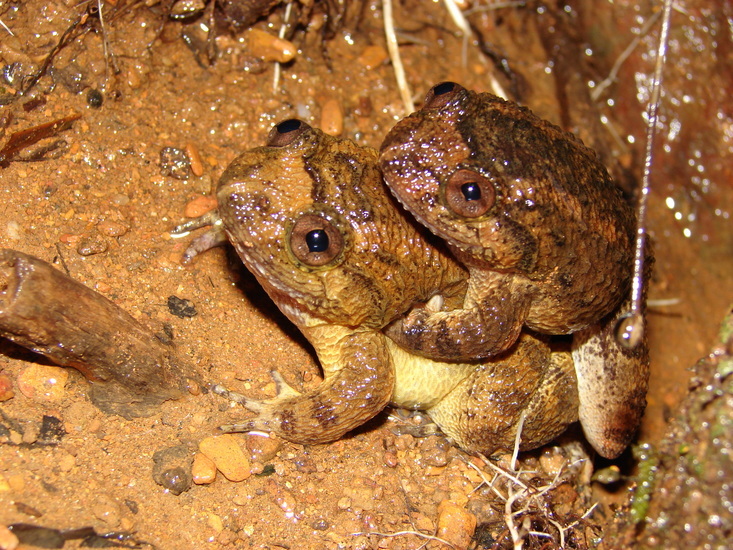
Sign in to saveNyctibatrachus is a genus of frogs endemic to the Western Ghats of southwestern India. Their common name is night frogs. Their scientific name also means "night frog", in reference to their habits and dark color. They are the only extant members of the monotypic subfamily Nyctibatrachinae. Currently, 35 species belong to Nyctibatrachus.
Species
GENUS
- KingdomAnimalia
- PhylumChordata
- ClassAmphibia
- OrderAnura
- FamilyNyctibatrachidae
Южноиндийские лягушки (лат. Nyctibatrachus) — род лягушек из семейства Nyctibatrachidae. Эндемик горной цепи Западные Гаты (штат Махараштра, Индия). Его научное название означает «ночная лягушка», в связи с их привычками и темным окрасом. Плотно сложенные лягушки, размеры которых варьируют от маленьких (длина тела менее 13 мм у Nyctibatrachus robinmoorei) до относительно крупных (до 84 мм Nyctibatrachus karnatakaensis). У них есть скрытая барабанная перепонка, продольные складки кожи на спине, бедренные железы и расширенные диски на пальцах передних и задних конечностей. Они встречаются вблизи ручьев в холмистых вечнозеленых лесах и ведут ночной образ жизни. У большинства видов есть амплексус, а у Nyctibatrachus humayuni — нет; у этого вида самец становится над икринками и оплодотворяет их после того, как самка их отложит.
via GBIF
Museum specimens
- Specimen records
- 20
- Family
- Nyctibatrachidae
- Collections
- CUMV, CM, USNM, FMNH, MNHN
- Recorded in
- India, Indonesia, Philippines
Wikidata facts
- Instance of
- taxon
- Parent taxon
- Nyctibatrachidae
- Image
- Nyctibatrachus spp.jpg
Show 4 more facts
- Commons category
- Nyctibatrachus
- topic's main category
- Category:Nyctibatrachus
- taxon name
- Nyctibatrachus
- taxon rank
- genus
Sources (1)
via Wikidata · CC0
~1 min read
Encyclopedic overview
3 sectionsContents
- Description
- Species
- References
Nyctibatrachus is a genus of frogs endemic to the Western Ghats of southwestern India. Their common name is night frogs. Their scientific name also means "night frog", in reference to their habits and dark color. They are the only extant members of the monotypic subfamily Nyctibatrachinae. Currently, 35 species belong to Nyctibatrachus.
==Description== Members of the genus Nyctibatrachus are robust-bodied frogs that range in size from small (snout–vent length <13 mm in Nyctibatrachus robinmoorei) to relatively large (up to 84 mm Nyctibatrachus karnatakaensis). The especially small species are among the smallest of all Indian frogs. They have a concealed tympanum, dorsum with longitudinal skin folds, femoral glands, and expanded finger and toes disks. They occur near streams in hilly evergreen forests and are nocturnal. Most species have amplexus but Nyctibatrachus humayuni does not; in this species the male moves over the eggs after the female has deposited them.
Excerpted from Wikipedia’s “Nyctibatrachus” article, available under the CC BY-SA 4.0 licence.