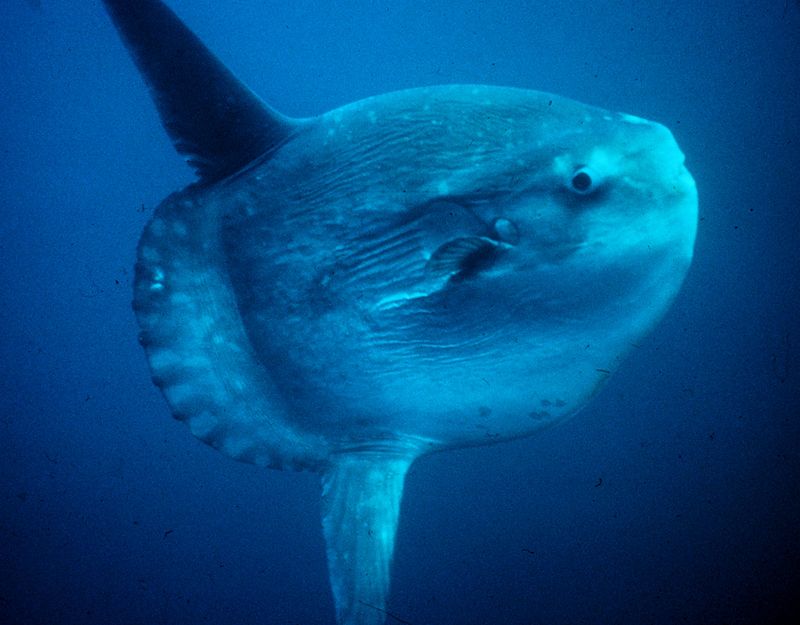
File:Mola_mola.jpg · Wikimedia Commons · See Wikimedia Commons
OverviewAI-generated
The ocean sunfish, scientifically named *Mola mola*, is a species within the family Molidae. It belongs to the order Tetraodontiformes, class Teleostei, and phylum Chordata. The taxon is also referred to by common names such as Sunfish, Mola, Peixe Lua, and Pez Cabeza. Its scientific authority is listed as Linnaeus, 1758, and the taxon name is accepted.
This marine organism is classified as Vulnerable according to the IUCN Red List, a status assigned in 2015. The species has a sequenced genome available through Ensembl.
Synthesized by Vinony from 22 facts across 4 sources: Wikidata, WoRMS, IUCN Red List, Vinony graph. Generated from structured data (not the Wikipedia text) and checked against those facts — may still contain errors.
Species
VulnerableCommon sunfish
Species
- PhylumChordata
- ClassTeleostei
- OrderTetraodontiformes
- FamilyMolidae
Observations: Very little is known about the longevity of sunfishes, though given their their large body size and reproductive output it is possibly they are long-lived. They can lay 300,000,000 eggs. Anecdotes suggest they can live more than 10 years in captivity, but possibly much longer (http://www.oceansunfish.org/).
via IUCN
Wikidata facts
Show 8 more facts
- Commons category
- Mola mola
- taxon rank
- species
- IUCN conservation status
- Vulnerable
- Commons gallery
- Mola mola
- taxon common name
- samogłów
- taxon name
- Mola mola
- sequenced genome URL
- www.ensembl.org/Mola_mola
- short name
- M. mola
via Wikidata · CC0
~19 min read
Encyclopedic overview
The ocean sunfish (Mola mola), also known as the common mola, is one of the largest bony fish in the world. It is the type species of the genus Mola, and one of five extant species in the family Molidae. It was formerly misidentified as the heaviest bony fish, which is actually a different and closely related species of sunfish, Mola alexandrini. Adults typically weigh between 247 and 1,000 kg (545 and 2,205 lb). It is native to tropical and temperate waters around the world. It resembles a fish head without a tail, and its main body is flattened laterally. Sunfish can be as tall as they are long (175-180 cm, or about 5’9-5’11) when their dorsal and ventral fins are extended.
Many areas of sunfish biology remain poorly understood, including mating practices and spawning locations, early life stages, movement and migration patterns, population structure and status, diet and trophic ecology, and post-release survival rates, and various research efforts are underway, including aerial surveys of populations, satellite surveillance using pop-off satellite tags, genetic analysis of tissue samples, and collection of amateur sighting data.
Excerpted from Wikipedia’s “ocean sunfish” article, available under the CC BY-SA 4.0 licence.
Gallery (11)
Available in 67 languages
- Español
- Français
- Deutsch
- 中文
- 日本語
- Русский
- Português
- Italiano
- العربية
- हिन्दी
- Afrikaans
- Asturian
- Azerbaijani
- Balinese
- Bangla
- Basque
- Bulgarian
- Catalan
Show 48 more
- Cebuano
- Corsican
- Croatian
- Czech
- Danish
- Egyptian Arabic
- Esperanto
- Estonian
- Finnish
- Galician
- Greek
- Hebrew
- Hungarian
- Icelandic
- Ido
- Irish
- Javanese
- Kazakh
- Latin
- Latvian
- Lithuanian
- Malagasy
- Malay
- Malayalam
- Marathi
- Navajo
- Nederlands
- Norwegian
- Norwegian Nynorsk
- Polski
- Romanian
- Serbian
- Serbian (Latin)
- simple
- Slovak
- Svenska
- szy
- Tamil
- Tiếng Việt
- Toki Pona
- Türkçe
- Ukrainian
- Waray
- Welsh
- zh_yue
- فارسی
- ไทย
- 한국어
via Wikidata sitelinks · CC0