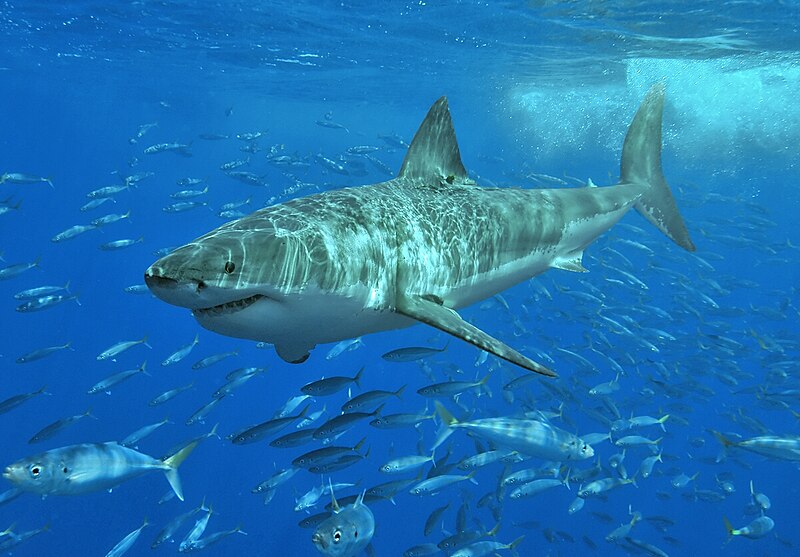
great white shark
Also known as Carcharodon carcharias, C. carcharias, white pointer, white shark, white death, great white
species of large lamniform shark
AI overview
The great white shark is a large species of shark belonging to the lamniform group. It is significant as one of the ocean's most notable predators and has captured widespread human attention and scientific interest.
AI-generated from the Wikipedia summary — may contain errors.
Species
Vulnerableanchovy-eater
Species
- PhylumChordata
- ClassElasmobranchii
- OrderLamniformes
- FamilyLamnidae
Habitatmarine, brackish
Dieser Artikel befasst sich mit dem Raubfisch. Zu anderen Bedeutungen siehe Der weiße Hai (Begriffsklärung). Der Weiße Hai (Carcharodon carcharias), seltener auch als Weißhai oder Menschenhai bezeichnet, ist die einzige Art der Gattung Carcharodon aus der Familie der Makrelenhaie (Lamnidae). Der Trivialname bezieht sich auf die auffällig helle Bauchfärbung der Tiere. Die Art kommt fast weltweit vor und besiedelt bevorzugt gemäßigte Küstengewässer. Als die größte Haiart, die sich nicht von Plankton ernährt, ist der Weiße Hai der größte Raubfisch; er kann auch Menschen gefährlich werden. Er ist im gesamten Verbreitungsgebiet selten; heute gilt er durch Beifang in der kommerziellen Fischerei sowie gezielte Bejagung zum Gewinn von Trophäen als im Bestand bedroht. Inhaltsverzeichnis 1 Merkmale 2 Schwimmweise und Physiologie 3 Vorkommen 4 Lebensweise 4.1 Sozialverhalten 4.2 Ernährung und Jagd 4.3 Fortpflanzung und Entwicklung 5 Systematik und Evolution 6 Weißer Hai und Mensch 6.1 Bedrohung und Schutz 6.2 Angriffe auf Menschen 6.3 Kulturelle Rezeption 6.4 Weiße Haie als Attraktion 7 Belege 7.1 Literatur 7.2 Einzelnachweise 8 Weblinks Merkmale Der Weiße Hai gehört mit einer durchschnittlic
via IUCN
Wikidata facts
Article
The great white shark (Carcharodon carcharias), also known as the white shark, white pointer, or great white, is a large shark. It is closely related to the mako sharks, the porbeagle, and the salmon shark. It is a robustly built species with a grayish upperside and a white underside. The white shark is one of the largest living shark and fish species, though it is still smaller than the whale shark and basking shark. It has about 300 triangular, serrated teeth that are continuously replaced. Its massive, fatty liver can reach over a quarter of its body weight, providing buoyancy and storing energy. The species is partially warm-blooded, an adaptation that allows it to remain active in colder waters.
White sharks inhabit tropical and temperate ocean waters around the world and can be found both near coasts and in the open ocean. Populations are most concentrated at the Pacific and Atlantic sides of North America and in the waters of southern Africa and Oceania. They are a highly migratory species, traveling between the coast and the open ocean and even between continents. The white shark preys on marine mammals such as seals and dolphins, as well as squid and fish, including other sharks. It also scavenges whale carcasses. Though normally an apex predator, the species is sometimes preyed on by orcas. White sharks are generally solitary, but may gather in aggregations, particularly at feeding sites. They may communicate and establish dominance hierarchies with body language. The species reproduces with pups hatching from eggs inside the female before being born live. Juvenile white sharks typically inhabit shallower water and are limited to feeding on smaller prey.