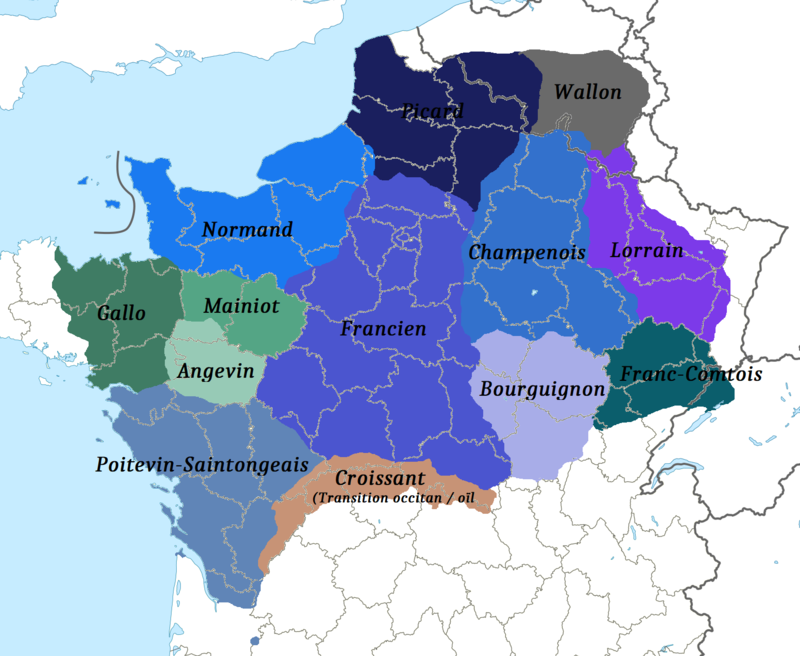
File:Langues_d'oïl_et_Croissant.png · Wikimedia Commons · See Wikimedia Commons
Also known as French languages, langue d'oïl, langues d'oïl, Oïl languages, Oïl language
dialect continuum that includes French and its closest relatives
"Oïl" refers to a group of closely related Romance language varieties, including French, that were historically spoken across northern France and neighboring regions. It matters because understanding these interconnected dialects helps explain how modern French developed and how languages evolve within a geographic area rather than existing as completely separate systems.
AI-generated from the Wikipedia summary — may contain errors.
Wikidata facts
- Instance of
- language family
- Has part
- Picard
- Country
- Belgium
Show 2 more facts
- topic's main category
- Category:Oïl languages
- Commons category
- Oïl languages
Sources (1)
via Wikidata · CC0
~20 min read
Encyclopedic overview
The langues d'oïl are a dialect continuum that includes standard French and its closest relatives historically spoken in the northern half of France, southern Belgium, and the Channel Islands. They belong to the larger category of Gallo-Romance languages, which also include the historical languages of east-central France and western Switzerland, southern France, portions of northern Italy, the Val d'Aran in Spain, and under certain acceptations those of Catalonia.
Linguists divide the Romance languages of France, and especially of Medieval France, into two main geographical subgroups: the langues d'oïl to the north, and the lengas d'òc in the southern half of France. Both groups are named after the word for yes in their recent ancestral languages. The most common modern langue d'oïl is standard French, in which the ancestral oïl has become oui.
Excerpted from Wikipedia’s “Oïl” article, available under the CC BY-SA 4.0 licence.