File:Orbit1.svg · Wikimedia Commons · See Wikimedia Commons
orbital inclination
Sign in to saveAlso known as inclination
angle between a reference plane and the plane of an orbit
Orbital inclination is the angle between a reference plane (like Earth's equator or the plane of the solar system) and the actual path an object takes as it orbits. It matters because it determines things like which parts of Earth a satellite can observe, how much fuel is needed to reach an orbit, and whether objects in space might collide with each other.
AI-generated from the Wikipedia summary — may contain errors.
Wikidata facts
- Part of
- Keplerian elements
Show 2 more facts
- has contributing factor
- latitude
- different from
- axial tilt
Sources (2)
via Wikidata · CC0
~8 min read
Encyclopedic overview
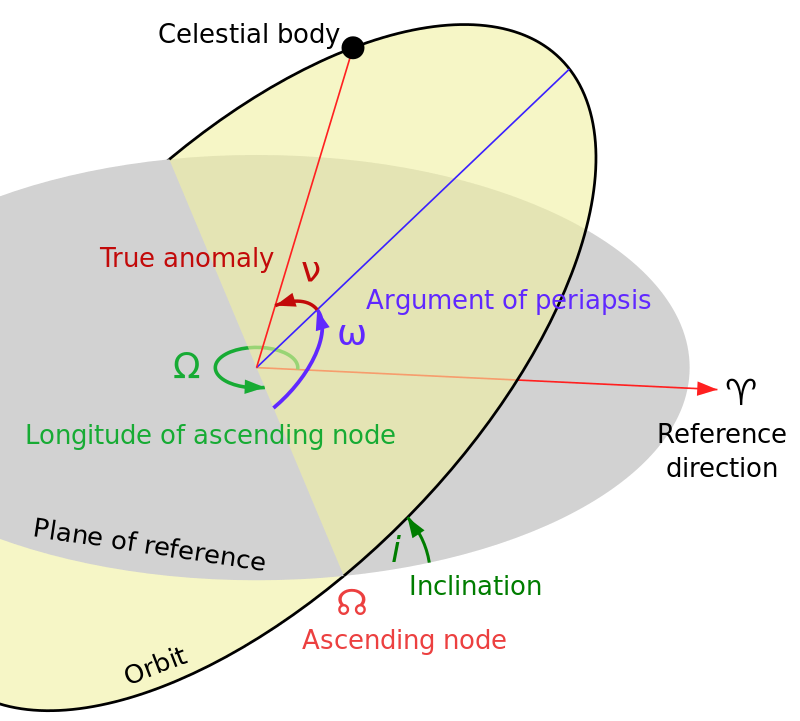
Fig. 1: Orbital inclination represented by i (dark green), along with other fundamental orbital parameters
Orbital inclination measures the tilt of an object's orbit around a celestial body. It is expressed as the angle between a reference plane and the orbital plane or axis of direction of the orbiting object.
Excerpted from Wikipedia’s “orbital inclination” article, available under the CC BY-SA 4.0 licence.
Gallery (3)
Available in 62 languages
- Español
- Français
- Deutsch
- 中文
- 日本語
- Русский
- Português
- Italiano
- العربية
- हिन्दी
- Afrikaans
- Albanian
- Aragonese
- Armenian
- Asturian
- Bahasa Indonesia
- Bangla
- Basque
Show 43 more
- Bulgarian
- Catalan
- Croatian
- Czech
- Danish
- Esperanto
- Estonian
- Finnish
- Galician
- Greek
- Hebrew
- Hungarian
- Javanese
- Latin
- Latvian
- Low German
- Macedonian
- Malay
- Manx
- Marathi
- Nederlands
- Norwegian
- Norwegian Nynorsk
- Polski
- Romanian
- Serbian
- Serbian (Latin)
- simple
- Slovak
- Slovenian
- Sundanese
- Svenska
- Swahili
- Telugu
- Tiếng Việt
- Türkçe
- Ukrainian
- Wu Chinese
- zh_min_nan
- zh_yue
- فارسی
- ไทย
- 한국어
via Wikidata sitelinks · CC0