Oreobambos · Kew POWO · Kew Plants of the World Online
Oreobambos
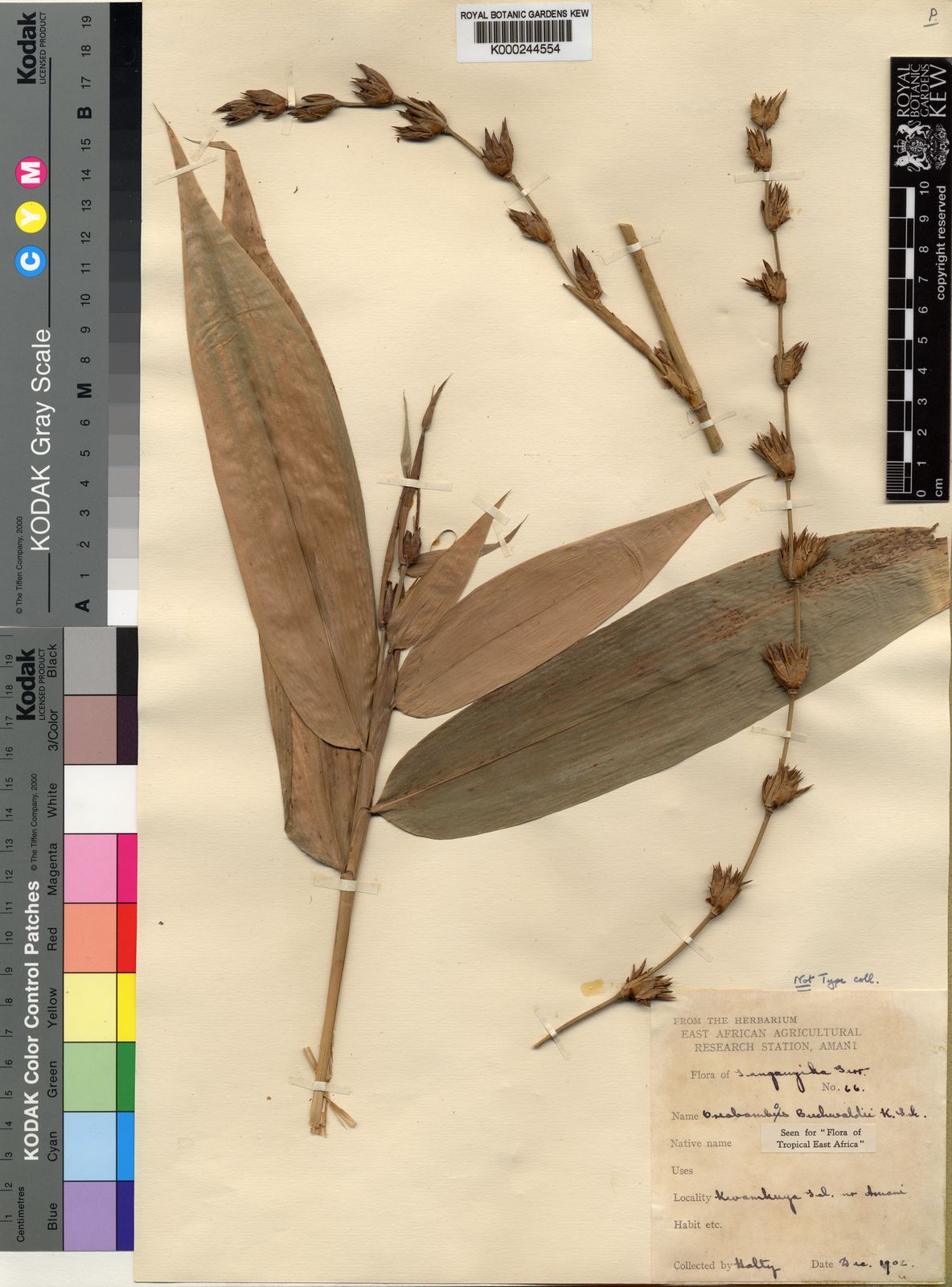
Sign in to saveOreobambos buchwaldii is the sole representative of Oreobambos, a monotypic African genus of bamboo, most closely related to the large genus Bambusa from tropical Asia and America. It is large and perennial with arching stems up to 20 m. high, growing in isolated clumps, in forest clearings and swamp forest, and along streams, at altitudes of 300–2000 m. It occurs along the tropical east of Africa in eastern DR Congo, Burundi, Kenya, Uganda, Tanzania, Mozambique, Malawi, Zimbabwe and Zambia. This is one of only a handful of indigenous African bamboos.
Species
GENUS
- KingdomPlantae
- PhylumTracheophyta
- ClassLiliopsida
- OrderPoales
- FamilyPoaceae
via GBIF · Kew POWO
Wikidata facts
Show 5 more facts
- topic's main category
- Category:Oreobambos
- taxon name
- Oreobambos
- taxon rank
- genus
- Commons category
- Oreobambos
Sources (1)
via Wikidata · CC0
~2 min read
Encyclopedic overview
2 sectionsContents
- References
- Gallery
Oreobambos buchwaldii is the sole representative of Oreobambos, a monotypic African genus of bamboo, most closely related to the large genus Bambusa from tropical Asia and America. It is large and perennial with arching stems up to 20 m. high, growing in isolated clumps, in forest clearings and swamp forest, and along streams, at altitudes of 300–2000 m. It occurs along the tropical east of Africa in eastern DR Congo, Burundi, Kenya, Uganda, Tanzania, Mozambique, Malawi, Zimbabwe and Zambia. This is one of only a handful of indigenous African bamboos.
Lateral branches are dendroid. Sheaths are covered in appressed, dark brown hairs when young. Leaves are 10-35 x 2·5–6 cm., lanceolate to oblong-lanceolate, and obscurely tessellate. Leaf-blade apex is acuminate, while the base is broadly rounded, with a small petiole-like connection to the sheath. Leaf-blades are deciduous at the ligule. Culm-internodes are hollow and 5–10 cm. in diameter. Flowering patterns seem to be erratic, with gregarious flowering recorded in the Shire Highlands of Malawi, and annual flowering in the Usambara Mountains of Tanzania. The plants die after flowering.
Excerpted from Wikipedia’s “Oreobambos” article, available under the CC BY-SA 4.0 licence.