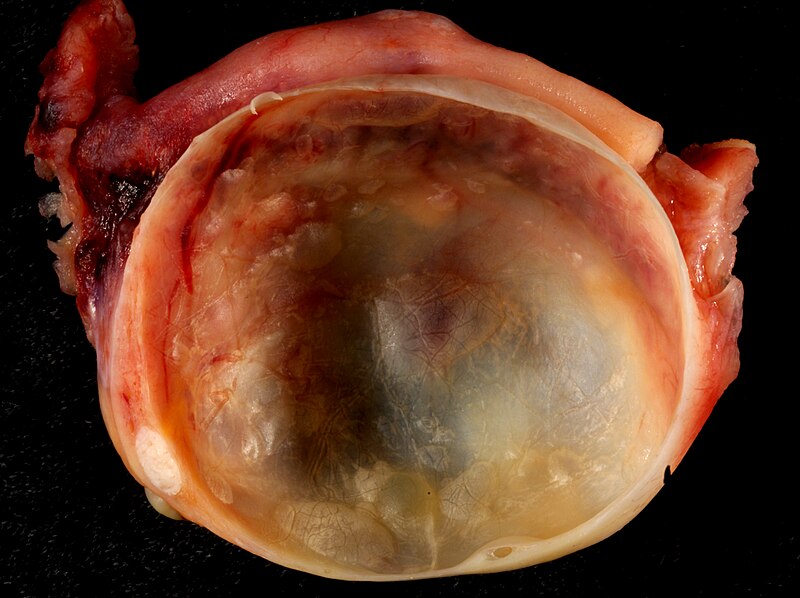
File:Benign_Ovarian_Cyst.jpg · Wikimedia Commons · See Wikimedia Commons
ovarian cyst
Sign in to savefluid-filled sac in the ovary
Key facts
- Specialty
- Gynecology
- Symptoms
- None, bloating, lower abdominal pain, lower back pain
- Complications
- Rupture , twisting of the ovary
- Types
- Follicular cyst , corpus luteum cyst , cysts due to endometriosis , dermoid cyst , cystadenoma , ovarian cancer
- Diagnostic method
- Ultrasound
- Prevention
- Hormonal birth control
- Treatment
- Conservative management , pain medication, surgery
- Prognosis
- Usually good
- Frequency
- 8% symptomatic before menopause
via Wikipedia infobox
Research
37,039 papers- Diagnosis and management of ovarian cyst accidents.Best practice & research. Clinical obstetrics & gynaecology · 2009
- Fetal Ovarian Cyst-A Scoping Review of the Data from the Last 10 Years.Medicina (Kaunas, Lithuania) · 2023
- Asymptomatic postmenopausal simple ovarian cyst.Obstetrical & gynecological survey · 2002
- Massive Ovarian Cyst Mimics Constipation.The Journal of emergency medicine · 2022
- A retroperitoneal cyst masquerading as an ovarian cyst.Asian journal of surgery · 2024
via PubMed
Wikidata facts
- Subclass of
- disease
- Image
- Benign Ovarian Cyst.jpg
Show 6 more facts
- exact match
- purl.obolibrary.org/obo/DOID_5119
- health specialty
- gynaecology
- Commons category
- Ovarian cysts
- ICD-9-CM
- 620.2
- NCI Thesaurus ID
- C3300
- facet of
- women's health
via Wikidata · CC0
~23 min read
Encyclopedic overview
An ovarian cyst is a fluid-filled sac within the ovary. They usually cause no symptoms, but occasionally they may produce bloating, lower abdominal pain, or lower back pain. The majority of cysts are harmless. If the cyst either breaks open or causes twisting of the ovary, it may cause severe pain. This may result in vomiting or feeling faint, and even cause headaches.
Most ovarian cysts are related to ovulation, being either follicular cysts or corpus luteum cysts. Other types include cysts due to endometriosis, dermoid cysts, and cystadenomas. Many small cysts occur in both ovaries in polycystic ovary syndrome (PCOS). Pelvic inflammatory disease may also result in cysts. Rarely, cysts may be a form of ovarian cancer. Diagnosis is undertaken by pelvic examination with a pelvic ultrasound or other testing used to gather further details.
Excerpted from Wikipedia’s “ovarian cyst” article, available under the CC BY-SA 4.0 licence.