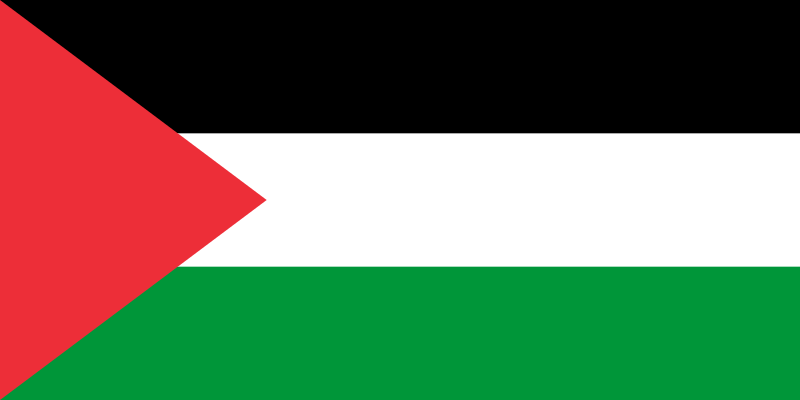
File:Flag_of_Palestine.svg · Wikimedia Commons · See Wikimedia Commons
Palestinians
Sign in to saveAlso known as Palestinian Arabs, Arab Palestinians, Palestinian people
Palestinians () are an Arab ethnonational group native to the Levantine region of Palestine. They represent a highly homogeneous community who share a cultural and ethnic identity, speak Palestinian Arabic and share close religious, linguistic, and cultural ties with other Levantine Arabs.
Palestinians are an Arab ethnic and national group originally from the region of Palestine in the Levant, who share a distinct cultural identity, Arabic language, and close ties with other Arabs in the region. They matter as a significant population whose history, rights, and political status have been central to major conflicts and ongoing international discussions in the Middle East.
AI-generated from the Wikipedia summary — may contain errors.
Key facts
- Ethnic group.group
- Palestinians
- Ethnic group.flag
- Flag of Palestine.svg
- Ethnic group.flag_caption
- Flag of Palestine
- Ethnic group.population
- 14.3 million |center|frameless|260px
- Ethnic group.popplace
- Palestine
- Ethnic group.pop1
- 5,350,000
- Ethnic group.region2
- – West Bank (Palestine)
- Ethnic group.pop2
- 3,190,000 (of whom 912,879 are registered refugees as of 2024)
- Ethnic group.region3
- – Gaza Strip (Palestine)
- Ethnic group.pop3
- 2,170,000 (of whom 1,476,706 are registered refugees as of 2024)
- Ethnic group.region4
- Jordan
- Ethnic group.pop4
- 2,307,011 (2024, registered refugees only)–3,240,000 (2009)
- Ethnic group.region5
- Israel
- Ethnic group.pop5
- 2,037,000 (2022)
- Ethnic group.region6
- Syria
- Ethnic group.pop6
- 568,530 (2021, registered refugees only)
- Ethnic group.region7
- Chile
- Ethnic group.pop7
- 500,000
via Wikipedia infobox
Described at
MAR | Data | Assessment for Palestinians in Israel
mar.umd.edu →With the new intifada ongoing since September 2000, the near-term situation for Palestinians in Israel (West Bank and Gaza) is very bleak. Since 2001, the death toll has soared as Sharon has intensified existing policies such as assassinating Palestinian militants, air strikes and incursions into Palestinian self-rule areas. Palestinian militants, meanwhile, have stepped up suicide bomb attacks in Israeli cities. The continual spiral of suicide bombings followed by Israeli reprisal attacks shows no signs of slowing. Violence significantly worsened in 2001 and 2002, and continued at a somewhat abated pace in 2003. Several international attempts to bring about peace have so far failed (such as the Mitchell commission, the Saudi Peace Proposal, and the US “Road map”), and it is unlikely that violence will cease in the near-future. Palestinians in Israel, or more properly, the Palestinian Authority (PA) of the West Bank and Gaza Strip (GROUPCON = 3), have been a people without a sovereign state for centuries. Nearly 90 percent of Palestinians are Sunni Muslims (BELIEF = 3; CULDIFX4 = 2) and all speak Arabic (with a majority also knowing Hebrew) (LANG = 3; CULDIFX2 = 2). Largely descendants from the earliest recorded inhabitants of the area or people forced to abandon their homes in Israel following wars in 1948 and 1967, the Palestinians in the PA live in relatively poor circumstances, suffer high and rising unemployment, rising birth rates, and deteriorating public health conditions (DMBIRTH00-03 = 2; DMSICK00-03 = 3). In 1992, for the first time in almost 2 decades, Israel's left wing Labor party won the election and took over the Knesset. This had an immediate impact on how Israel dealt with the peace process already underway. Prime Minister Yitzhak Rabin ordered a freeze on new settlements in the territories and began secret negotiations with the PLO in an effort to produce a Palestinian self-rule agreement. In September 1993, Israel and the PLO recognized each other and signed a basic plan outlining the steps toward Palestinian self-rule. In May 1994 an agreement on Palestinian self-rule by the Palestinian National Authority (PNA) was reached. The peace did not last long, as violence resumed in 2000. As non-Israeli citizens, Palestinians experience complete exclusion from the Israeli political process (POLDIS00-03 = 4, although note that free and fair elections do occur within the PA), and since the rise of the new intifada in 2000 they have additionally suffered economic exclusion as the border with Israel proper has been closed (ECDIS00-03 = 4). The uprising from 2000 to the present has utilized hundreds of suicide bombings and also more conventional armed attacks (REB03 = 4) – and mass rallies denouncing the Israeli government’s refusal for full Palestinian statehood (PROT03 = 3). A major grievance of the Palestinians has been against the building of the Israeli “security wall” since 2002. Instead of being built on the green line demarcating Israel from the West Bank, the barrier cuts several kilometers into West Bank land; since Palestinians (and most of the international community) see the green line as the eventual border between Israeli and a Palestinian state, the Israeli barrier threatens to redraw the border and take land away from the Palestinians. In February 2004, the International Court of Justice at The Hague held a hearing into the legality of the barrier. In response to Palestinian protests (both violent and peaceful), the Sharon government has used unrestrained force against protesters (REP1903 = 3), confiscated property (REP1003 = 3), assassinated Palestinian leaders (REP0701-03 = 1), and sought the arrest (REP0201–03 = 3) or death of those deemed to be terrorist members of militant Palestinian organizations such as Hamas and the Islamic Jihad. Whether a Palestinian preaches non-violence or is willing to die for his cause, however, all Palestinians have the ultimate wish for full independence (AUTGR296-03
Excerpt from a page describing this subject · 6,778 chars · not written by Vinony
Wikidata facts
- Subclass of
- people
- Part of
- Arabs
- Demonym
- فلسطينية
- Citizenship
- Palestine
- Languages spoken
- Arabic
- Native language
- Arabic
- Religion
- Judaism
- Country
- Palestine
- Population
- 14300000
- Image
- Palestine 1930.jpg
- Residence
- Mandatory Palestine
Show 9 more facts
- Commons category
- People of Palestine
- topic's main category
- Category:People from Palestine
- topic has template
- Template:Palestinians
- Commons gallery
- Palestinians
- native label
- فلسطينيون
- female form of label
- فلسطينية
- described at URL
- www.mar.umd.edu/assessment.asp?groupId=66003
- male form of label
- فلسطيني
- indigenous to
- Palestine
Sources (7)
via Wikidata · CC0
~81 min read
Encyclopedic overview
32 sectionsContents
- Etymology
- Origins
- Genetics
- Identity
- Emergence of a distinct identity
- Rise of Palestinian nationalism
- British Mandate (1917–1947)
- War (1947–1949)
- "Lost years" (1949–1967)
- 1967–present
- Demographics
- Refugees
- Religion
- Current demographics
- Society
- Language
- Education
- Women and family
- Culture
- Cuisine
- Art
- Literature
- Music
- Palestinian hip hop
- Dance
- Sport
- See also
- References
- Notes
- Citations
- Sources
- External links
Palestinians () are an Arab ethnonational group native to the Levantine region of Palestine. They represent a highly homogeneous community who share a cultural and ethnic identity, speak Palestinian Arabic and share close religious, linguistic, and cultural ties with other Levantine Arabs.
In 1919, Palestinian Muslims and Christians constituted 90 percent of the population of Palestine, just before the third wave of Jewish immigration and the setting up of British Mandatory Palestine after World War I. Opposition to Jewish immigration spurred the consolidation of a unified national identity, though Palestinian society was still fragmented by regional, class, religious, and family differences. The history of the Palestinian national identity is a disputed issue amongst scholars. For some, the term "Palestinian" is used to refer to the nationalist concept of a Palestinian people by Palestinian Arabs from the late 19th century and in the pre-World War I period, while others assert the Palestinian identity encompasses the heritage of all eras from biblical times up to the Ottoman period. After the Israeli Declaration of Independence, the 1948 Palestinian expulsion, and more so after the 1967 Palestinian exodus, the term "Palestinian" evolved into a sense of a shared future in the form of aspirations for a Palestinian state. Though the concept of Palestinian citizenship for the purpose of international law has been revived, the in fieri realization of self-determination is still insufficient, thus Palestinians remain over the threshold of eligibility to receive international protection as refugees and stateless persons.
Excerpted from Wikipedia’s “Palestinians” article, available under the CC BY-SA 4.0 licence.
Gallery (52)
Available in 84 languages
- Español
- Français
- Deutsch
- 中文
- 日本語
- Русский
- Português
- Italiano
- العربية
- हिन्दी
- Achinese
- Afrikaans
- Albanian
- Aragonese
- Asturian
- azb
- Azerbaijani
- Bahasa Indonesia
Show 65 more
- Balinese
- Bangla
- Basque
- be_x_old
- Belarusian
- Bosnian
- Bulgarian
- Catalan
- Central Kurdish
- Chuvash
- Croatian
- Czech
- Danish
- Egyptian Arabic
- Esperanto
- Estonian
- Filipino
- Finnish
- Galician
- Georgian
- Greek
- Hausa
- Hebrew
- Hungarian
- Iban
- Ido
- Irish
- Javanese
- Kashubian
- Kazakh
- Latin
- Latvian
- Lithuanian
- Madurese
- Malay
- Minangkabau
- Mingrelian
- Nederlands
- Norwegian
- Norwegian Nynorsk
- Pashto
- Polski
- Romanian
- Sardinian
- Serbian
- Serbian (Latin)
- Silesian
- simple
- Slovenian
- Somali
- Sundanese
- Svenska
- Tiếng Việt
- Türkçe
- Ukrainian
- Urdu
- Uzbek
- Welsh
- Western Frisian
- Western Panjabi
- Yiddish
- zh_yue
- فارسی
- ไทย
- 한국어
via Wikidata sitelinks · CC0