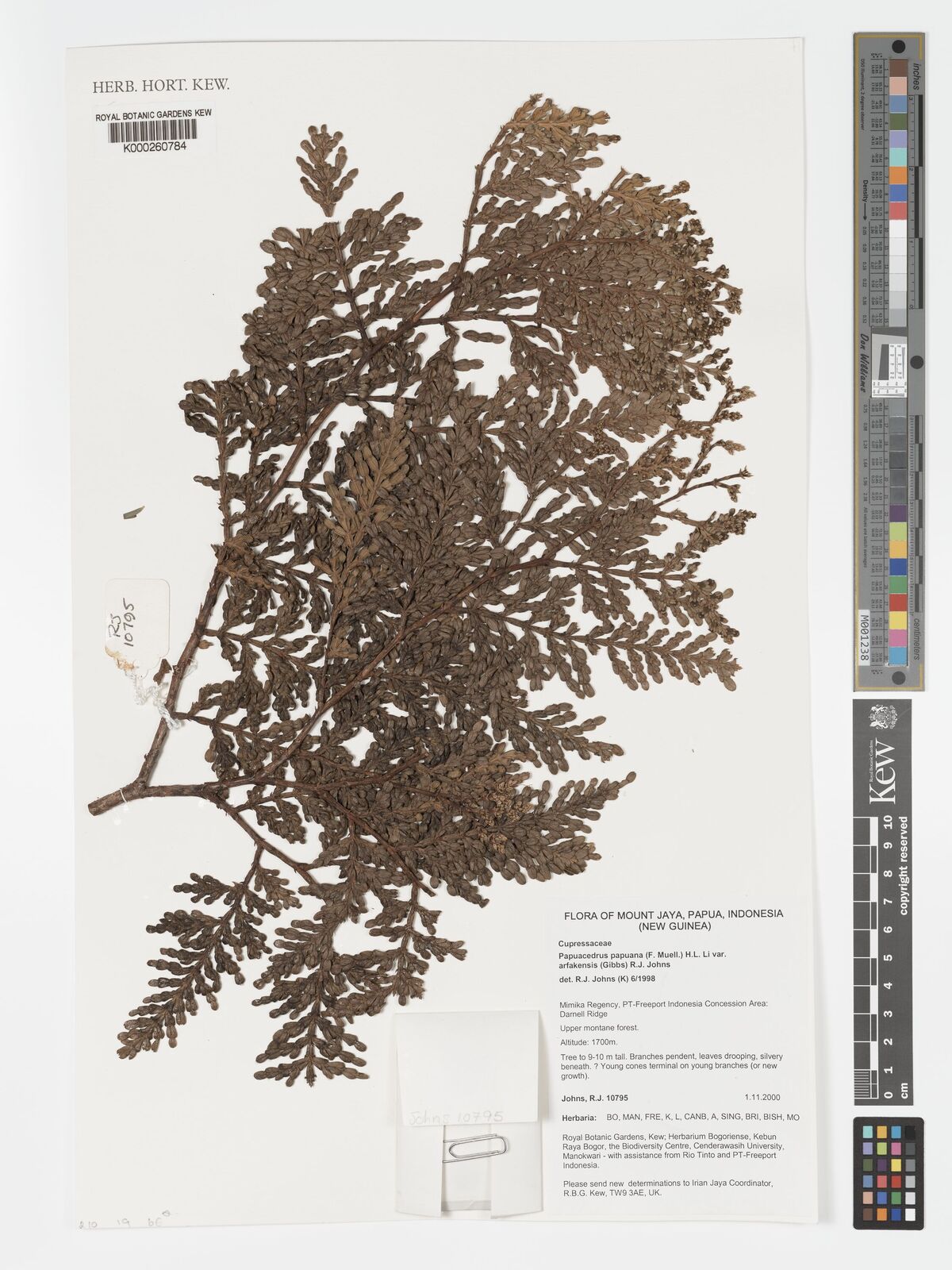
Papuacedrus papuana
Papuacedrus papuana is a species in the conifer family Cupressaceae, the sole species in the genus Papuacedrus. Some botanists do not consider this species as forming a distinct genus, but include it in the related genus Libocedrus. It is native to New Guinea and to the Indonesian province of Maluku.
Species
SPECIES
- KingdomPlantae
- PhylumTracheophyta
- ClassPinopsida
- OrderPinales
- FamilyCupressaceae
Native toMaluku, New Guinea
Царство: Растения Подцарство: Зелёные растения Отдел: Хвойные Класс: Хвойные Порядок: Сосновые Семейство: Кипарисовые Род: Папуацедрус Международное научное название Papuacedrus H.L.Li Единственный вид Papuacedrus papuana (F.Muell.) H.L.Li — Папуацедрус папуасский Охранный статус Вызывающие наименьшие опасенияIUCN 3.1 Least Concern: 42260 Систематикана ВикивидахИзображенияна Викискладе NCBI 103977EOL 1061650IPNI 294873-1TPL kew-2411533 Папуацедрус (лат. Papuacedrus) — род деревьев семейства Кипарисовые. Некоторыми систематиками включается в состав рода Либоцедрус (Libocedrus Endl.). В естественных условиях растёт высоко в горах в экваториальных лесах Новой Гвинеи. Отдельные экземпляры этих деревьев местами растут на высоте до 3800 м. Папуацедрус — дерево с раскидистой кроной и красноватой чешуевидной корой. Смолистая древесина дерева устойчива против гниения. Виды Род включает один вид с двумя подвидами, ранее рассматривавшимися как самостоятельные виды[1]: Papuacedrus papuana (F.Muell.) H.L.Li — Папуацедрус папуасский Papuacedrus papuana (F.Muell.) H.L.Li var. arfakensis (Gibbs) R.J.Johns — Папуацедрус арфакский Papuacedrus papuana (F.Muell.) H.L.Li var. papuana Ссылки Папуацедрус
via GBIF · Kew POWO
Article
2 sectionsContents
- References
- Further reading
Papuacedrus papuana is a species in the conifer family Cupressaceae, the sole species in the genus Papuacedrus. Some botanists do not consider this species as forming a distinct genus, but include it in the related genus Libocedrus. It is native to New Guinea and to the Indonesian province of Maluku.
It is usually a medium-sized to large evergreen tree 16–50 m tall, at high elevations only a shrub reaching up to 3 m). The foliage is borne in flat sprays, with the leaves scale-like, in opposite pairs, with facial and lateral pairs alternating; the lateral leaves are larger, 2–3 mm long on mature trees and up to 20 mm long on young trees, the facial leaves smaller, 1 mm on mature trees and up to 8 mm on young trees. The cones are 1–2 cm long, with four scales, a small, sterile basal pair, and a larger fertile pair; the fertile scales each bearing two winged seeds.