File:1880-_Global_average_sea_level_rise_(SLR)_-_annually.svg · Wikimedia Commons · See Wikimedia Commons
sea level rise
Sign in to saveAlso known as rising sea levels
current long-term trend for global sea levels to rise mainly in response to climate change
Sea level rise is the ongoing increase in the height of oceans around the world, primarily caused by climate change. It matters because even small increases in sea level can threaten coastal communities, infrastructure, and ecosystems that depend on stable shorelines.
AI-generated from the Wikipedia summary — may contain errors.
Research
3,007 papersvia PubMed
Wikidata facts
- Instance of
- phenomenon
- Image
- Rhos on Sea Coastal Defence Improvements - Gwelliannau i Amddiffynfeydd Arfordirol Llandrillo-yn-Rhos; Mehefin - June 2023 01.jpg
Show 5 more facts
- has cause
- climate change
- has effect
- ice calving
- on focus list of Wikimedia project
- WikiProject Climate change
- Commons category
- Sea level rise
- facet of
- sea level
Sources (2)
via Wikidata · CC0
~40 min read
Encyclopedic overview
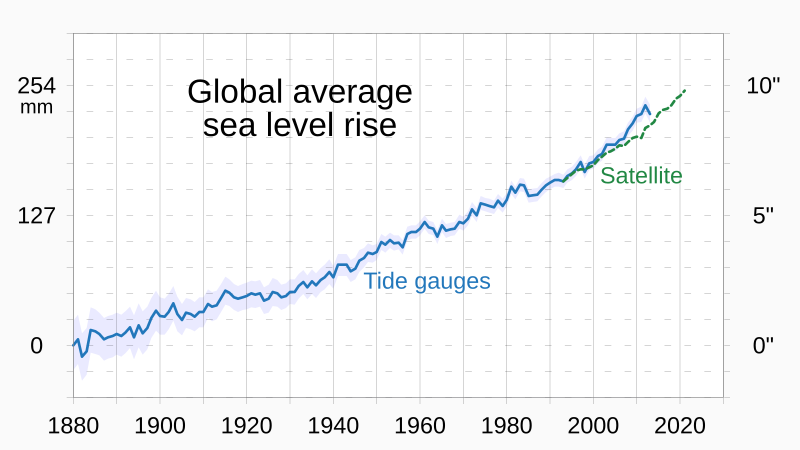
The global average sea level has risen about 25 centimetres (9.8 in) since 1880.
Sea surface height change from 1992 to 2019: Blue regions are where sea level has gone down, and orange/red regions are where sea level has risen (the visualization is based on satellite data). The sea level has been rising since the end of the Last Glacial Maximum, which was around 20,000 years ago. Between 1901 and 2018, the average sea level rose by 15–25 cm (6–10 in), with an increase of 2.3 mm (0.091 in) per year since the 1970s. This was faster than the sea level had ever risen over at least the past 3,000 years. The rate accelerated to 4.62 mm (0.182 in)/yr for the decade 2013–2022. Climate change due to human activities is the main cause of this persistent acceleration. Between 1993 and 2018, melting ice sheets and glaciers accounted for 44% of sea level rise, with another 42% resulting from thermal expansion of water.
Excerpted from Wikipedia’s “sea level rise” article, available under the CC BY-SA 4.0 licence.