performativité
Sign in to saveAlso known as Performative turn
qualité linguistique, phrase qui est aussi une action
Described at
Performativity | Tate
Tate glossary definition for performativity: Describes the interdependent relationship between certain words and actions – as when a word or sentence implies an action
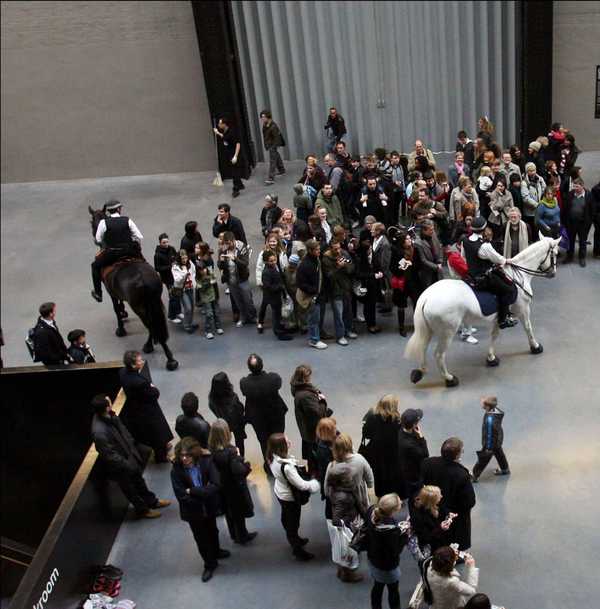
tate.org.uk →The term was first introduced by the theorist J. L. Austin in his 1955 book How to Do Things with Words . Austin used the word performative to describe a sentence that was also an action; like uttering the words ‘I name this ship the Queen Elizabeth’ while smashing a bottle against the boat. Other examples would be a judge declaring a verdict, or two people saying ‘I do’ upon being asked whether they take their partner in marriage. This symbiotic or interdependent relationship between words and actions that the performative encompasses is a key aspect of performance art, with theorists and philosophers examining the role of actions, gestures and artistic decision-making through the idea of performativity. Since Austin’s first use of the word, there have been many philosophers who have elaborated on performativity including John Searle, Jacques Derrida and Judith Butler. A work like Tania Bruguera’s Tatlin’s Whisper in which two mounted policemen perform crowd control with the audience submitting to their commands is an example of performativity. Does this text contain inaccurate information or language that you feel we should improve or change? We would like to hear from you. Conceptual art is art for which the idea (or concept) behind the work is more important than the finished art object. It emerged as an art movement in the 1960s and the term usually refers to art made from the mid-1960s to the mid-1970s. The Underground chambers of the old power station at Bankside, where oil once lurked with electric potential, will soon open to the public with a programme dedicated to art that has traditionally sat uneasily within a museum collection. Large installations and interdisciplinary works will feature strongly, while the South Tank will be dedicated to the presentation of live performance.
Excerpt from a page describing this subject · 11,201 chars · not written by Vinony
Wikidata facts
- Instance of
- concept
- Subclass of
- result
- Part of
- linguistics
Show 2 more facts
- described at URL
- www.tate.org.uk/art/art-terms/p/performativity
- named by
- John Langshaw Austin
Sources (3)
via Wikidata · CC0
Article · Français
La performativité est le fait, pour un signe linguistique (énoncé, phrase, verbe, etc.) de réaliser lui-même ce qu'il énonce ; on dit alors que le signe est « performatif ». Le fait d'utiliser un de ces signes fait advenir une réalité. Par exemple, lors du jugement d’un accusé, la sentence décidée par le juge déterminera l’avenir de l’individu ; il deviendra soit « coupable », soit « innocent », la sentence sera donc « performative », les deux mots ayant un impact considérable sur l’identité de l’interlocuteur. On peut également énoncer la phrase « Je vous déclare unis par les liens du mariage », phrase performative qui intègre les conjoint(e)s dans le régime du mariage. Émile Benveniste note qu'il s'agit avant tout de pragmatique, la performativité dépendant du locuteur et des circonstances et non de la langue seule. Peter L. Berger, sociologue et théologien américain, considère ce type de système comme des constructions sociales. En effet, celui-ci peut « fournir une interprétation totale de la réalité ». En parlant de performativité, il faut ainsi prêter une certaine attention aux contextes dans lesquels se produit l’énonciation.
Abstract from DBpedia / Wikipedia · CC BY-SA