перформатив
Sign in to saveAlso known as Performative turn
Performativity is the concept that language can function as a form of social action and have the effect of change. The concept has multiple applications in diverse fields such as anthropology, social and cultural geography, economics, gender studies (social construction of gender), law, linguistics, performance studies, history, management studies and philosophy.
Described at
Performativity | Tate
Tate glossary definition for performativity: Describes the interdependent relationship between certain words and actions – as when a word or sentence implies an action
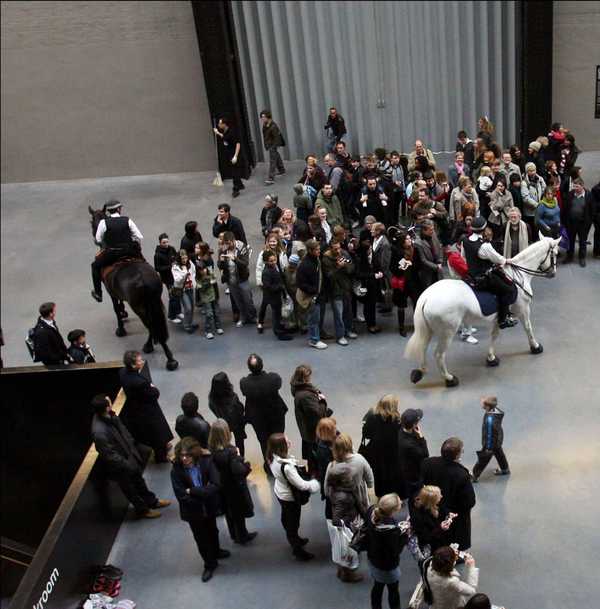
tate.org.uk →The term was first introduced by the theorist J. L. Austin in his 1955 book How to Do Things with Words . Austin used the word performative to describe a sentence that was also an action; like uttering the words ‘I name this ship the Queen Elizabeth’ while smashing a bottle against the boat. Other examples would be a judge declaring a verdict, or two people saying ‘I do’ upon being asked whether they take their partner in marriage. This symbiotic or interdependent relationship between words and actions that the performative encompasses is a key aspect of performance art, with theorists and philosophers examining the role of actions, gestures and artistic decision-making through the idea of performativity. Since Austin’s first use of the word, there have been many philosophers who have elaborated on performativity including John Searle, Jacques Derrida and Judith Butler. A work like Tania Bruguera’s Tatlin’s Whisper in which two mounted policemen perform crowd control with the audience submitting to their commands is an example of performativity. Does this text contain inaccurate information or language that you feel we should improve or change? We would like to hear from you. Conceptual art is art for which the idea (or concept) behind the work is more important than the finished art object. It emerged as an art movement in the 1960s and the term usually refers to art made from the mid-1960s to the mid-1970s. The Underground chambers of the old power station at Bankside, where oil once lurked with electric potential, will soon open to the public with a programme dedicated to art that has traditionally sat uneasily within a museum collection. Large installations and interdisciplinary works will feature strongly, while the South Tank will be dedicated to the presentation of live performance.
Excerpt from a page describing this subject · 11,201 chars · not written by Vinony
Wikidata facts
- Instance of
- concept
- Subclass of
- result
- Part of
- linguistics
Show 2 more facts
- described at URL
- www.tate.org.uk/art/art-terms/p/performativity
- named by
- John Langshaw Austin
Sources (3)
via Wikidata · CC0
Article · Русский
Перформати́в (лат. performo — «создаю», «образовываю») — речевые акты, равноценные поступку. В широкое употребление этот термин ввел Джон Остин, разделявший высказывания на перформативные и констатирующие. Примерами перформативов являются клятвы, обещания, предупреждения, приказания. Перформативы обладают следующими свойствами: * Часто перформативными выражениями являются глаголы в первом лице единственного числа, например, «поздравляю», «требую» и так далее, возможны также обезличенные формулировки («Пассажиров просят пройти на посадку»). * Оценивать перформативы на истинность невозможно, в отличие от констативов они не могут быть признаны истинными или ложными. * Перформативное высказывание можно оценить на эффективность («условие успешности», «верифицируемость употребления»). * Перформативы базируются на принятой в обществе системе норм, которая определяет последствия для сделанного высказывания. Неверное перформативное использование глаголов может порождать языковую игру и юмор. Например, глагол «аргументировать» не употребляется перформативно, поэтому ответ «Аргументирую!» на обращение «Аргументируйте?» в эстрадном диалоге Романа Карцева и Виктора Ильченко порождал комический эффект.
Abstract from DBpedia / Wikipedia · CC BY-SA