File:Perpendicular-coloured.svg · Wikimedia Commons · See Wikimedia Commons
perpendicularity
Sign in to saveAlso known as perpendicular, perpendicular to
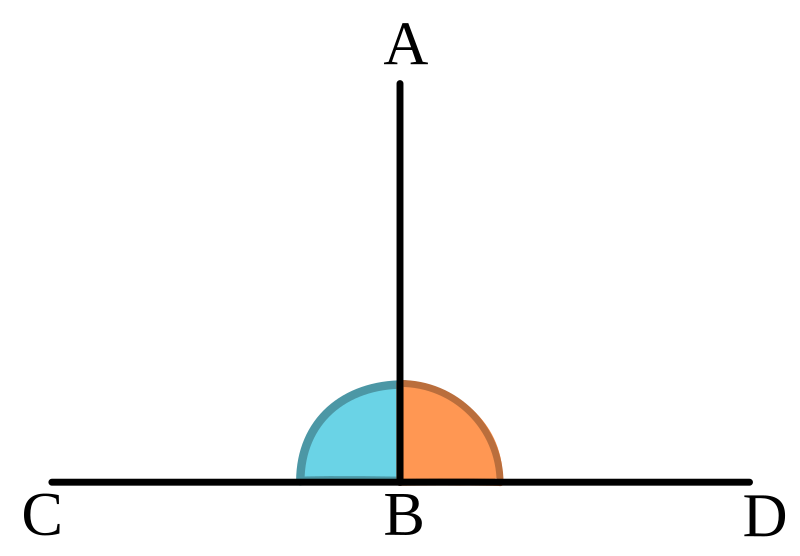
class=skin-invert-image|right|thumb|236px|The segment AB is perpendicular to the segment CD because the two angles it creates (indicated in orange and blue) are each 90 degrees. The segment AB can be called the perpendicular from A to the segment CD, using "perpendicular" as a noun. The point B is called the foot of the perpendicular from A to segment CD, or simply, the foot of A on CD.
Perpendicularity describes the relationship between two lines or segments that meet at a 90-degree angle, with each of the angles formed at their intersection being exactly 90 degrees. This concept matters because perpendicular lines are fundamental to measuring distances, constructing right angles, and establishing coordinate systems used across mathematics, engineering, and everyday spatial navigation.
AI-generated from the Wikipedia summary — may contain errors.
Wikidata facts
- Subclass of
- orthogonality
- Image
- Perpendicular-coloured.svg
Show 4 more facts
- described by source
- Granat Encyclopedic Dictionary
- Commons category
- Perpendicular
- maintained by WikiProject
- WikiProject Mathematics
- characteristic of
- line
via Wikidata · CC0
~11 min read
Encyclopedic overview
18 sectionsContents
- Foot of a perpendicular{{anchor|Foot}}
- Construction of the perpendicular
- In relationship to parallel lines
- In computing distances{{anchor|Distance}}
- Graph of functions
- In circles and other conics
- Circles
- Ellipses
- Parabolas
- Hyperbolas
- In polygons
- Triangles
- Quadrilaterals
- Lines in three dimensions
- See also
- Notes
- References
- External links
class=skin-invert-image|right|thumb|236px|The segment AB is perpendicular to the segment CD because the two angles it creates (indicated in orange and blue) are each 90 degrees. The segment AB can be called the perpendicular from A to the segment CD, using "perpendicular" as a noun. The point B is called the foot of the perpendicular from A to segment CD, or simply, the foot of A on CD.
In geometry, two geometric objects are perpendicular if they intersect at right angles, i.e. at an angle of 90 degrees or π/2 radians. The condition of perpendicularity may be represented graphically using the perpendicular symbol, ⟂. Perpendicular intersections can happen between two lines (or two line segments), between a line and a plane, and between two planes.
Excerpted from Wikipedia’s “perpendicularity” article, available under the CC BY-SA 4.0 licence.
Gallery (12)
Available in 60 languages
- Español
- Français
- 中文
- 日本語
- Русский
- Português
- Italiano
- العربية
- हिन्दी
- Afrikaans
- Albanian
- Amharic
- Armenian
- Assamese
- Asturian
- Azerbaijani
- Bahasa Indonesia
- Bangla
Show 41 more
- Basque
- Bosnian
- Bulgarian
- Catalan
- Central Kurdish
- Chuvash
- Czech
- Esperanto
- Estonian
- Filipino
- Finnish
- Galician
- Greek
- Hebrew
- Ido
- Kazakh
- Latvian
- Lithuanian
- Macedonian
- Malay
- Nederlands
- Norwegian
- Norwegian Nynorsk
- Oromo
- Polski
- Romanian
- Shona
- Slovak
- Slovenian
- Svenska
- Tiếng Việt
- Türkçe
- Ukrainian
- Uzbek
- Welsh
- zh_classical
- zh_min_nan
- zh_yue
- فارسی
- ไทย
- 한국어
via Wikidata sitelinks · CC0