
Perú
Sign in to saveAlso known as pe, Republic of Peru, República del Perú, Republica del Peru, per
país de América del Sur
OverviewAI-generated
Peru, officially the Republic of Peru, is a country in South America. Its capital is Lima. The nation operates under a presidential system with the Congress of the Republic of Peru as its legislative body. The head of government holds the office of President of Peru. Peru shares diplomatic relations with Italy, Brazil, Germany, and Australia.
The country has a population of 34,350,244 and covers an area of 1,285,216. Official languages include Spanish, Aymara, and Quechua. The currency is the Nuevo sol, with the Peruvian inti also listed. The internet country code is .pe. Emergency services are reached via 911. The electrical plug type is the Europlug.
Peru is characterized as a free country. It has a life expectancy of 77.941 years and an urban population percentage of 85.1912729600355. The forest area accounts for 56.103020234375 percent of the land. Renewable energy sources provide 30.6 percent of power. The unemployment rate is 5.117 percent. The GDP is 289,221,969,062.941 USD.
Synthesized by Vinony from 68 facts across 9 sources: Wikidata, REST Countries, Openweathermap, Open Meteo, World Bank, OpenStreetMap, PubMed, Vinony graph, Geo. Generated from structured data (not the Wikipedia text) and checked against those facts — may still contain errors.
Weather now
7-day forecast
via Open-Meteo
Country
- Capital
- Lima
- Population
- 34,350,244
- Region
- Americas · South America
- Demonym
- Peruvian
- Currencies
- PEN (S/ )
- Languages
- Aymara, Quechua, Spanish
- Calling code
- +51
- Drives on
- Right
- Gini
- 41.5 (2019)
- FIFA code
- PER
- TLD
- .pe
- Timezones
- UTC-05:00
- Borders
- BOL, BRA, CHL, COL, ECU
via REST Countries
Indicators · World Bank
- GDP
- $289.2B(2024)
- Population
- 34,217,848(2024)
- Life expectancy
- 77.9 yrs(2024)
- Unemployment
- 5.1 %(2025)
- Urban population
- 85.2 %(2024)
- Internet users
- 82 %(2024)
- Forest area
- 56.1 %(2023)
- Renewable energy
- 30.6 %(2021)
via World Bank Open Data · CC BY 4.0
Place details
- Locality
- Molino
- Region
- Huánuco
- Country
- Perú
- Population
- 31,989,256
- Timezone
- America/Lima
via OpenStreetMap · GeoNames
Wikipedia views (30d)
133,026 totalvia Wikimedia Pageviews API
Key facts
- Country.conventional_long_name
- Republic of Peru
- Country.common_name
- Peru
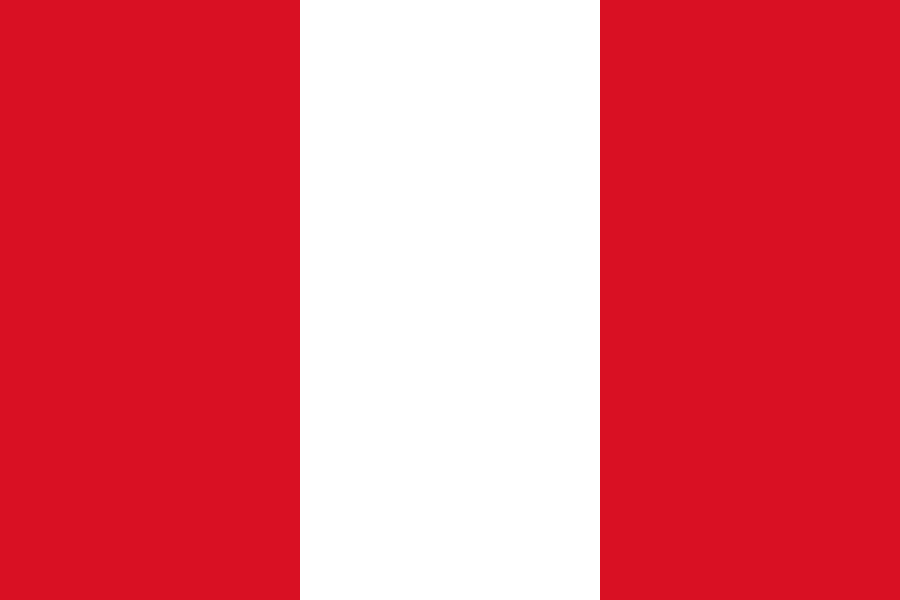
- Country.image_flag
- Flag of Peru.svg
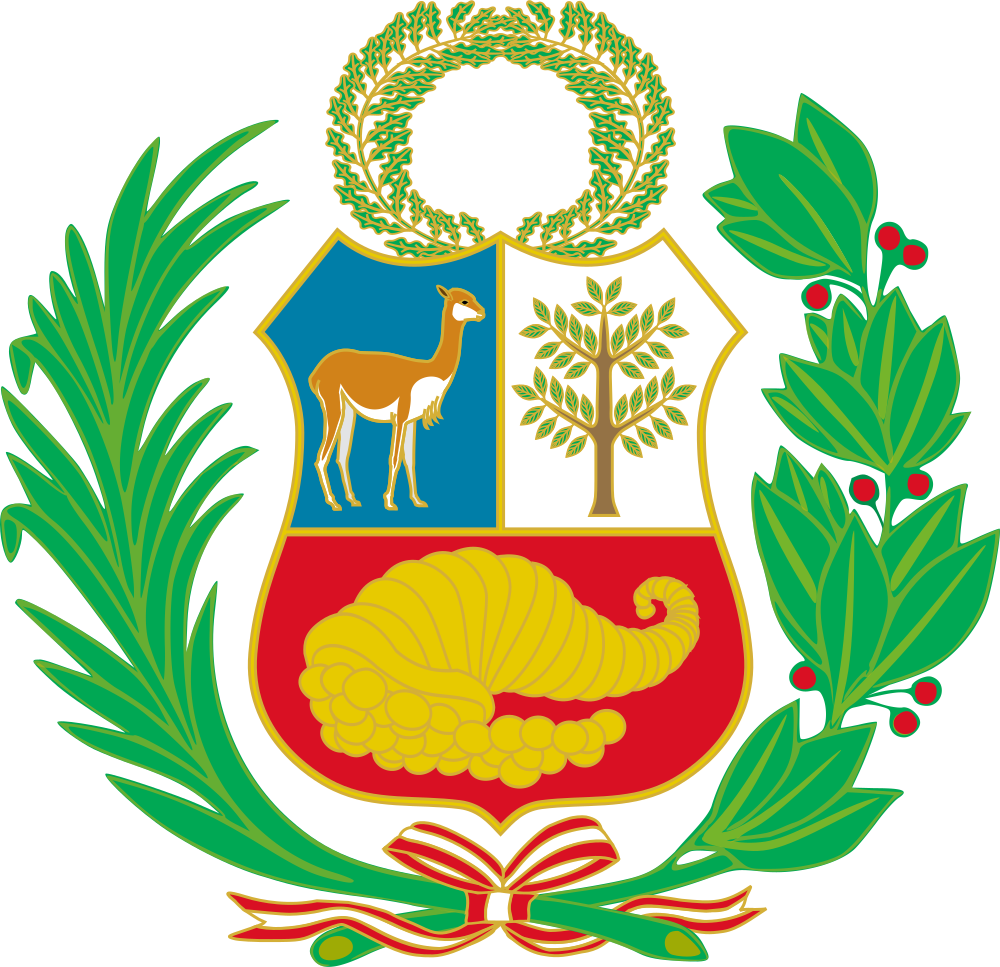
- Country.image_coat
- Escudo nacional del Perú.svg
- Country.other_symbol
- 100pxGreat Seal of the State
- Country.other_symbol_type
- National seal
- Country.national_motto
- "Firm and Happy for the Union"
- Country.national_anthem
- "National Anthem of Peru"
- Country.march
- "March of Flags"
- Country.image_map
- PER orthographic.svg
- Country.capital
- Lima
- Country.largest_city
- capital
- Country.official_languages
- Spanish
- Country.languages_type
- Co-official languages
- Country.ethnic_groups_year
- 2017
- Country.demonym
- Peruvian
- Country.government_type
- Unitary semi-presidential republic
- Country.leader_title1
- President
via Wikipedia infobox
Research
40,477 papers- Monkeypox Outbreak in Peru.ReviewMedicina (Kaunas, Lithuania) · 2023Ramírez-Soto MCDOI: 10.3390/medicina59061096
- Diagnosis of primary immunodeficiencies in Peru.ReviewCurrent opinion in pediatrics · 2020Aldave-Becerra JC, Veramendi-Espinoza LE, Rentería-Valdiviezo CADOI: 10.1097/MOP.0000000000000964
- Scientific misconducts: paper mills in Peru.Revista peruana de medicina experimental y salud publica · 2022Mayta-Tristán P, Borja-García RDOI: 10.17843/rpmesp.2022.394.12473
- [Medical and health care in Peru].Revista peruana de medicina experimental y salud publica · 2019Cabezas CDOI: 10.17843/rpmesp.2019.362.4620
- Peru.Department of State publication. Background notes series · 1987United States. Department of State. Bureau of Public Affairs
- [Health in Perú].Revista peruana de medicina experimental y salud publica · 2014Arias-Stella J
- Peru advances towards universal health care for patients with cancer.The Lancet. Oncology · 2024Burki TDOI: 10.1016/S1470-2045(24)00445-5
- Peru.Epidemiological bulletin · 2004
via PubMed
Wikidata facts
- Instance of
- country
- Part of
- Latin America
- Official name
- República del Perú
- Demonym
- Peiriúch
- Participant in
- Ecuadorian–Peruvian War
- Country
- Peru
- Contains
- Moquegua Department
- Continent
- South America
- Capital
- Lima
- Official language
- Quechua
- Currency
- Peruvian inti
- Population
- 33726000
- Area
- 1285216
- Body of water
- Grau Sea
- Head of government
- José María Balcázar
- Head of state
- José María Balcázar
- Form of government
- presidential system
- Legislature
- Congress of the Republic of Peru
- Anthem
- National Anthem of Peru
- Shares border with
- Gran Colombia
- Highest point
- Huascarán
- Follows
- Protectorate of San Martín
- Official website
- www.gob.pe
- Image
- Cuarentena Lima (19 de marzo 2).jpg
Show 75 more facts
- Life expectancy
- 73
- Nominal GDP
- 242631549613
- Unemployment rate
- 4
- Calling code
- +51
- Licence plate code
- PE
- Mains voltage
- 220
- Motto
- Gwlad yr Inca
- Flag
- flag of Peru
- Coat of arms
- coat of arms of Peru
- Significant event
- Peruvian War of Independence
- topic's main Wikimedia portal
- Portal:Peru
- Unicode character
- 🇵🇪
- category of associated people
- Category:Peruvian people
- geography of topic
- Geography of Peru
- office held by head of government
- President of Peru
- has characteristic
- free country
- number of out-of-school children
- 614346
- diplomatic relation
- Hungary
- inception
- 1821-07-28
- Commons gallery
- Peru
- trunk prefix
- 0
- history of topic
- history of Peru
- native label
- República del Perú
- marriageable age
- 18
- mobile country code
- 716
- total fertility rate
- 2.455
- maritime identification digits
- 760
- topic's main category
- Category:Peru
- category for people buried here
- Category:Burials in Peru
- age of majority
- 18
- member of
- World Customs Organization
- category for films shot at this location
- Category:Films shot in Peru
- executive body
- Government of Peru
- category for people who died here
- Category:Deaths in Peru
- office held by head of state
- President of Peru
- Commons category
- Peru
- top-level Internet domain
- .pe
- category for people born here
- Category:Births in Peru
- driving side
- right
- described by source
- The Nuttall Encyclopædia
- central bank
- Central Reserve Bank of Peru
- water as percent of area
- 8.8
- minimum temperature record
- -25.2
- different from
- PE
- GS1 country code
- 775
- culture
- culture of Peru
- VAT rate
- 18
- BTI Status Index
- 6.56
- BTI Governance Index
- 5.77
- economy of topic
- economy of Peru
- demographics of topic
- demographics of Peru
- alternative name
- Peruvian Republic
- Democracy Index
- 6.09
- topic has template
- Template:Regions of Peru
- Human Development Index
- 0.762
- P11012
- cattle
- hashtag
- Peru
- on focus list of Wikimedia project
- Wikipedia:Vital articles/Level/4
- Happy Planet Index score
- 55.9
- Gini coefficient
- 43.8
- Inequality-adjusted Human Development Index
- 0.635
- suicide rate
- 2.7
- name
- ꠙꠦꠞꠥ
- ethnic group
- Peruvians
- P12749
- Category:Contents
- birth rate
- 17.376
- male population
- 16857086
- death rate
- 7.505
- rural population
- 7249838
- female population
- 17192503
- urban population
- 26799750
- P8168
- Yolanda de Courtenay
- located in/on physical feature
- South America
- most populous urban area
- Lima
- coastline
- 3080
Sources (15)
via Wikidata · CC0
Travel guide
Understand
Despite a quarter of the population (2014; mostly Amerindians in rural areas) living under the poverty line, most Peruvians are nationalists and will talk with love and pride about their country. For many of them, government, police and political affairs may be distrusted and criticized, as corruption and scandals are all around. However, that is not what makes up their beloved state of Peru. It's the rich natural resources and strong history as the centre of the ancient pre-Inca cultures, Inca Empire, and later colonial Spanish colony that inspire their nationalist sentiments.
You'll often encounter the term gringo, which used to refer to all white people who don't speak Spanish. Now, many people use it only for people from the U.S.A. and those looking like being from there. It's typically not meant to offend. Peruvians will not hesitate to greet you with "¡Hola, gringo!", especially if you're blond.
As in many South American countries, efficiency or punctuality aren't among Peru's many qualities. Go with the flow and don't expect things to be exactly on time or precisely as planned. Take into account that outside of the main tourist spots people will often not speak English, and (trying to be helpful) might give wrong or inexact advice. For some general advice, have a look at our tips for travel in developing countries.
Get in
thumb|375px|Visa policy of Peru thumb|right|300px|La Alpaca. Huayllay National Sanctuary
See
thumb|A llama overlooking [[Machu Picchu]] thumb|The Condor, one of the many stunning figures of the Nazca lines Forgotten temples in dense Amazon jungles, lost Inca cities, fabulous wildlife and extra-ordinary folklore. Peru holds all the stuff adventure movies are made of.
Many of the best Inca sites are in the Inca Highlands, around the beautiful city of Cuzco, once the capital of the Inca Empire and now a World Heritage Site itself, as well as a bustling city. Book at least half a year in advance if you want to walk the famous 4-day hike Inca Trail, which commonly starts at the 15th century Inca dwellings of Ollantaytambo. Your imagination must be on its A-game to see past the large crowds at the end destination, Machu Picchu, but it's worth your trouble. Wait for the biggest crowds to leave, find a quiet spot away from the tourist hassle and contemplate your view of one of the most famous and spectacular archaeological sites in the world. Many other sites are in the neighboring Sacred Valley.
The list of great Peruvian ruins from Pre-Columbian times is long, and not all of them are of Inca origin. A World Heritage Site, the ancient adobe capital Chan Chan, built by the Chimú culture, was conquered in the 15th century. Other popular sites are the tombs of Sipán, the ruined fortress of Kuelap, the pre-Incan burial grounds of Sillustani, and Caral, the most ancient city in the Americas. Particularly well-known are the spectacular Nazca lines, which you should see from the…
Do
Trekking is a great way to see the country. The most widely known route is the classic Inca Trail to Machu Picchu. Other popular routes include Cordillera Blanca, Colca Canyon, Ausangate circuit and the Salkantay trail.
Trek prices can vary considerably between companies, as can their respective porters' working conditions (no pack animals are allowed, hence equipment is carried by human porters). Although there is a minimum porter wage (S/42 a day) and maximum load porters can carry (25 kg/55 lb), not all companies keep to their claims!
Beaches exist in many locations along the Pacific Coast and on Lake Titicaca, but the water in both is very cold, unless you go pretty far north.
Eat
thumb|Chanfainita is one of Peru's many beef organ dishes, mostly made of lungs thumb|Peruvian purple corn is the base for many dishes and drinks, including the popular purple sweet custard (mazamorra morada) Peruvian cuisine is among the most varied in the world. Not only does the country grow a variety of fruits and vegetables, but it does so throughout the year. Peruvian geography offers at least 8 different climates (desert along the coast, steep and high mountains, the Amazon basin). In Lima, due to its history as an important Spanish colonial port, the dishes are a mixture of amerindian, Spanish, African, Chinese, Japanese and even Italian influences that contribute to the ever changing platos criollos (creole dishes). Rice is the staple foodstuff, and expect many dishes to include rice, in the Siera it's corn and potatoes, and in the Jungle yuca. Meat is traditionally included in most Peruvian dishes. Chicken (pollo), pork, sheep and beef are common. Alpacas are actually kept for wool, not for meat. Mostly, you will find that alpaca meat is rather tough. An Andean delicacy is guinea pig (cuy). Peruvian cuisine includes dishes which use various organs, including anticuchos, a kebab made from very marinated and spicy beef heart, and cau-cau (sounds like cow-cow), made from cow stomach served in a yellow sauce with potatoes. Anticuchos are a standard street stall food, but be careful with it.
Fish can be found along the coast (of course), but also in the jungle area sinc…
Drink
The Pisco-Nazca area is famous for wine cultivating. Their more expensive vintages compare favorably against Chilean imports. Beer is nice, stronger than American brands but less full bodied than European ones. Most of Peruvian beers are made by Backus, which is owned by SAB Miller.
When drinking at bars and/or restaurants, be aware that Peruvian "Happy Hour" is a little different than in most countries. Prices for drinks will usually be posted on the walls and be a little cheaper than normal. The real differences is that you will be served 2 drinks, instead of one, for the listed price -- giving a new meaning to the term "half price." This can be a great way to save money (if you are travelling with a group) or to meet locals (if you are travelling alone). It can also lead you to get completely falling-down-drunk by accident, so be careful.
Common drinks include caliente, a hot alcoholic herbal tea served during celebrations; chicha de Jora, a cheap alcoholic drink made from fermented corn; chicha morada, a soft drink made from boiled purple corn; coca tea; emoliente; and pisco sour, an alcoholic drink mad from Pisco brandy.
Sleep
Hotels in Peru are very common and fairly cheap. They range from 1 - 5 stars. 5 star hotels are normally for package tourism or business travel, and very common outside of Lima for most visited tourist attractions such as Cuzco/Machu Picchu with amazing landscapes, Paracas (to flight over the Nazca Lines), Tumbes with great beach resorts, and of course in Lima with international and Peruvian companies. All of them under international standards and expensive, but really worthwhile to try them. 4 star hotels are usually a bit on the expensive side (>US$80 per night) and common in the large cities. 3 star hotels are a good compromise between price and quality and usually US$30-50. 2 and 1 star hotels are very cheap (<US$30), but don't expect hot water or a particularly safe neighborhood.
In many cities there are hotels in residential areas, but they are not tourist hotels but "couples" rooms for lovers. They are usually signed as "Hostel", which can confuse the unaware traveller thinking it was for backpackers. Lately there has been a huge development of guesthouses, backpackers lodging, bed and breakfast, and also vacation rentals (apartments for short term rent). So, the lodging options are more varied now.
Stay safe
thumb|Night in Lima
Dial 911 for all emergency services, but dialing the old 105 can also connect you with the police. In Lima and some of the larger cities there is a sort of local police called "Serenazgo": you may ask for help but they have no tourist oriented services.
Be aware of your surroundings and try to avoid unlit or unpopulated areas, especially at night. There is a lot of petty crime that can turn violent. Avoid groups of male youngsters since there are many small gangs trying to rob passers-by. If you witness a robbery be very careful before intervening, since robbers may be armed and are quite prone to shooting if they feel threatened. Armed robberies of tourists are fairly common. A dirty old backpack with valuable contents is safer than a new one with old clothes in it. It's often good not to look too rich. Some travelers don't use wallets, but keep the bills and coins directly in their pocket. Let's say some little bills on the left side and the rest on the right side. Thus, the pickpocket's job gets much harder. Don't walk around with debit or credit cards in your pocket. Leave them in a safe place when you do not immediately need them, because tourists have been kidnapped and forced to take out money each day for a period of a few days. If you want to take large amounts of cash out with you, a neck wallet is always a good idea - you can hide it under your shirt. Watch out for false bills. Every bank has posters that explain what to check for when getting…
Stay healthy
Food safety Enjoy the food, but be judicious, lest you contract diarrhea, dysentery, or a more serious disease such as a parasitic infestation that could ruin your trip. Thoroughly cooked food is most likely to be safe. Food that's been left out too long or landed on by flies could make you sick. Seafood can go bad particularly easily. Raw fruits and vegetables can be dangerous unless you can safely peel them without touching the pulp inside, or at least wash them in safe (not unboiled tap) water. Bananas and papayas are the safest fruits.
Tap water Tap water is unsafe to drink or use for brushing your teeth in Peru, unless you boil it. Bottled water is cheap and tastes better than boiled water. Check the bottle to make sure that it has not been opened and refilled. In restaurants, (if you don't trust them) you could ask for the bottle of water to be opened in your presence. Ice cubes are ideally made with purified water, however avoid ice if in doubt.
Insect bites Avoiding insect bites reduces the risk of contracting diseases transmitted by mosquitoes such as yellow fever, dengue fever, leishmaniosis and malaria. Consider wearing long sleeves and read Pests#Mosquitoes for other useful advice.
Zika virus Zika is a mosquito-borne and sexually transmitted infection that can cause serious birth defects. Travellers who are pregnant or planning a pregnancy should avoid travel to Peru or follow strict mosquito bite prevention measures.
Rabies There have been reported cases of …
Respect
Don't use the word indio, even though it's Spanish. For natives, it's very much like the English n-word, since it was used by Spanish conquerors. The politically correct way of speaking is el indígena or la indígena — although, like the n-word, very close people inside a circle of friends can get away with it. Another word to be careful with is cholo, chola, or cholita, meaning indígena. This may be used affectionately among indigenous people (it's a very common appellation for a child, for instance), but it's offensive coming from an outsider. The n-word is used, but in a funny/playful way, so If you hear it in the street, don't be offended right away.
Even if you have about 20 No Drugs t-shirts at home, accept that people — especially from the countryside — chew coca leaves. See it as a part of the culture with social and ritual components. Keep in mind that coca leaves have much lower concentration of cocaine than cocaine used by drug addicts, and are legal in Peru. You can try them to experience the culture. If you don't like to chew them, try a mate de hojas de coca (also quite effective against altitude sickness). However, coca leaves and its derivative products are considered drugs in other countries, so you should never bring them across the border. Moreover, the use of coca leaf tea may lead to testing positive on drug tests within the next few weeks: see our article on Coca for more information.
Officially, most Peruvians are Roman Catholic, but especially in the …
Travel guide from Wikivoyage (CC BY-SA 4.0)
Article · Español
Perú, oficialmente la República del Perú, es un país soberano ubicado en el oeste de América del Sur. Perú tiene una población de 32 millones, y su capital y ciudad más grande es Lima. Con 1,28 millones de km², Perú es el decimonoveno país más grande del mundo y el tercero más grande de América del Sur. Adopta la forma de gobierno republicano, democrático, unitario, representativo, presidencialista y con separación de poderes. Su territorio se extiende por el océano Pacífico bordeando su costa al oeste, limitando con Ecuador al noroeste, con Colombia al noreste, con Brasil al este, con Bolivia al sureste y con Chile al sur. Su territorio se compone de diversos paisajes: los valles, las mesetas y las altas cumbres de los Andes se despliegan al oeste en dirección a la costa desértica, desde el norte hasta el sureste del país y el este hacia la inmensa Amazonia. Es uno de los países con mayor diversidad biológica y mayores recursos minerales del planeta.[cita requerida] El Antiguo Perú fue el hogar de sucesivas civilizaciones durante los períodos antiguo y medieval, y tiene una de las historias de civilización más largas de cualquier país, cuya herencia se remonta al décimo milenio a. C. Las culturas y civilizaciones precoloniales notables incluyen la civilización Caral-Supe en el 3200 a. C. (la civilización más antigua de América y considerada una de las cunas de la civilización), la cultura Nazca, la cultura Chavín, los imperios Huari, Tiahuanaco, el Reino Chimú, y el Imperio incaico, que fue el último Estado autóctono o indígena, el cual dominó gran parte del occidente sudamericano hacia el siglo XV. En el siguiente siglo se produjo la conquista del Perú, tras la cual el territorio se configuró como un virreinato del Imperio español articulado en torno a la explotación de plata y oro con trabajo forzado de indígenas y de esclavos africanos en minas y haciendas. Aunque también dejaron un legado cultural, representado en el arte y la arquitectura barroca. En 1551 la corona española fundó oficialmente la Universidad Nacional Mayor de San Marcos en Lima, la primera y más antigua universidad del Nuevo Mundo. Las reformas borbónicas del siglo XVIII suscitaron diversos levantamientos contra la autoridad colonial, cuyo máximo exponente fue la rebelión de Túpac Amaru II. Con la ocupación francesa de España y la promulgación de la Constitución de 1812, se difundieron ideas de autonomía política en la América española. La Independencia del Perú se proclamó formalmente el 28 de julio de 1821 por el general José de San Martín, y fue definida en la batalla de Ayacucho tres años después. El país se mantuvo en recesión y bajo el caudillismo militar hasta la bonanza y declive de la Era del Guano, que culminó poco antes de la guerra del Pacífico. En la posguerra, se cimentó una política oligárquica que prevaleció hasta el fin del Oncenio. Los sucesivos gobiernos democráticos fueron constantemente interrumpidos por golpes de Estado. En 1968, se impuso una dictadura militar de tinte socialista que introdujo diversas y profundas reformas de corte nacionalista. El gobierno democrático y representativo fue restablecido en 1980, en esa época se desata una feroz actividad de grupos extremistas desatando el terrorismo y sumiendo al país en una grave situación, ocasionado pérdidas por más de 42,000 millones de US$, que ya para el año 1988 las perdidas por la actividad terrorista de Sendero Luminoso y el MRTA en contra del Estado peruano generó una pérdida del 42.4% del PBI, la década culmina con una crisis inflacionaria e hiperinflación. En los años noventa, se implementó un modelo económico neoliberal, cuyas bases continúan aún vigentes. Gracias al modelo económico adoptado, a inicios del siglo XXI, el país experimentó un importante crecimiento económico y reducción de la pobreza. Políticamente, el país está organizado como una república unitaria, representativa, presidencialista y democrática con un sistema multipartidista estructurado bajo los principios de separación de poderes y descentralización. El Estado soberano del Perú, está administrativamente compuesto por veinticinco Gobiernos Regionales, veinticuatro departamentos y la Provincia Constitucional del Callao. La Provincia de Lima, posee autonomía regional por ser capital del país, teniendo su propia Municipalidad Provincial y Gobierno Regional. El país es un mercado emergente, con un alto puntaje en el índice de desarrollo humano y una economía de renta media alta. Es una de las economías más prósperas de la región con una tasa de crecimiento promedio de 5,9% y tiene una de las tasas de crecimiento industrial más rápidas del mundo con un promedio de 9,6%. Entre sus principales actividades económicas se incluyen la agricultura, la minería, la pesca, la manufactura, la construcción y el comercio, junto con otros sectores en crecimiento como las telecomunicaciones y la biotecnología. El Perú forma parte de Los Pumas del Pacífico, una agrupación política y económica de países a lo largo de la costa del Pacífico de América Latina que comparten tendencias comunes de crecimiento positivo, bases macroeconómicas estables, mejor gobernabilidad y apertura a la integración global. Perú ocupa un lugar destacado en libertad social; es miembro activo de la ONU, la OEA, de la Cooperación Económica Asia-Pacífico, de la Alianza del Pacífico, de la Comunidad Andina de Naciones, del Acuerdo Integral y Progresista de Asociación Transpacífico y la Organización Mundial del Comercio; y es considerado como una potencia media. El idioma principal y más hablado es el español, aunque un número significativo de peruanos, más que todo, los que habitan en zonas rurales de la sierra y de la selva habla diversas lenguas nativas, siendo la más extendida el quechua, en particular el dialecto quechua sureño.
Abstract from DBpedia / Wikipedia · CC BY-SA
Gallery (59)
On the map
6 mapped locations
Available in 269 languages
- Español
- Français
- Deutsch
- 中文
- 日本語
- Русский
- Português
- Italiano
- العربية
- हिन्दी
- Abkhazian
- Achinese
- Adyghe
- Afrikaans
- Albanian
- Albanian
- Amharic
- ami
Show 250 more
- Angika
- Aragonese
- Armenian
- Arpitan
- Assamese
- Asturian
- Awadhi
- Aymara
- azb
- Azerbaijani
- Bahasa Indonesia
- Balinese
- Bambara
- Bangla
- Bashkir
- Basque
- bat_smg
- Bavarian
- be_x_old
- Belarusian
- Betawi
- Bhojpuri
- Bikol
- Bishnupriya
- Bislama
- blk
- Bosnian
- Breton
- Bulgarian
- Buriat
- Burmese
- Catalan
- cdo
- Cebuano
- Central Kurdish
- Chamorro
- Chechen
- Cheyenne
- Chuvash
- Cornish
- Corsican
- Crimean Tatar
- Croatian
- Czech
- Danish
- Divehi
- dty
- Egyptian Arabic
- Esperanto
- Estonian
- Ewe
- Extremaduran
- Faroese
- Fiji Hindi
- Fijian
- Filipino
- Finnish
- fiu_vro
- Friulian
- Fula
- Gagauz
- Galician
- Ganda
- gcr
- Georgian
- Gilaki
- Goan Konkani
- Gothic
- gpe
- Greek
- Guarani
- Gujarati
- Haitian Creole
- Hakka Chinese
- Hausa
- Hawaiian
- Hebrew
- Hungarian
- hyw
- Iban
- Icelandic
- Ido
- Igbo
- Iloko
- Inari Sami
- Interlingua
- Interlingue
- Irish
- Jamaican Creole English
- Javanese
- Kabyle
- Kannada
- Kanuri
- Kara-Kalpak
- Karachay-Balkar
- Kashubian
- Kazakh
- kbp
- kge
- Khmer
- Kikuyu
- Kinyarwanda
- Komi
- Kongo
- Kotava
- Kurdish
- Kyrgyz
- Ladino
- Lao
- Latgalian
- Latin
- Latvian
- Lezghian
- Ligurian
- Limburgish
- Lingala
- Lingua Franca Nova
- Lithuanian
- lld
- Lojban
- Lombard
- Low German
- Lower Sorbian
- Luxembourgish
- Macedonian
- Madurese
- Malagasy
- Malay
- Malayalam
- Maltese
- Manipuri
- Manx
- Māori
- map_bms
- Marathi
- Mari
- Mazanderani
- Minangkabau
- Mingrelian
- Mirandese
- Moksha
- Mongolian
- Moroccan Arabic
- Navajo
- nds_nl
- Neapolitan
- Nederlands
- Nepali
- Newari
- Northern Frisian
- Northern Sami
- Northern Sotho
- Norwegian
- Norwegian Nynorsk
- Novial
- nrm
- Nyanja
- Occitan
- Old English
- olo
- Oromo
- Ossetic
- Pampanga
- Pangasinan
- Papiamento
- Pashto
- Picard
- Piedmontese
- Polski
- Punjabi
- Quechua
- Romanian
- Romansh
- Romany
- Rusyn
- Samoan
- Sanskrit
- Santali
- Sardinian
- Saterland Frisian
- Scots
- Scottish Gaelic
- Serbian
- Serbian (Latin)
- Shan
- Shona
- Sicilian
- Silesian
- simple
- Sindhi
- Sinhala
- Slovak
- Slovenian
- Somali
- Southern Altai
- Sundanese
- Svenska
- Swahili
- Swati
- syl
- szy
- Tajik
- Talysh
- Tamil
- Taroko
- Tatar
- tay
- Telugu
- Tetum
- Tibetan
- Tiếng Việt
- Tok Pisin
- Toki Pona
- Tongan
- Tumbuka
- Türkçe
- Turkmen
- Udmurt
- Ukrainian
- Upper Sorbian
- Urdu
- Uyghur
- Uzbek
- Venetian
- Veps
- Volapük
- Walloon
- Waray
- Wayuu
- Welsh
- West Flemish
- Western Frisian
- Western Mari
- Western Panjabi
- Wolof
- Wu Chinese
- Xhosa
- Yakut
- Yiddish
- Yoruba
- Zaza
- Zeelandic
- zh_classical
- zh_min_nan
- zh_yue
- Zhuang
- Zulu
- فارسی
- ไทย
- 한국어
via Wikidata sitelinks · CC0