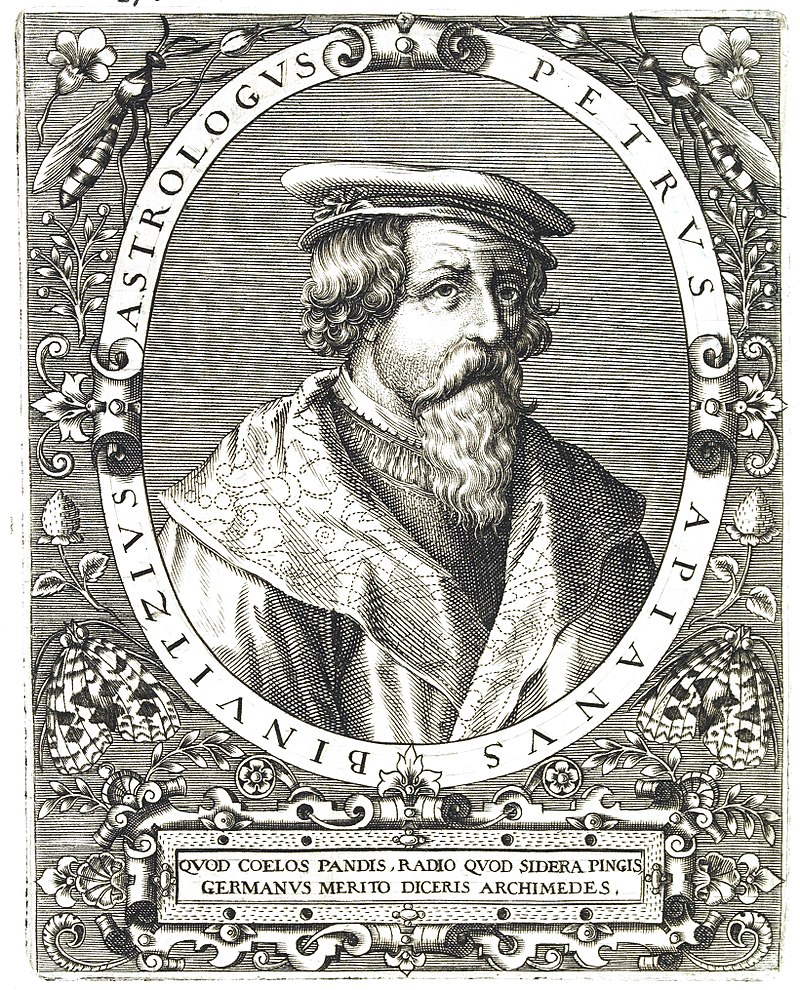
File:Peter_Apian.jpg · Wikimedia Commons · See Wikimedia Commons
Petrus Apianus
Sign in to saveAlso known as Peter Apian
German astronomer, mathematician and cartographer (1495-1552)
Wikidata facts
- Instance of
- human
- Given name
- Peter
- Gender
- male
- Citizenship
- Electorate of Saxony
- Place of birth
- Leisnig
- Place of death
- Ingolstadt
- Child
- Philipp Apian
- Occupation
- editor
- Educated at
- University of Vienna
- Employer
- University of Ingolstadt
- Languages spoken
- German
- Field of work
- publishing
- Movement
- German Renaissance
- Image
- Petrus Apianus (136142150).jpg
- Work location
- Ingolstadt
Show 11 more facts
- Commons category
- Petrus Apianus
- date of birth
- 1495-04-16
- date of death
- 1552-04-21
- Commons gallery
- Petrus Apianus
- Commons Creator page
- Petrus Apianus
- has works in the collection
- Metropolitan Museum of Art
- student
- Michael Maestlin
- name in native language
- Peter Apian
- maintained by WikiProject
- WikiProject Mathematics
- birth name
- Peter Bienewitz
- P13311
- Fonzaso
Sources (2)
via Wikidata · CC0
~8 min read
Encyclopedic overview
Apianus on a 16th-century engraving by Theodor de Bry Petrus Apianus (April 16, 1495 – April 21, 1552), also known as Peter Apian, Peter Bennewitz, and Peter Bienewitz, was a German humanist, known for his works in mathematics, astronomy and cartography. His work on "cosmography", the field that dealt with the earth and its position in the universe, was presented in his most famous publications, Astronomicum Caesareum (1540) and Cosmographicus liber (1524). His books were extremely influential in his time, with the numerous editions in multiple languages being published until 1609. The lunar crater Apianus and asteroid 19139 Apian are named in his honour.
Life and work
Excerpted from Wikipedia’s “Petrus Apianus” article, available under the CC BY-SA 4.0 licence.