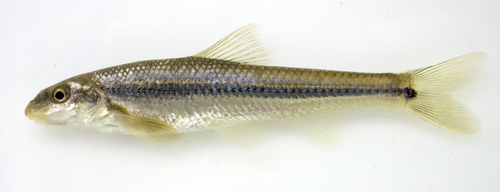
(c) Michi Tobler, all rights reserved, uploaded by Michi Tobler
Phenacobius
Sign in to savePhenacobius, the suckermouth minnows, is a genus of freshwater ray-finned fishes belonging to the family Leuciscidae, the shiners, daces and minnows. The fishes in this genus are endemic to the United States. Historically the suckermouth minnow was not found as far eastward as Ohio, now they seem to be a stable species living throughout the Midwest and parts of southern states such as Texas, New Mexico, and Alabama. Many forests and prairies were cleared out to make farmland, this caused for drainage streams and rivers to take form, moving the minnows eastward. Originally the suckermouth minno
Species
Suckermouth Minnow
GENUS
- KingdomAnimalia
- PhylumChordata
- ClassTeleostei
- OrderCypriniformes
- FamilyCyprinidae
via GBIF
Museum specimens
- Specimen records
- 12
- With media
- 1
- Family
- Cyprinidae
- Collections
- LSUMZ, CAS, AUM, UMMZ, CSUC, ODU
- Recorded in
- United States
Wikidata facts
- Instance of
- taxon
- Parent taxon
- Cyprinidae
- Image
- Phenacobius mirabilis.jpg
Show 4 more facts
- Commons category
- Phenacobius
- taxon name
- Phenacobius
- taxon rank
- genus
- topic's main category
- Category:Phenacobius
Sources (1)
via Wikidata · CC0
~4 min read
Encyclopedic overview
7 sectionsContents
- Species
- Description
- Length and weight
- Reproduction
- Food habitat
- Fishing
- References
Phenacobius, the suckermouth minnows, is a genus of freshwater ray-finned fishes belonging to the family Leuciscidae, the shiners, daces and minnows. The fishes in this genus are endemic to the United States. Historically the suckermouth minnow was not found as far eastward as Ohio, now they seem to be a stable species living throughout the Midwest and parts of southern states such as Texas, New Mexico, and Alabama. Many forests and prairies were cleared out to make farmland, this caused for drainage streams and rivers to take form, moving the minnows eastward. Originally the suckermouth minnows probably never crossed the Mississippi River prior to the developed farm land. They have a lifespan of roughly 3–5 years, but is hard to measure due to predation, survival rate of about 50 percent. There are currently five described species. Etymologically, "phenacobius" means "deceptive life", possibly because these species eat insects despite an herbivorous appearance.
== Species == Phenacobius contains the following species: Phenacobius catostomus D. S. Jordan, 1877 (Riffle minnow) Phenacobius crassilabrum W. L. Minckley & Craddock, 1962 (Fatlips minnow) Phenacobius mirabilis (Girard, 1856) (Suckermouth minnow) Phenacobius teretulus Cope, 1867 (Kanawha minnow) Phenacobius uranops Cope, 1867 (Stargazing minnow)
Excerpted from Wikipedia’s “Phenacobius” article, available under the CC BY-SA 4.0 licence.