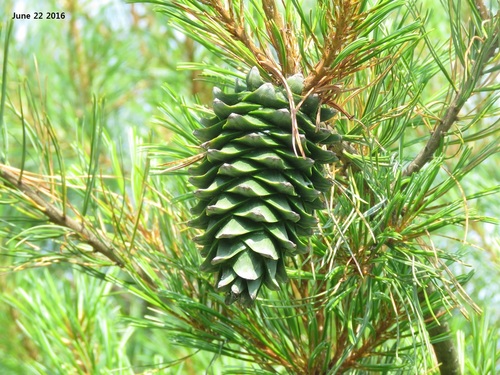
(c) Alexander Ganse, some rights reserved (CC BY-NC), uploaded by Alexander Ganse · cc-by-nc
Species
Korean pine
SPECIES
- KingdomPlantae
- PhylumTracheophyta
- ClassPinopsida
- OrderPinales
- FamilyPinaceae
General: Pinus koraiensis is rated as Least Concerned (LC) according
via GBIF · Kew POWO
Museum specimens
- Specimen records
- 192
- With media
- 148
- Family
- Pinaceae
- Collections
- MOR, CM, WCUH, NY, SBBG, MU
- Recorded in
- United States, China, Japan, Germany
Wikidata facts
- Instance of
- taxon
- Parent taxon
- Pinus
- Image
- Pinus koraiensis in Sikhote-Alin.jpg
- Has use
- medicinal plant
Show 10 more facts
- taxon author citation
- Siebold & Zucc.
- taxon rank
- species
- IUCN conservation status
- Least Concern
- taxon name
- Pinus koraiensis
- Commons category
- Pinus koraiensis
- Commons gallery
- Pinus koraiensis
- taxon common name
- 松树脂
- taxon range
- China
- short name
- P. koraiensis
Sources (3)
via Wikidata · CC0
~9 min read
Encyclopedic overview
Pinus koraiensis is a species of pine known commonly as the Korean pine. It is a relic species of the Tertiary, identified as a rare tree species by United Nations. It is native to eastern Asia, in Korea, northeastern China, the temperate rainforests of the Russian Far East, and central Japan. In the north of its range, it grows at moderate elevations, typically 600 to 900 metres (2,000 to 3,000 feet), whereas further south, it is a mountain tree, growing at 2,000 to 2,600 m (6,600 to 8,500 ft) elevation in Japan. Other common names include "Chinese pinenut". The ancient woodland of P. koraiensis on the earth is about 50 million hectares, and China has about 30 million hectares, accounting for 60%. It is a second-class national key protected plant in China. P. koraiensis is a tree species with high economic and ecological value. The official name in Chinese is "红松 hóng sōng/red pine", because almost every part of it is related to red.
According to some research, P. koraiensis can be divided into two natural types according to the thickness of the bark, namely Pinus koraiensis Sieb. et Zucc. f. pachidermis Wang et Chi and Pinus koraiensis Sieb. et Zucc. f. leptodermis Wang et Chi, though these are not accepted as distinct by the Plants of the World Online database.
Excerpted from Wikipedia’s “Pinus koraiensis” article, available under the CC BY-SA 4.0 licence.