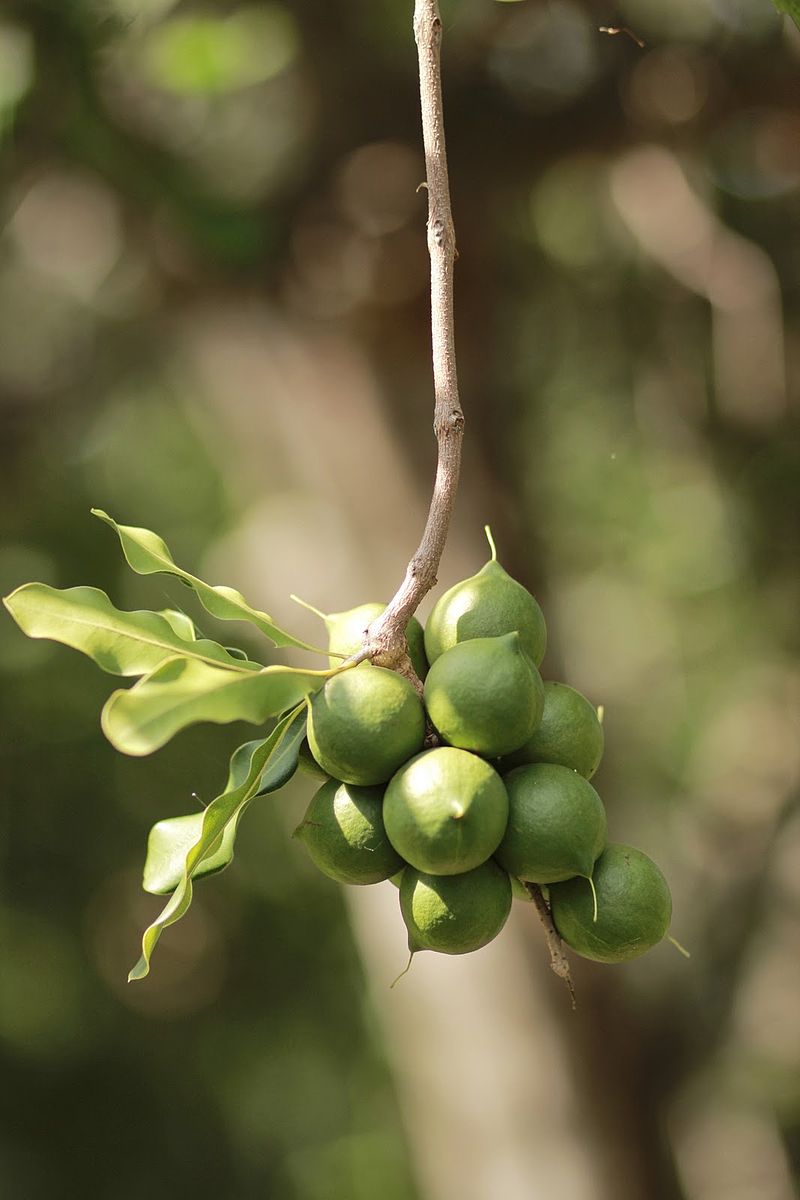
File:Macadamia_nuts_on_tree.JPG · Wikimedia Commons · See Wikimedia Commons
Macadamia
Sign in to saveMacadamia is a genus of four species of trees in the flowering plant family Proteaceae. They are indigenous to Australia—specifically, northeastern New South Wales and central and southeastern Queensland. Two species of the genus are commercially important for their fruit, the macadamia nut (or simply macadamia). Global production in 2025 was . Other names include Queensland nut, bush nut, maroochi nut or bauple nut. It was an important source of bushfood for the Aboriginal peoples.
OverviewAI-generated
Macadamia is a genus of plants in the family Proteaceae, belonging to the order Proteales and class Magnoliopsida. The scientific name is Macadamia F.Muell., and the genus was named after John Macadam. It is native to New South Wales and Queensland. Common names for the genus include macadamia and coohoy.
The genus has been documented in various collections, with 4,391 occurrences recorded. Specimens are held by institutions in Mexico, the United States, the Philippines, Papua New Guinea, and Nigeria. Macadamia nuts are a food product category, with 84 products listed. Nutritional data for these nuts indicates an energy value of 666 kcal, with 67.4 grams of fat, 16.8 grams of carbohydrates, and 6.9 grams of protein per serving.
Synthesized by Vinony from 49 facts across 9 sources: Wikidata, GBIF, iNaturalist, PubMed, Gbif Occ, Plants of the World, Openfoodfacts, iDigBio, Vinony graph. Generated from structured data (not the Wikipedia text) and checked against those facts — may still contain errors.
Species
Macadamia Tree
Macadamia
GENUS
- KingdomPlantae
- PhylumTracheophyta
- ClassMagnoliopsida
- OrderProteales
- FamilyProteaceae
Common Name: coohoy
via GBIF · Kew POWO
Museum specimens
- Specimen records
- 79
- With media
- 45
- Family
- Proteaceae
- Collections
- INECOL, SD, MO, A, MEL, BRIT
- Recorded in
- Mexico, United States, Philippines, Papua New Guinea, Nigeria, Australia, New Caledonia, Guinea
Nutrition · Open Food Facts
Typical values per 100 g · averaged across 84 products
- Energy
- 666 kcal
- Fat
- 67.4 g
- — of which saturates
- 11.4 g
- Carbohydrates
- 16.8 g
- — of which sugars
- 8.1 g
- Fibre
- 7.6 g
- Protein
- 6.9 g
- Salt
- 0.47 g
via Open Food Facts · ODbL
Research
517 papers- Exploring the Prospects of Macadamia Nutshells for Bio-Synthetic Polymer Composites: A Review.Polymers · 2023
- Macadamia nut effects on cardiometabolic risk factors: a randomised trial.Journal of nutritional science · 2023
- Challenges to optimal macadamia (Macadamia spp.) kernel quality in a changing climate.Functional plant biology : FPB · 2025
- Macadamia nut-specific IgE levels for predicting anaphylaxis.Pediatric allergy and immunology : official publication of the European Society of Pediatric Allergy and Immunology · 2022
- Household Food Items Toxic to Dogs and Cats.Frontiers in veterinary science · 2016
via PubMed
Wikidata facts
- Instance of
- taxon
- Parent taxon
- Proteaceae
- Named after
- John Macadam
- Image
- Macadamia integrifolia.jpg
Show 6 more facts
- taxon rank
- genus
- taxon name
- Macadamia
- Commons category
- Macadamia
- topic's main category
- Category:Macadamia
- taxon common name
- 澳洲坚果属
via Wikidata · CC0
~15 min read
Encyclopedic overview
23 sectionsContents
- Description
- Taxonomy
- Species
- Etymology
- Cultivation
- Cultivars
- Beaumont
- Maroochy
- Nelmac II
- Renown
- Production
- History
- Shelling
- Toxicity
- Allergen
- Toxicity in dogs and cats
- Uses
- Nutrition
- Other uses
- Modern history
- See also
- References
- External links
Macadamia is a genus of four species of trees in the flowering plant family Proteaceae. They are indigenous to Australia—specifically, northeastern New South Wales and central and southeastern Queensland. Two species of the genus are commercially important for their fruit, the macadamia nut (or simply macadamia). Global production in 2025 was . Other names include Queensland nut, bush nut, maroochi nut or bauple nut. It was an important source of bushfood for the Aboriginal peoples.
thumb|Fresh macadamia nut with husk or pericarp cut in half thumb|Stages of a Macadamia integrifolia nut: unripe, ripe, husk peeled, deshelled thumb|Roasted macadamia nuts with sawn nutshell, one cracked open
Excerpted from Wikipedia’s “Macadamia” article, available under the CC BY-SA 4.0 licence.