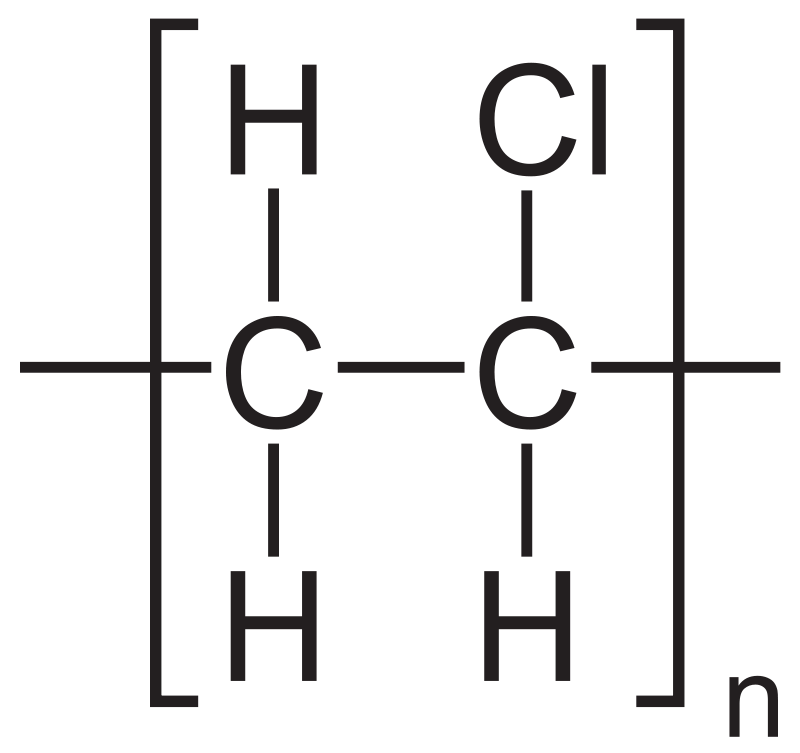
File:Polyvinylchlorid.svg · Wikimedia Commons · See Wikimedia Commons
polyvinyl chloride
Sign in to saveAlso known as polychloroethylene, poly(1-chloroethylene), poly(vinyl chloride), vinyl, polyvinyl, vinal, PVC
synthetic plastic polymer - A thermoplastic resin produced by the polymerization of vinyl chloride gas.
Polyvinyl chloride (PVC) is a synthetic plastic made by chemically combining vinyl chloride gas into long chains, creating a material that can be melted and reshaped when heated. It matters because its durability and versatility make it useful for many everyday products, from pipes and flooring to medical tubing and vinyl records.
AI-generated from the Wikipedia summary — may contain errors.
Research
9,886 papers- Vinyl chloride and polyvinyl chloride.ReviewOccupational medicine (Philadelphia, Pa.) · 1999Lewis R
- Hydrothermal treatment of polyvinyl chloride: Reactors, dechlorination chemistry, application, and challenges.ReviewChemosphere · 2023Ling M, Ma D, Hu X et al.DOI: 10.1016/j.chemosphere.2022.137718
- Polyvinyl chloride pneumoconiosis.Thorax · 1978Arnaud A, Pommier de Santi PP, Garbe L et al.DOI: 10.1136/thx.33.1.19
- [Plasticizers Used in Polyvinyl Chloride Toys (2019-2020)].Shokuhin eiseigaku zasshi. Journal of the Food Hygienic Society of Japan · 2023Abe Y, Yamaguchi M, Kataoka Y et al.DOI: 10.3358/shokueishi.64.145
- Acute Trimethyltin Poisoning Caused by Exposure to Polyvinyl Chloride Production: 8 Cases.ReviewThe American journal of the medical sciences · 2021Du YDOI: 10.1016/j.amjms.2021.02.010
- Carcinogenicity and epidemiological profile analysis of vinyl chloride and polyvinyl chloride.ReviewRegulatory toxicology and pharmacology : RTP · 1984Kalmaz EE, Kalmaz GDDOI: 10.1016/0273-2300(84)90003-5
- Comprehensive Review on Bio-Based Treatments for Polyvinyl Chloride Plastic.ReviewApplied biochemistry and biotechnology · 2025Hatwar N, Qureshi ADOI: 10.1007/s12010-024-05174-0
- Mechanistic Insights into Propylparaben Sorption on Polyvinyl Chloride.Journal of pharmaceutical sciences · 2024Correa-Soto CE, Sengupta R, Gonzales I et al.DOI: 10.1016/j.xphs.2024.03.025
via PubMed
Wikidata facts
Show 9 more facts
- described by source
- Armenian Soviet Encyclopedia
- CXSMILES
- [*]CC([Cl])[*] |Sg:n:1,2,3::ht|
- Commons category
- Polyvinyl chloride
- polymer of
- vinyl chloride
- melting point
- 200
- recycling code
- 03
- glass transition temperature
- 91.5
- density
- 1.39
- short name
- ПВХ
Sources (3)
via Wikidata · CC0
~24 min read
Encyclopedic overview
Polyvinyl chloride (alternatively: poly(vinyl chloride), colloquial: vinyl or polyvinyl; abbreviated: PVC) is the world's third-most widely produced synthetic polymer of plastic (after polyethylene and polypropylene). About 40 million tons of PVC are produced each year.
PVC comes in rigid (sometimes abbreviated as RPVC) and flexible forms. Rigid PVC is used in construction for pipes, doors and windows. It is also used in making plastic bottles, packaging, and bank or membership cards. Adding plasticizers makes PVC softer and more flexible. It is used in plumbing, electrical cable insulation, flooring, signage, phonograph records, inflatable products, and in rubber substitutes. With cotton or linen, it is used in the production of canvas.
Excerpted from Wikipedia’s “polyvinyl chloride” article, available under the CC BY-SA 4.0 licence.
Gallery (12)
Available in 73 languages
- Español
- Français
- Deutsch
- 中文
- 日本語
- Русский
- Português
- Italiano
- العربية
- हिन्दी
- Afrikaans
- Albanian
- Armenian
- Asturian
- azb
- Azerbaijani
- Bahasa Indonesia
- Bangla
Show 54 more
- Basque
- Bosnian
- Bulgarian
- Catalan
- Central Kurdish
- Croatian
- Czech
- Danish
- Esperanto
- Estonian
- Finnish
- Galician
- Greek
- Hebrew
- Hungarian
- Icelandic
- Irish
- Kazakh
- Kyrgyz
- Latvian
- Lithuanian
- Lombard
- Macedonian
- Malay
- Malayalam
- Nederlands
- Northern Frisian
- Norwegian
- Occitan
- Pashto
- Polski
- Punjabi
- Romanian
- Serbian
- Serbian (Latin)
- simple
- Slovak
- Slovenian
- Sundanese
- Svenska
- Tamil
- Tatar
- Telugu
- Tiếng Việt
- Türkçe
- Ukrainian
- Uyghur
- Uzbek
- Waray
- zh_min_nan
- zh_yue
- فارسی
- ไทย
- 한국어
via Wikidata sitelinks · CC0