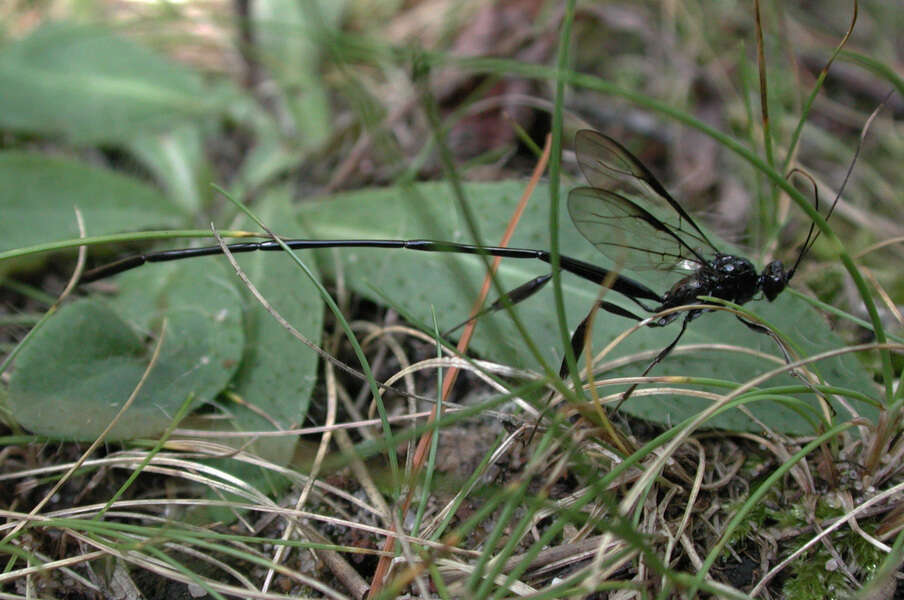
Encyclopedia of Life · EOL (see source)
Proctotrupoidea
Sign in to saveProctotrupoidea is a hymenopteran superfamily containing seven extant families, though others have been recognized in the past, most of these having been removed to a recently erected superfamily Diaprioidea. Of the remaining families, only Proctotrupidae contains a substantial number of species, with over 400 described. The others are small, often relictual groups. See links for individual families for details of life history and diversity.
Species
This is a large and diverse group of parasitic Hymenoptera, but the North American proctotrupoid fauna has had little critical study with the result that apparently most of our species remain undescribed. The only comprehensive treatments of the North American Proctotrupoidea are that by Ashmead, in 1893, and that included by Kieffer in his monograph of the world fauna, which comprises three volumes that were published between 1914 and 1926. Kieffer used the name Serphoidea, based on Serphus Schrank, 1780, for this superfamily and that usage was followed generally in the literature of the next thirty years; but Serphus Schrank was set aside by the International Commission on Zoological Nomenclature in 1946 (Opinion 178), under suspension of the Rules, and its synonym Proctotrupes Latreille, 1796, with P. brevipennis Latreille as type-species, was added to the Official List of Generic Names in Zoology as Name No. 616. As a result of that action the name Proctotrupoidea has come into general use again. ~I am indebted to Dr. Lubomir Masner, biosystematics Research Institute, Canada Department of Agriculture, for much helpful advice and for new records, in connection with the preparati
via
Museum specimens
- Specimen records
- 107
- Family
- Proctotrupoidea
- Collections
- SDNHM, CLEVELAND MUSEUM OF NATURAL HISTORY, OH (CLEV)
- Recorded in
- United States
Wikidata facts
Show 4 more facts
- topic's main category
- Category:Proctotrupoidea
- taxon name
- Proctotrupoidea
- taxon rank
- superfamily
- Commons category
- Proctotrupoidea
Sources (1)
via Wikidata · CC0
~1 min read
Encyclopedic overview
2 sectionsContents
- See also
- References
Proctotrupoidea is a hymenopteran superfamily containing seven extant families, though others have been recognized in the past, most of these having been removed to a recently erected superfamily Diaprioidea. Of the remaining families, only Proctotrupidae contains a substantial number of species, with over 400 described. The others are small, often relictual groups. See links for individual families for details of life history and diversity.
==See also== Tree of Life Apocrita; shows polyphyletic Proctotrupoidea.
Excerpted from Wikipedia’s “Proctotrupoidea” article, available under the CC BY-SA 4.0 licence.