
File:Marie_Curie_c._1920s.jpg · Wikimedia Commons · See Wikimedia Commons
Q7186
Sign in to savePolish-French physicist and chemist (1867–1934)
OverviewAI-generated
Marie Curie, born Marya Salomea Skłodowska in Warsaw in 1867, was a physicist, chemist, and university teacher. She worked in the fields of radioactivity, chemistry, physics, and radium. Curie was educated at the Flying University and the University of Paris. Her doctoral advisor was Gabriel Lippmann. She was married to Pierre Curie and had two children, Irène Joliot-Curie and Ève Curie.
Curie received the Nobel Prize in Physics and the Nobel Prize in Chemistry. She also received the Willard Gibbs Award and the John Scott Award. She was a member of the German Academy of Sciences Leopoldina, the Saint Petersburg Academy of Sciences, the Academy of Sciences of the USSR, and the Royal Swedish Academy of Sciences. Her doctoral students included André-Louis Debierne, Marguerite Perey, Branca Edmée Marques, and Ștefania Mărăcineanu. She died in 1934 and is buried in the Panthéon.
Synthesized by Vinony from 47 facts across 8 sources: Wikidata, Firecrawl, TMDb, VIAF, MusicBrainz, Nobel Prize, Vinony collections, Vinony graph. Generated from structured data (not the Wikipedia text) and checked against those facts — may still contain errors.
Film & TV
Acting · Warsaw, Poland
Known for
- Duels of History2024
- 100 Years of the Atom — Self (archive footage)2020
- The Genius of Marie Curie: The Woman Who Lit up the World — Herself (archive footage)2013
- Marie Curie: Beyond the Myth — Self2011
- Life Begins Tomorrow — Self (archive footage)1950
via TMDB
Music · MusicBrainz
- Type
- Person
- Gender
- Female
- Country
- France
- Active from
- 1867
- Active to
- 1934
via MusicBrainz · CC0
Authority record · VIAF
- Lifespan
- 1867–1934
- Nationality
- FR, PL
- Role / Field
- Physicists, Fyzicky, Chemists, Chemicky, Zinatniece, Chemia
- Language
- fre, pol, fra
- Gender
- Female
Recorded by 40 libraries
via VIAF · OCLC
Nobel Prizes (2)
- The Nobel Prize in Physics1903
“in recognition of the extraordinary services they have rendered by their joint researches on the radiation phenomena discovered by Professor Henri Becquerel”
Shared · 1/4 portion
- The Nobel Prize in Chemistry1911
“in recognition of her services to the advancement of chemistry by the discovery of the elements radium and polonium, by the isolation of radium and the study of the nature and compounds of this remarkable element”
Described at
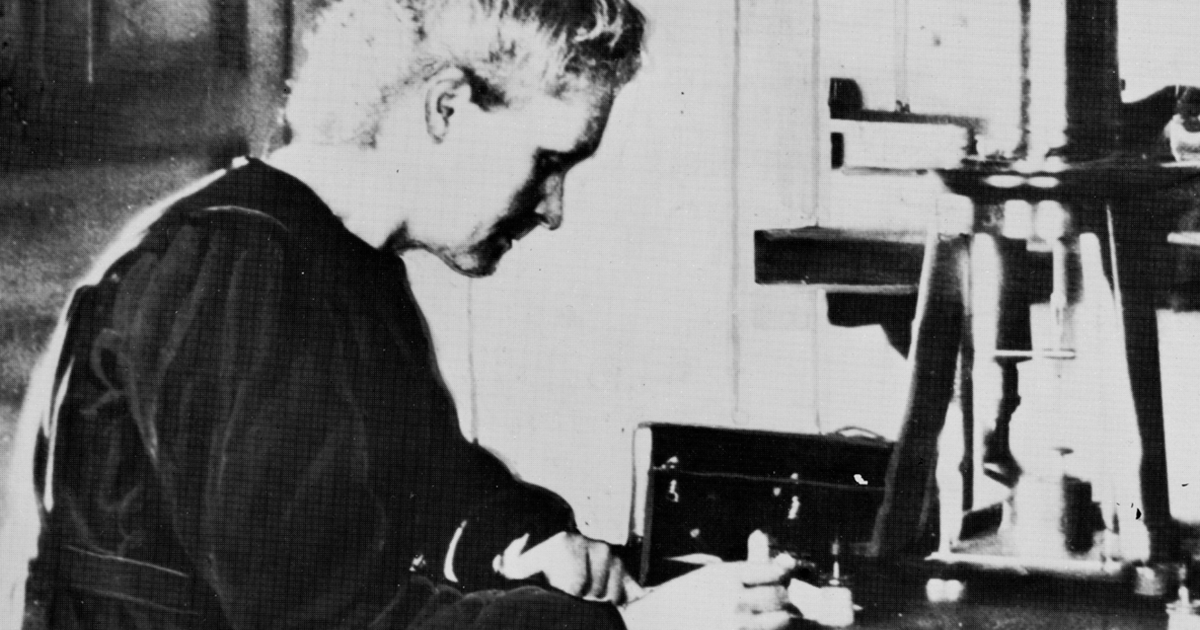
Marie Curie - Marie Curie and Her Legend
history.aip.org →Link to a page describing this subject · 6,844 chars · not written by Vinony
Wikidata facts
- Instance of
- human
- Gender
- female
- Citizenship
- Russian Empire
- Place of birth
- Warsaw
- Place of death
- Sancellemoz
- Spouse
- Pierre Curie
- Child
- Ève Curie
- Father
- Władysław Skłodowski
- Sibling
- Helena Skłodowska-Szalay
- Occupation
- university teacher
- Position held
- professor
- Educated at
- University of Paris
- Employer
- Curie Institute
- Languages spoken
- English language
- Native language
- Polish
- Religion
- agnosticism
- Academic degree
- doctorate
- Doctoral advisor
- Gabriel Lippmann
- Doctoral student
- Ștefania Mărăcineanu
- Field of work
- polonium
- Image
- Marie Curie (1900) (cropped).jpg
- Coat of arms
- Dołęga
- Residence
- Paris
- Significant event
- funeral
Show 24 more facts
- birth name
- Marya Salomea Skłodowska
- Commons category
- Marie Curie
- date of birth
- 1867-11-07
- date of death
- 1934-07-04
- topic's main category
- Category:Marie Curie
- Erdős number
- 7
- name in native language
- Maria Skłodowska-Curie
- Commons gallery
- Maria Skłodowska-Curie
- Commons Creator page
- Marie Curie
- nominated for
- Nobel Prize in Chemistry
- cause of death
- aplastic anemia
- IPA transcription
- ˈmarja salɔˈmɛa skwɔˈdɔfska
- manner of death
- natural causes
- archives at
- Bibliothèque nationale de France
- writing language
- Polish
- P6482
- Q7186
- described at URL
- history.aip.org/exhibits/curie/romleg.htm
- handedness
- left-handedness
- maintained by WikiProject
- WikiProject Mathematics
- relative
- Józef Boguski
- P8168
- Joseph Trumbull
- ethnic group
- Poles
- student
- Irène Joliot-Curie
- interested in
- experimental physics
Sources (15)
via Wikidata · CC0
~40 min read
Encyclopedic overview
Maria Salomea Skłodowska Curie ( Polish: [ˈmarja salɔˈmɛa skwɔˈdɔfska kiˈri] ; née Skłodowska; 7 November 1867 – 4 July 1934), better known as Marie Curie (/ˈkjʊəri/ KURE-ee; French: [maʁi kyʁi] ), was a Polish and naturalised-French physicist and chemist. She shared the 1903 Nobel Prize in Physics with her husband Pierre Curie "for their joint researches on the radioactivity phenomena discovered by Professor Henri Becquerel". She won the 1911 Nobel Prize in Chemistry "[for] the discovery of the elements radium and polonium, by the isolation of radium and the study of the nature and compounds of this remarkable element".
She was the first woman to win a Nobel Prize, the first person to win a Nobel Prize twice, and the only person to win a Nobel Prize in two different scientific fields. Marie and Pierre were the first married couple to win the Nobel Prize and launching the Curie family legacy of five Nobel Prizes. She was, in 1906, the first woman to become a professor at the University of Paris.
Excerpted from Wikipedia’s “Q7186” article, available under the CC BY-SA 4.0 licence.
Gallery (13)
Available in 196 languages
- Español
- Français
- Deutsch
- 中文
- 日本語
- Русский
- Português
- Italiano
- العربية
- हिन्दी
- abstract
- Afrikaans
- Albanian
- Albanian
- Amharic
- Aragonese
- Armenian
- Assamese
Show 177 more
- Asturian
- Aymara
- azb
- Azerbaijani
- Bahasa Indonesia
- Balinese
- Bangla
- Bashkir
- Basque
- bat_smg
- Bavarian
- be_x_old
- Belarusian
- Betawi
- Bhojpuri
- Bikol
- Bislama
- Bosnian
- Breton
- btm
- Bulgarian
- Buriat
- Burmese
- Catalan
- Cebuano
- Central Dusun
- Central Kurdish
- Chechen
- Chuvash
- Cornish
- Crimean Tatar
- Croatian
- Czech
- Danish
- dty
- Egyptian Arabic
- Esperanto
- Estonian
- Extremaduran
- Faroese
- Fiji Hindi
- Filipino
- Finnish
- Fon
- Galician
- Gan Chinese
- gcr
- Georgian
- gpe
- Greek
- Guarani
- Gujarati
- Haitian Creole
- Hakka Chinese
- Hausa
- Hebrew
- Hungarian
- hyw
- Iban
- Icelandic
- Ido
- Iloko
- Inari Sami
- Interlingua
- Irish
- Jamaican Creole English
- Javanese
- Kabyle
- Kannada
- Kanuri
- Kara-Kalpak
- Kashmiri
- Kashubian
- Kazakh
- kbp
- Khmer
- Kurdish
- Kyrgyz
- Ladino
- Lao
- Latin
- Latvian
- Ligurian
- Limburgish
- Lithuanian
- Lojban
- Lombard
- Low German
- Luxembourgish
- Macedonian
- Madurese
- Maithili
- Malagasy
- Malay
- Malayalam
- Maltese
- Manipuri
- map_bms
- Marathi
- Mazanderani
- Minangkabau
- Mingrelian
- mnw
- Mongolian
- Moroccan Arabic
- nah
- nds_nl
- Nederlands
- Nepali
- Newari
- Northern Frisian
- Norwegian
- Norwegian Nynorsk
- Obolo
- Occitan
- Odia
- olo
- Oromo
- Pampanga
- Pashto
- Picard
- Piedmontese
- Polski
- ppl
- Punjabi
- Quechua
- roa_rup
- Romanian
- Rusyn
- Sanskrit
- Santali
- Scots
- Scottish Gaelic
- Serbian
- Serbian (Latin)
- Sicilian
- simple
- Sindhi
- Sinhala
- Slovak
- Slovenian
- Southern Altai
- Sundanese
- Svenska
- Swahili
- Tajik
- Tamil
- Tatar
- Telugu
- Tiếng Việt
- Toki Pona
- Tswana
- Tulu
- Türkçe
- Tuvinian
- Udmurt
- Ukrainian
- Urdu
- Uzbek
- Veps
- Volapük
- Waray
- Welsh
- Western Frisian
- Western Panjabi
- Wu Chinese
- Yakut
- Yiddish
- Yoruba
- Zaza
- Zeelandic
- zh_classical
- zh_min_nan
- zh_yue
- فارسی
- ไทย
- 한국어
via Wikidata sitelinks · CC0