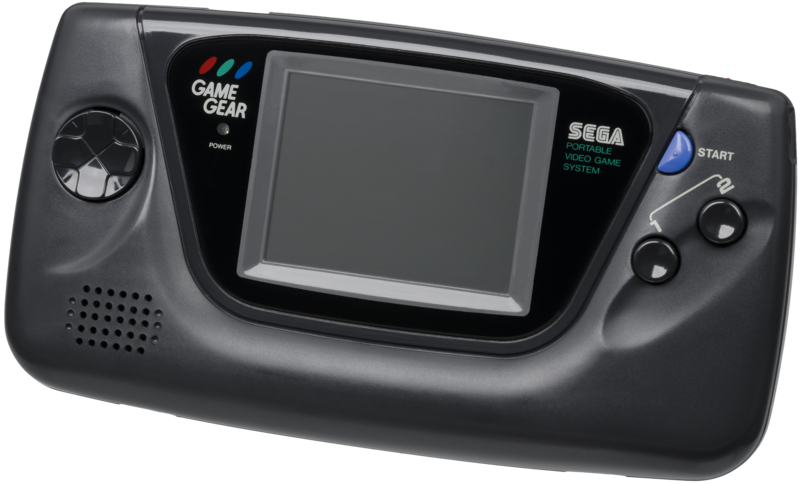
File:Sega-Game-Gear-WB.png · Wikimedia Commons · See Wikimedia Commons
Game Gear
Sign in to savehandheld game console developed by Sega
Key facts
- Manufacturer
- Sega
- Type
- Handheld video game console
- Generation
- Fourth
- Released
- JP : October 6, 1990 NA / EU : April 1991 AU : 1992
- Introductory price
- ¥19,800 (equivalent to ¥24,000 in 2024), US$149.99 (equivalent to $350 in 2025) , £99.99 (equivalent to £230 in 2025)
- Discontinued
- WW : April 30, 1997 (Sega) NA : 2002 ( Majesco Entertainment )
- Units sold
- Around 14 million
- Media
- ROM cartridge
- Cpu
- Zilog Z80 @ 3.5 MHz
- Memory
- 8 KB RAM , 16 KB VRAM
- Display
- 3.2 in (81 mm) backlit LCD , 160 × 144 px
- Graphics
- 4,096-color palette, 32 colors on-screen
- Sound
- SN76489 Mono speaker Headphone jack
- Power
- 6 × AA batteries (3 to 5 hours)
- Dimensions
- 210 × 113 × 38 mm (8.3 × 4.4 × 1.5 in)
- Best selling game
- Sonic the Hedgehog 2 (400,000)
- Successor
- Genesis Nomad
via Wikipedia infobox
Wikidata facts
- Subclass of
- handheld game console
- Followed by
- Sega Nomad
- Manufacturer
- Sega
- Image
- Game-Gear-Handheld.jpg
Show 9 more facts
- Commons category
- Sega Game Gear
- topic's main category
- Category:Game Gear
- Commons gallery
- Sega Game Gear
- publication date
- 1992-00-00
- units sold
- 10620000
- discontinuation date
- 1997-04-30
- CPU
- Zilog Z80
- price
- 99.99
- title
- Gēmu Gia
Sources (3)
via Wikidata · CC0
~19 min read
Encyclopedic overview
The Game Gear is a handheld game console developed and marketed by Sega. It was released in Japan on October 6, 1990, in North America and Europe in April 1991, and in Australia in 1992. The Game Gear was Sega's first handheld console and competed with Nintendo's Game Boy, Atari's Lynx, and NEC's TurboExpress in the fourth generation of video game consoles.
Sega rushed the 8-bit Game Gear to market to compete with the Game Boy. It shares much of its hardware with the Master System, and can play Master System games with an adapter. Its hardware is superior to the Game Boy's, with a full-color backlit screen and a Z80 CPU. However, it resulted in a much shorter battery life, running for three to five hours on six AA batteries. Sega based the landscape design on the Sega Genesis controller and sought to repeat the Genesis's success by positioning the Game Gear as a more mature and attractive alternative to the Game Boy.
Excerpted from Wikipedia’s “Game Gear” article, available under the CC BY-SA 4.0 licence.