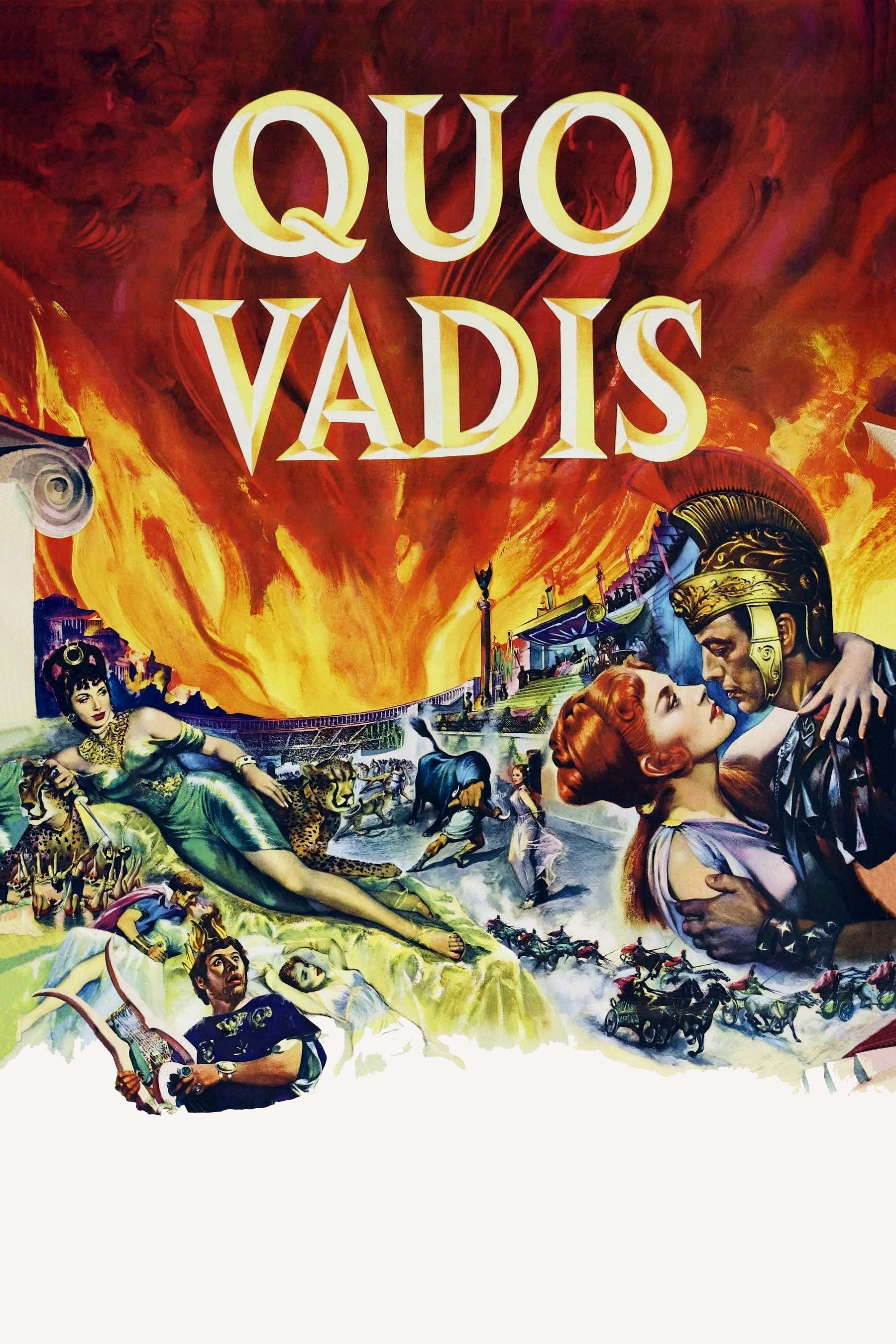
Poster from TMDB
OverviewAI-generated
Quo Vadis is a 1951 American drama and sword-and-sandal film directed by Mervyn LeRoy. The screenplay was written by S. N. Behrman, Sonya Levien, and Henryk Sienkiewicz, based on the work by Sienkiewicz. The cast includes Robert Taylor, Deborah Kerr, Peter Ustinov, and Leo Genn, with Walter Pidgeon serving as narrator. Produced by Sam Zimbalist for Metro-Goldwyn-Mayer, the film was shot in English.
The movie has a runtime of 171 minutes and was released on November 8, 1951. It was distributed by Metro-Goldwyn-Mayer and Netflix. The film received an IMDb rating of 7.1 from 18,529 votes and a Metascore of 65. It was nominated for the Academy Award for Best Picture, Best Supporting Actor, and Best Film Editing, among eight total Oscar nominations.
Synthesized by Vinony from 47 facts across 5 sources: Wikidata, TMDb, IMDb, OMDb, Vinony graph. Generated from structured data (not the Wikipedia text) and checked against those facts — may still contain errors.
Film · TMDB
7.1After fierce Roman commander Marcus Vinicius becomes infatuated with beautiful Christian hostage Lygia, he begins to question the tyrannical leadership of the despotic emperor Nero.
Cast
- Robert Taylor as Marcus Vinicius
- Deborah Kerr as Lygia
- Leo Genn as Petronius
- Peter Ustinov as Nero
- Patricia Laffan as Poppaea
- Finlay Currie as Peter
Themes
- suicide
- based on novel or book
- rome, italy
- roman empire
- christianity
- emperor
- ancient rome
- burning
- roman army
- nero
This product uses the TMDB API but is not endorsed or certified by TMDB.
Ratings
IMDb
7.1/10
17,840 votes
Rotten Tomatoes
84%
Metacritic
65/100
- Year
- 1951
- Runtime
- 171 min
- Genres
- Drama, Romance
- Rated
- Approved
- Awards
- Nominated for 8 Oscars. 9 wins & 10 nominations total
via OMDb · IMDb
Key facts
- Directed by
- Mervyn LeRoy
- Screenplay by
- S. N. Behrman , Sonya Levien , John Lee Mahin
- Based on
- Quo Vadis , 1896 novel, by Henryk Sienkiewicz
- Produced by
- Sam Zimbalist
- Starring
- Robert Taylor , Deborah Kerr , Leo Genn , Peter Ustinov
- Cinematography
- Robert Surtees , William V. Skall
- Edited by
- Ralph E. Winters
- Music by
- Miklós Rózsa
- Production company
- Metro-Goldwyn-Mayer
- Distributed by
- Loew's, Inc.
- Release date
- November 2, 1951 ( 1951-11-02 )
- Running time
- 171 minutes
- Country
- United States
- Language
- English
- Budget
- $7.6 million
- Box office
- $21 million
via Wikipedia infobox
Wikidata facts
- Instance of
- film
- Country of origin
- United States
- Original language
- English language
- Based on
- Quo Vadis
- Director
- Mervyn LeRoy
- Screenwriter
- Henryk Sienkiewicz
- Cast member
- Elspeth March
- Composer
- Miklós Rózsa
- Producer
- Sam Zimbalist
- Production company
- Metro-Goldwyn-Mayer
- Cinematographer
- William V. Skall
- Narrative location
- Rome
- Duration
- 171
- FilmAffinity ID
- 434938
- Distribution format
- video on demand
Show 13 more facts
- Commons category
- Quo Vadis (1951 film)
- publication date
- 1951-01-01
- film editor
- Ralph E. Winters
- title
- Quo Vadis
- narrator
- Walter Pidgeon
- distributed by
- Netflix
- after a work by
- Henryk Sienkiewicz
- film crew member
- David S. Hall
- assessment
- Bechdel test
- different from
- Quo Vadis
- review score
- 84%
- characters
- Jesus
- capital cost
- 7623000
Sources (15)
via Wikidata · CC0
~23 min read
Encyclopedic overview
Quo Vadis (Latin for "Where are you going?") is a 1951 American religious epic historical film set in ancient Rome during the final years of Emperor Nero's reign, based on the 1896 novel of the same title by Polish Nobel Laureate author Henryk Sienkiewicz. Produced by Metro-Goldwyn-Mayer and filmed in Technicolor, it was directed by Mervyn LeRoy from a screenplay by S. N. Behrman, Sonya Levien, and John Lee Mahin. It is the fourth screen adaptation of Sienkiewicz's novel. The film stars Robert Taylor, Deborah Kerr, Leo Genn, and Peter Ustinov, and features Patricia Laffan, Finlay Currie, Abraham Sofaer, Marina Berti, Buddy Baer, and Felix Aylmer. Future Italian stars Sophia Loren and Bud Spencer appeared as uncredited extras. The score is by Miklós Rózsa and the cinematography by Robert Surtees and William V. Skall. The film was released by Metro-Goldwyn-Mayer on November 2, 1951.
The story, set between 64 and 68 AD, combines both historical and fictional events and characters, and compresses the key events of that period into the space of only a few weeks. Its main theme is the Roman Empire’s conflict with Christianity and persecution of Christians in the final years of the Julio-Claudian line. Unlike his illustrious and powerful predecessor, Emperor Claudius, Nero proved corrupt and destructive, and his actions eventually threatened to destroy Rome's previously peaceful social order. The title refers to an incident in the apocryphal Acts of Peter.
Excerpted from Wikipedia’s “Quo Vadis” article, available under the CC BY-SA 4.0 licence.