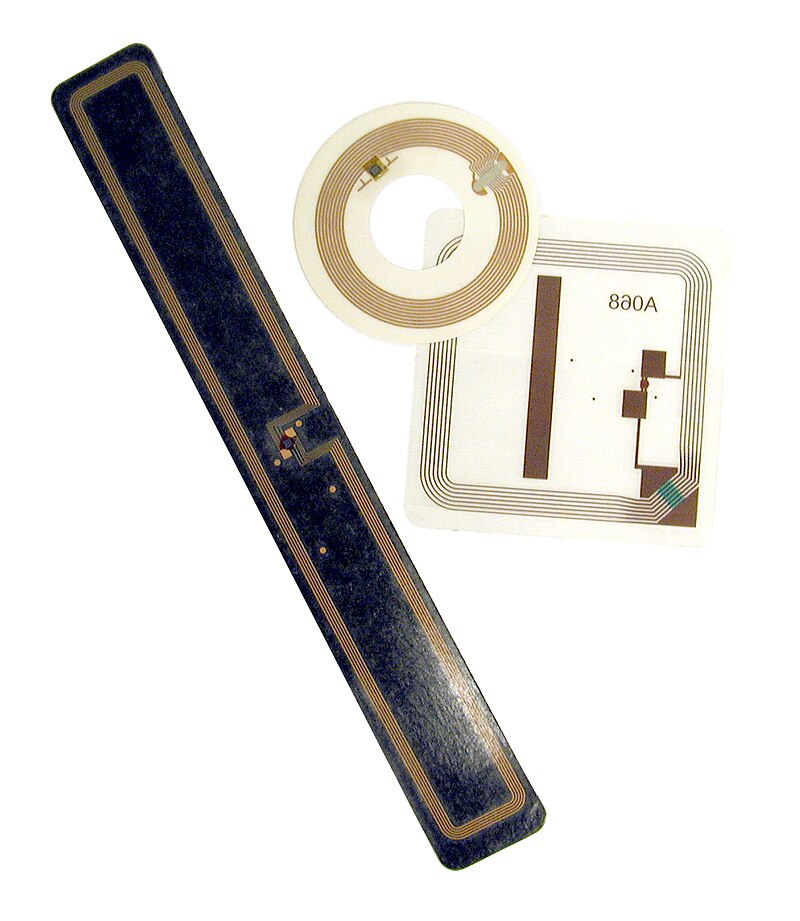
File:RFID_Tags.jpg · Wikimedia Commons · See Wikimedia Commons
radio-frequency identification
Sign in to saveAlso known as RFID, radio frequency identifier
technology using electromagnetic fields to automatically identify and track tags attached to objects
Radio-frequency identification is a technology that uses electromagnetic fields to automatically identify and track tags attached to objects. It matters because it enables quick, automatic identification of items without requiring physical contact or line-of-sight scanning, making it useful for applications like inventory management, asset tracking, and product authentication.
AI-generated from the Wikipedia summary — may contain errors.
Wikidata facts
- Subclass of
- radio communication
- Image
- Santa Gertrudis.jpg
Show 4 more facts
- short name
- RFID
- Commons category
- RFID
- topic's main category
- Category:Radio-frequency identification
- P13411
- Aisne
Sources (3)
via Wikidata · CC0
~40 min read
Encyclopedic overview
Textile RFID tag for laundry with printed EPC and QR code
Radio-frequency identification (RFID) uses electromagnetic fields to automatically identify and track tags attached to objects. An RFID system consists of a tiny radio transponder called a tag, a radio receiver, and a transmitter. When triggered by an electromagnetic interrogation pulse from a nearby RFID reader device, the tag transmits digital data, usually an identifying inventory number, back to the reader. This number can be used to track inventory goods.
Excerpted from Wikipedia’s “radio-frequency identification” article, available under the CC BY-SA 4.0 licence.
Gallery (12)
Available in 62 languages
- Español
- Français
- Deutsch
- 中文
- 日本語
- Русский
- Português
- Italiano
- العربية
- हिन्दी
- Albanian
- Bahasa Indonesia
- Bangla
- Basque
- Belarusian
- Bulgarian
- Catalan
- Chuvash
Show 43 more
- Croatian
- Czech
- Danish
- Esperanto
- Estonian
- Finnish
- Greek
- Hebrew
- Hungarian
- Icelandic
- Kannada
- Kazakh
- Khmer
- Kikuyu
- Latvian
- Low German
- Malay
- Mongolian
- Nederlands
- Norwegian
- Norwegian Nynorsk
- Occitan
- Polski
- Punjabi
- Romanian
- Serbian
- simple
- skr
- Slovak
- Slovenian
- Svenska
- Tamil
- Tiếng Việt
- Türkçe
- Ukrainian
- Urdu
- Uzbek
- Western Panjabi
- Wu Chinese
- zh_yue
- فارسی
- ไทย
- 한국어
via Wikidata sitelinks · CC0