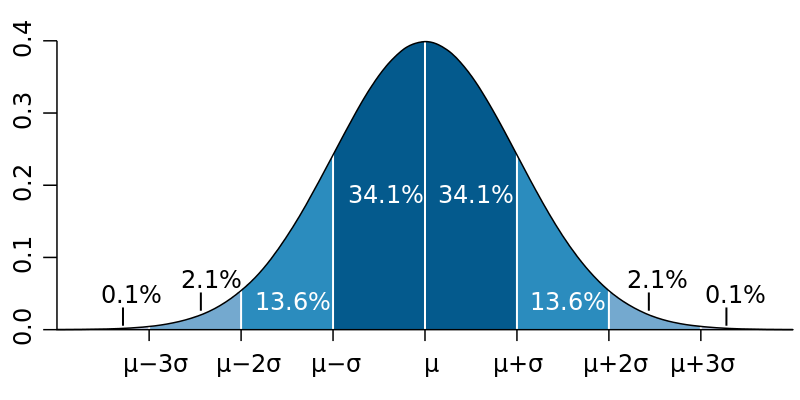
File:Standard_deviation_diagram_micro.svg · Wikimedia Commons · See Wikimedia Commons
randomness
Sign in to savethumb|alt=|A Pseudorandom Number Generator|pseudorandomly generated [[bitmap]] In common usage, randomness is the apparent or actual lack of definite patterns or predictability in information. A random sequence of events, symbols or steps often has no order and does not follow an intelligible pattern or combination. Individual random events are, by definition, unpredictable, but if there is a known probability distribution, the frequency of different outcomes over repeated events (or "trials") is predictable. For example, when throwing two dice, the outcome of any particular roll is unpredicta
Randomness describes when events or information appear to have no predictable pattern or order, even though individual outcomes cannot be foreseen. While we cannot predict what will happen in any single random event, we can predict how often different outcomes will occur over many repeated events if we know the underlying probabilities—like how rolling two dice will average certain results over time.
AI-generated from the Wikipedia summary — may contain errors.
In the Vinony graph
Within Vinony's link graph, randomness is referenced by 563 other articles, and connects out to median, pseudorandom number generator and resampling.
It sits within the topics Cryptography, Randomness and Statistical randomness.
Its subject is documented across 48 Wikipedia language editions.
Wikidata facts
- Image
- Roulette wheel.jpg
Show 4 more facts
- Commons category
- Randomness
- Stack Exchange tag
- stackoverflow.com/tags/random
- Unicode character
- 🔀
- hashtag
- random
Sources (6)
via Wikidata · CC0
~23 min read
Encyclopedic overview
22 sectionsContents
- History
- In science
- In the physical sciences
- In biology
- In mathematics
- In statistics
- In information science
- In finance
- In politics
- Randomness and religion
- Applications
- Generation
- Measures and tests
- Misconceptions and logical fallacies
- Fallacy: a number is "due"
- Fallacy: a number is "cursed" or "blessed"
- Fallacy: odds are never dynamic
- See also
- Notes
- References
- Further reading
- External links
thumb|alt=|A Pseudorandom Number Generator|pseudorandomly generated [[bitmap]] In common usage, randomness is the apparent or actual lack of definite patterns or predictability in information. A random sequence of events, symbols or steps often has no order and does not follow an intelligible pattern or combination. Individual random events are, by definition, unpredictable, but if there is a known probability distribution, the frequency of different outcomes over repeated events (or "trials") is predictable. For example, when throwing two dice, the outcome of any particular roll is unpredictable, but a sum of 7 will tend to occur twice as often as 4. In this view, randomness is not haphazardness; it is a measure of uncertainty of an outcome. Randomness applies to concepts of chance, probability, and information entropy.
The fields of mathematics, probability, and statistics use formal definitions of randomness, typically assuming that there is some 'objective' probability distribution. In statistics, a random variable is an assignment of a numerical value to each possible outcome of an event space. This association facilitates the identification and the calculation of probabilities of the events. Random variables can appear in random sequences. A random process is a sequence of random variables whose outcomes do not follow a deterministic pattern, but follow an evolution described by probability distributions. These and other constructs are extremely useful in probability theory and the various applications of randomness.
Excerpted from Wikipedia’s “randomness” article, available under the CC BY-SA 4.0 licence.
Gallery (10)
Available in 48 languages
- Español
- Français
- Deutsch
- 中文
- 日本語
- Русский
- Português
- Italiano
- العربية
- हिन्दी
- Afrikaans
- Albanian
- Azerbaijani
- Bahasa Indonesia
- Basque
- Belarusian
- Bulgarian
- Central Kurdish
Show 29 more
via Wikidata sitelinks · CC0