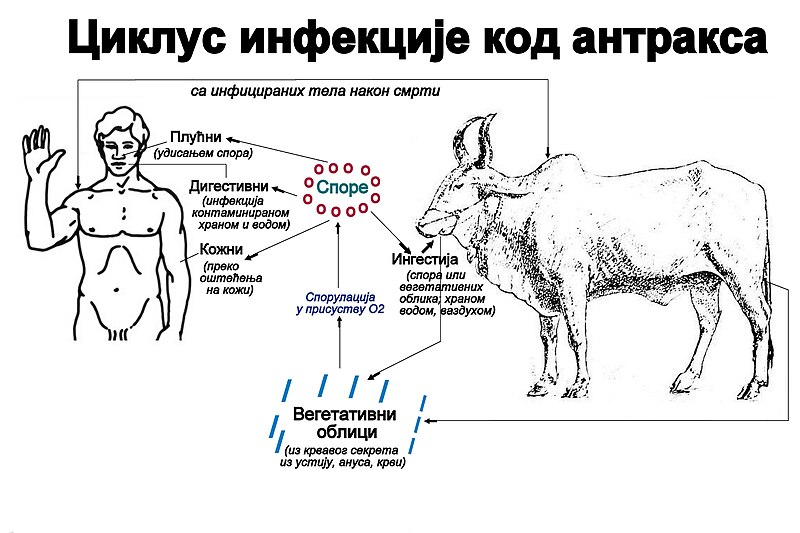
File:Cycle_of_infection_in_anthrax.jpg · Wikimedia Commons · See Wikimedia Commons
Robert Koch
Sign in to saveAlso known as Koch, Heinrich Hermann Robert Koch, Robert Heinrich Hermann Koch, R. Koch, R Koch, Koch R, Koch R.
German physician, bacteriologist (1843–1910)
OverviewAI-generated
Robert Koch was a German biologist, physician, inventor, and photographer born in Clausthal in 1843. He held citizenship in the Kingdom of Hanover and the German Empire. Koch worked in the field of microbiology and was employed by the Humboldt-Universität zu Berlin. He participated in the Franco-Prussian War. His doctoral advisors were Georg Meissner and Rudolf Virchow. He supervised doctoral students including Emil von Behring, Friedrich Loeffler, Kitasato Shibasaburō, and August von Wassermann.
Koch received the Nobel Prize in Physiology or Medicine and the Bavarian Maximilian Order for Science and Art. He was a member of the Royal Society, the Royal Prussian Academy of Sciences, the Royal Swedish Academy of Sciences, and the American Academy of Arts and Sciences. He was educated at the University of Göttingen. His works include *Berichte über Die Tätigkeit der Malariaexpedition 1899-1900* and *Die Bekämpfung der Infektionskrankheiten Inbesondere der Kriegsseuchen*. He died of myocardial infarction in Baden-Baden in 1910.
Synthesized by Vinony from 32 facts across 5 sources: Wikidata, Europeana Sparql, Open Library, Nobel Prize, Vinony collections. Generated from structured data (not the Wikipedia text) and checked against those facts — may still contain errors.
Person · Open Library
- Works
- 71
Top works
- Berichte über Die Tätigkeit der Malariaexpedition 1899-1900
- CHRISTIANITY
- Die Bekämpfung der Infektionskrankheiten Inbesondere der Kriegsseuchen
- Prof. Koch's Method to Cure Tuberculosis Popularly Treated - Robert Koch
- Professor Koch on the Bacteriological Diagnosis of Cholera, Water-Filtration and Cholera, and the Cholera in Germany During the Winter Of 1892-93
via Open Library + Wikidata
Nobel Prize
- The Nobel Prize in Physiology or Medicine1905
“for his investigations and discoveries in relation to tuberculosis”
Wikidata facts
- Instance of
- human
- Given name
- Heinrich
- Family name
- Koch
- Gender
- male
- Citizenship
- German Empire
- Place of birth
- Clausthal
- Place of death
- Baden-Baden
- Occupation
- military physician
- Educated at
- University of Göttingen
- Employer
- Humboldt-Universität zu Berlin
- Languages spoken
- German
- Notable work
- Koch's postulates
- Academic degree
- Doctor
- Doctoral advisor
- Rudolf Virchow
- Doctoral student
- August von Wassermann
- Field of work
- microbiology
- Conflict
- Franco-Prussian War
- Image
- Robert Koch.jpg
- Work location
- German East Africa
Show 18 more facts
- Commons category
- Robert Koch
- member of
- Accademia Nazionale dei Lincei
- cause of death
- myocardial infarction
- date of birth
- 1843-12-11
- date of death
- 1910-05-27
- topic's main category
- Category:Robert Koch
- manner of death
- natural causes
- Commons gallery
- Robert Koch
- nominated for
- Nobel Prize in Physiology or Medicine
- student
- John Addison Fordyce
- ethnic group
- Germans
- birth name
- Robert Heinrich Hermann Koch
- name in native language
- Robert Heinrich Hermann Koch
- archives at
- Märkisches Museum
- relative
- William Threlfall
- P8168
- TNP
- on focus list of Wikimedia project
- Wikipedia:Vital articles/Level/4
- contributed to creative work
- Popular Science
Sources (6)
via Wikidata · CC0
Works in European collections
1 object attributed to Robert Koch, held across European museums, libraries & archives · via Europeana

~35 min read
Encyclopedic overview
Heinrich Hermann Robert Koch (/kɒx/ KOKH; German: [ˈʁoːbɛʁt kɔx] ; 11 December 1843 – 27 May 1910) was a German physician and microbiologist. He won the 1905 Nobel Prize in Physiology or Medicine "for his investigations and discoveries in relation to tuberculosis".
As the discoverer of the specific causative agents of deadly infectious diseases, including tuberculosis, cholera, and anthrax, he is regarded as one of the main founders of modern bacteriology. As such, he is popularly nicknamed the father of microbiology (with Louis Pasteur), and as the father of medical bacteriology. His discovery of the anthrax bacterium (Bacillus anthracis) in 1876 is considered the birth of modern bacteriology. Koch used his discoveries to establish that germs "could cause a specific disease" and directly provided proofs for the germ theory of diseases, therefore creating the scientific basis of public health, saving millions of lives. For his life's work, Koch is seen as one of the founders of modern medicine.
Excerpted from Wikipedia’s “Robert Koch” article, available under the CC BY-SA 4.0 licence.
Gallery (8)
Available in 117 languages
- Español
- Français
- Deutsch
- 中文
- 日本語
- Русский
- Português
- Italiano
- العربية
- हिन्दी
- Afrikaans
- Albanian
- Albanian
- Amharic
- Aragonese
- Armenian
- Asturian
- Aymara
Show 98 more
- azb
- Azerbaijani
- Bahasa Indonesia
- Balinese
- Bangla
- Bashkir
- Basque
- be_x_old
- Belarusian
- Bosnian
- Breton
- Bulgarian
- Buriat
- Burmese
- Catalan
- Cebuano
- Central Kurdish
- Chuvash
- Croatian
- Czech
- Danish
- Egyptian Arabic
- Esperanto
- Estonian
- Filipino
- Finnish
- Galician
- Georgian
- Greek
- Gujarati
- Hawaiian
- Hebrew
- Hungarian
- Icelandic
- Ido
- Interlingue
- Irish
- Javanese
- Kannada
- Kazakh
- Kurdish
- Kyrgyz
- Latin
- Latvian
- Lithuanian
- Luxembourgish
- Macedonian
- Malagasy
- Malay
- Malayalam
- Marathi
- Mazanderani
- Mingrelian
- Mongolian
- Nederlands
- Nepali
- Newari
- Norwegian
- Norwegian Nynorsk
- Occitan
- Odia
- Pampanga
- Pashto
- Polski
- Punjabi
- Quechua
- Romanian
- Sanskrit
- Sardinian
- Scottish Gaelic
- Serbian
- Serbian (Latin)
- simple
- Slovak
- Slovenian
- Svenska
- Swahili
- Tamil
- Tatar
- Telugu
- Tiếng Việt
- Türkçe
- Ukrainian
- Urdu
- Uzbek
- Waray
- Welsh
- Western Frisian
- Western Panjabi
- Wu Chinese
- Yakut
- Yoruba
- Zaza
- zh_min_nan
- zh_yue
- فارسی
- ไทย
- 한국어
via Wikidata sitelinks · CC0