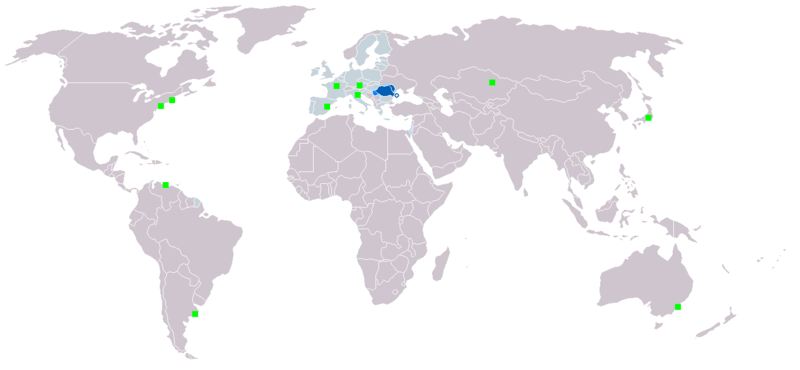
File:Map_Roumanophone_World.png · Wikimedia Commons · See Wikimedia Commons
Romanian
Sign in to saveAlso known as Romanian language, Rumanian, Rumanian language, Roumanian, Roumanian language, Moldovan, Moldovan language, Daco-Romanian
Romance language
Romanian is a Romance language spoken primarily in Romania and Moldova, making it one of the major languages derived from Latin in Europe. It matters because it represents a distinct linguistic heritage that preserves features of Latin while developing independently from other Romance languages like Spanish, French, and Italian.
AI-generated from the Wikipedia summary — may contain errors.
Wikidata facts
Show 14 more facts
- coordinate location
- 45,26
- female form of label
- la langue roumaine
- Commons category
- Romanian language
- short name
- румынская
- number of speakers, writers, or signers
- 24300000
- Wikimedia language code
- ro
- native label
- românește
- exact match
- afbo.info/languages/125
- P10369
- Lithuania
- P11012
- German
- entry in abbreviations table
- рум.
- Stack Exchange tag
- linguistics.stackexchange.com/tags/romanian
- P8168
- Alvaro Mancori
- NCI Thesaurus ID
- C154090
Sources (15)
via Wikidata · CC0
~40 min read
Article
Native from Bucharest, Romania, speaking Romanian. The Romanian dialect from Bucharest is standard Romanian (from the region of Muntenia, part of the historical Wallachia).
Romanian (obsolete spelling: Roumanian; endonym: limba română [ˈlimba roˈmɨnə] , or românește [romɨˈneʃte], lit. 'in Romanian') is the official and main language of Romania and Moldova. Romanian is part of the Eastern Romance sub-branch of Romance languages, a linguistic group that evolved from several dialects of Vulgar Latin which separated from the Western Romance languages in the course of the period from the 5th to the 8th centuries. To distinguish it within the Eastern Romance languages, in comparative linguistics it is called Daco-Romanian as opposed to its closest relatives, Aromanian, Megleno-Romanian, and Istro-Romanian. It is also spoken as a minority language by stable communities in the countries surrounding Romania (Bulgaria, Hungary, Serbia and Ukraine), and by the large Romanian diaspora. In total, it is spoken by 22 million people as a first language.
Gallery (12)
On the map
Available in 180 languages
- Español
- Français
- Deutsch
- 中文
- 日本語
- Русский
- Português
- Italiano
- العربية
- हिन्दी
- Abkhazian
- Afrikaans
- Albanian
- Albanian
- Amharic
- Angika
- Aragonese
- Aramaic
Show 161 more
- Armenian
- Arpitan
- Asturian
- azb
- Azerbaijani
- Bahasa Indonesia
- Bangla
- Bashkir
- Basque
- bat_smg
- be_x_old
- Belarusian
- Bikol
- Bosnian
- Breton
- Bulgarian
- Catalan
- cdo
- Cebuano
- Central Kurdish
- Chechen
- Church Slavic
- Chuvash
- Cornish
- Corsican
- Crimean Tatar
- Croatian
- Czech
- Danish
- Egyptian Arabic
- eml
- Erzya
- Esperanto
- Estonian
- Extremaduran
- Faroese
- Fiji Hindi
- Filipino
- Finnish
- Friulian
- Gagauz
- Galician
- Georgian
- Greek
- Guarani
- Haitian Creole
- Hakka Chinese
- Hawaiian
- Hebrew
- Hungarian
- hyw
- Icelandic
- Ido
- Iloko
- Interlingua
- Irish
- Javanese
- Kara-Kalpak
- Karachay-Balkar
- Kashmiri
- Kashubian
- Kazakh
- Khmer
- Komi
- Komi-Permyak
- Konkani
- Kurdish
- Kyrgyz
- Lao
- Latin
- Latvian
- Ligurian
- Limburgish
- Lingua Franca Nova
- Lithuanian
- Lombard
- Low German
- Lower Sorbian
- Luxembourgish
- Macedonian
- Malagasy
- Malay
- Malayalam
- Manipuri
- Manx
- Māori
- Marathi
- Mari
- Mazanderani
- Mingrelian
- Moroccan Arabic
- Nederlands
- Newari
- Northern Frisian
- Northern Sami
- Norwegian
- Norwegian Nynorsk
- Novial
- nrm
- Occitan
- Old English
- Ossetic
- Papiamento
- Pashto
- Picard
- Piedmontese
- Polski
- Quechua
- roa_rup
- Romanian
- Romansh
- Romany
- Rusyn
- Samoan
- Santali
- Sardinian
- Scots
- Scottish Gaelic
- Serbian
- Serbian (Latin)
- Sicilian
- Silesian
- simple
- Slovak
- Slovenian
- Somali
- Svenska
- Swahili
- Tajik
- Talysh
- Tamil
- Tatar
- Tiếng Việt
- Toki Pona
- Türkçe
- Tyap
- Udmurt
- Ukrainian
- Upper Sorbian
- Urdu
- Uyghur
- Uzbek
- Venetian
- Volapük
- Walloon
- Waray
- Welsh
- West Flemish
- Western Frisian
- Western Panjabi
- wikifunctions
- Wu Chinese
- Xhosa
- Yiddish
- Yoruba
- Zaza
- zh_min_nan
- zh_yue
- فارسی
- ไทย
- 한국어
via Wikidata sitelinks · CC0